Shoppers keeping an eye on fat content
You want a clear figure per 100 ml, rather than simply relying on packaging that makes the drink sound light.


To choose a low-fat oat drink, start by comparing the figures per 100 ml: under EU Regulation (EC) No 1924/2006, a liquid can contain no more than 1.5 g of fat per 100 ml to make this claim. For a savoury breakfast, then check the ‘sugars’ line and the ingredients. ‘No added sugars’ does not mean ‘sugar-free’, and a drink’s stated suitability for cooking does not, by itself, tell you how much fat it contains.
You want a clear figure per 100 ml, rather than simply relying on packaging that makes the drink sound light.
You want to use oat drink in a savoury dish without overlooking its sugar content or the flavour you’re looking for.
You also compare ingredients, fat and sugars. Organic certification is no substitute for checking the nutritional information.
If low fat is your deciding factor, start with the fat content per 100 ml. Then compare the drinks that meet your requirements by looking at their sugar content and ingredients to find one that suits your savoury dish.
| Criterion | What to check | Who it matters to |
|---|---|---|
| Fat content | Check the ‘fat’ line per 100 ml. Under EU Regulation (EC) No 1924/2006, a liquid can contain no more than 1.5 g of fat per 100 ml to make a low-fat claim. | If I’m primarily looking for an oat drink that meets a specific threshold, a figure per 100 ml matters more to me than a vague claim. Around 45% of shoppers would put this need first. |
| Sugars in a savoury recipe | Compare the ‘sugars’ line per 100 ml, even if the packaging says ‘no added sugars’. | For a sauce or savoury pancakes, I want to be able to make an informed choice about the drink’s sugar content. This would be the main concern for around 33% of shoppers. |
| Organic ingredients | Check the ingredients and nutritional information as well as the organic label. | When I choose an organic drink, I also want to understand what’s in it without making assumptions about its sugar or fat content. Around 22% of shoppers would put this criterion first. |
A drink with no added sugars can still contain sugars. For example, the E.Leclerc product page for Bio Village oat drink, labelled ‘no added sugars’, lists 5.0 g of sugars per 100 ml.
If you want to limit sugars in your savoury dish, check the nutritional information rather than relying only on the claim on the front of the pack.
Under EU Regulation (EC) No 1924/2006, the low-fat threshold for a liquid is expressed per 100 ml. A figure per 100 g, or one showing only saturated fat, doesn’t allow for the same comparison.
To check whether an oat drink meets this threshold, look for its total fat content per 100 ml on the label.
The term ‘oat drink’ alone doesn’t tell you whether the product has this characteristic.
If gluten-free is a requirement for you, check for the relevant claim on the packaging of the product you’re buying.
The details below apply to specific products, not to every drink sold under each brand.
Carrefour’s product page for BJORG Organic Unsweetened Oat Drink lists 0.9 g of fat per 100 ml and states ‘sugar-free’.
Carrefour Bio oat drink is listed as containing 1.2 g of fat per 100 ml and labelled ‘no added sugars’.
E.Leclerc’s product page for Bio Village oat drink lists 1.2 g of fat and 5.0 g of sugars per 100 ml.
Oatly says its No Sugars oat drink can replace milk in a savoury recipe, in the same quantity.
Carrefour’s product page for Alpro Unsweetened Oat Drink says it can be used in sweet or savoury recipes.
These three oat drinks are worth comparing for a savoury breakfast. Before choosing one for a particular recipe, check the figures per 100 ml and the ingredients on the packaging.
 Image unavailable
If low fat is your priority for a savoury breakfast, compare the figure per 100 ml on the packaging. The ‘0%’ in the name doesn’t replace this check.
Size: 1 L. Check the sugars too, and make sure the flavour suits your dish.
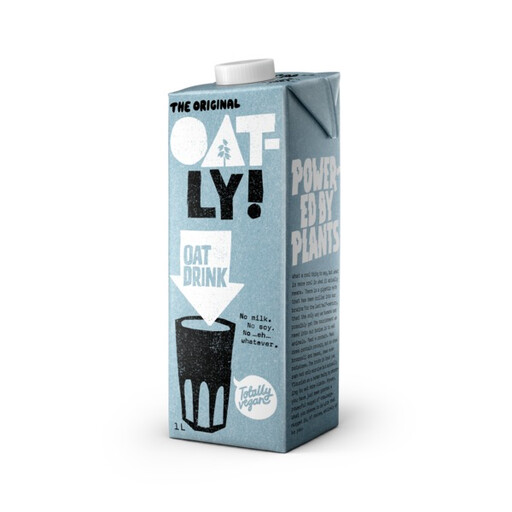 Image unavailable
If you’re considering this Original version for cooking, compare its fat and sugar content per 100 ml before using it in a savoury dish.
Size: 1 L. Whether it suits a particular savoury recipe will depend, among other things, on the flavour you’re looking for.
 Image unavailable
If you want several cartons of oat drink for cooking, first compare the fat and sugar content per 100 ml with the needs of your savoury recipes.
Pack size: three 1 L cartons. Make sure the flavour suits your recipe before choosing this pack.
For a liquid, EU Regulation (EC) No 1924/2006 sets a maximum of 1.5 g of fat per 100 ml for the claim ‘low fat’ or wording with the same meaning. Check the ‘fat’ line per 100 ml on the oat drink you choose.
No. A drink with no added sugars can still contain sugars. E.Leclerc’s product page for Bio Village oat drink uses this claim while listing 5.0 g of sugars per 100 ml. So, if sugars matter for your savoury recipe, compare the ‘sugars’ line.
Yes, if the product is suitable for the way you plan to use it, but you should still consider its flavour and nutritional values. Oatly says its No Sugars drink can replace milk in a savoury recipe, in the same quantity. This guidance doesn’t automatically apply to every oat drink from the brand.
No. The name ‘oat drink’ alone doesn’t tell you whether a product is gluten-free. If this is one of your buying criteria, look for a ‘gluten-free’ claim on the packaging of the product you choose.
Start by comparing drinks on the same 100 ml basis. The DGCCRF says that nutritional information per 100 g or 100 ml makes it easier to compare products. The per-serving figure can then help you understand the information for the amount you use.