Parents keeping an eye on fat
You’re making cakes, pancakes or desserts with children and want to check that your chosen drink contains no more than 1.5 g of fat per 100 ml.


When baking with children and looking for a low-fat oat drink, start by checking the value per 100 ml: Regulation (EC) No 1924/2006 sets the threshold for a ‘low-fat’ claim on liquids at no more than 1.5 g. The product details for ETHIQUABLE, NATRUE at Auchan, Carrefour Bio, Bio Village and Oatly Original show values that meet this threshold. Then choose the exact product to suit your recipe, the sugars listed and any allergens you need to check for the children involved.
You’re making cakes, pancakes or desserts with children and want to check that your chosen drink contains no more than 1.5 g of fat per 100 ml.
You’re looking for a product labelled ‘no added sugars’ for a recipe, without mistaking this for a product that contains no naturally occurring sugars.
Before choosing a carton, check its ingredients and precautionary allergen information: the composition can vary from one product to another, even within the same brand.
For this baking recipe, check the fat per 100 ml first, then choose based on the ingredients in the recipe and who will be eating it.
| What to check | What to look for | Who it matters to |
|---|---|---|
| Fat | Check the value per 100 ml on the product you’re buying. For the ‘low-fat’ claim on liquids, Regulation (EC) No 1924/2006 sets a maximum of 1.5 g per 100 ml. | If my priority is to stay within this limit when making a cake, I check the carton rather than relying on a general claim about the brand. Around 36% of consumers in question would put this first. |
| Sugars and recipe | Distinguish the ‘no added sugars’ claim from the ‘of which sugars’ figure, and check whether the product is recommended for cooking. | To manage the added sugar in my pancakes or dessert, I want to know what the drink already contains. This would be a priority for around 29% of consumers. |
| Allergens | Check the ingredients, allergen information and ‘may contain’ statements for the exact product, especially if a child has an allergy. | When I’m cooking for a child with an allergy, checking the exact ingredients comes before choosing a brand. Around 21% of consumers in question would make this their top priority. |
| Availability and pack size | Check that the product is available at your chosen shop or online grocery service, and compare the pack size with the amount needed for your recipe. | If I’m planning a baking session around my usual food shop, I need to be able to find the right product in a useful size. This would be a priority for around 14% of consumers. |
These claims refer to different parts of the nutritional information. For liquids, the 1.5 g of fat per 100 ml limit set by Regulation (EC) No 1924/2006 applies to total fat.
Start with the ‘fat’ figure per 100 ml, then check the sugars separately to help you adapt your recipe.
The NATRUE oat drink listed by Auchan contains 0.7 g of fat per 100 ml, while the NATRUE ‘0%’ variant listed on Joybuy contains 1.2 g per 100 ml. These are two different products.
Check the full product name, pack size and nutritional information on the carton you plan to buy.
Ingredients and possible traces vary between products. The Joybuy listing for NATRUE ‘0%’, for example, mentions possible traces of soya and nuts.
Before baking for a child with an allergy, check the ingredients, allergen information and trace warnings on the exact product with an adult.
An out-of-date offer or retailer listing doesn’t guarantee that the product you want will be available in your shop or through your online grocery service when you do your food shop.
Check that the exact product is available before planning your baking session.
Compare the specific products listed, not the brands as a whole: different variants can have different ingredients and nutritional values.
The organic oat drink listed by Auchan contains 1.4 g of fat per 100 ml and is suitable for desserts.
The oat drink listed by Auchan contains 0.7 g of fat per 100 ml, while the NATRUE ‘0%’ variant listed on Joybuy contains 1.2 g per 100 ml.
The Carrefour listing for this organic oat drink gives a fat content of 1.2 g per 100 ml and says ‘no added sugars’.
The E.Leclerc listing for this organic oat drink gives a fat content of 1.2 g per 100 ml and says ‘no added sugars’.
The Joybuy listing for Oatly Original gives a fat content of 1.5 g per 100 ml and recommends it for cooking and baking.
Carrefour lists an Alpro oat drink that can be used for cooking, while a Joybuy listing titled ‘Alpro Oat Drink 1 L’ gives a fat content of 3 g per 100 ml.
This editorial order brings together products whose listings show no more than 1.5 g of fat per 100 ml, while also taking into account any stated suitability for cooking. It isn’t a taste ranking or an indication of availability.
| Rank | Product | Features | Why it’s included | Retailer |
|---|---|---|---|---|
| 1 | ETHIQUABLE Organic Oat Drink, No Added Sugars, 1 L | 1.4 g of fat per 100 ml. | The Auchan listing says ‘low-fat’ and recommends it for desserts and savoury dishes. | Auchan |
| 2 | NATRUE Oat Plant Drink, 1 L | 0.7 g of fat per 100 ml. | The Auchan listing recommends it for cooking. This is a different product from the NATRUE ‘0%’ variant listed on Joybuy. | Auchan |
| 3 | Carrefour Bio Organic Oat Plant Drink, 1 L | 1.2 g of fat per 100 ml; no added sugars. | The Carrefour listing lets you check these values. If texture is important for your bake, try it with your planned recipe first. | Carrefour |
| 4 | Bio Village Organic Oat Drink, No Added Sugars, 1 L | 1.2 g of fat per 100 ml. | The E.Leclerc listing gives the ingredients as water, oats, sunflower oil and salt. Check local availability. | E.Leclerc |
| 5 | Oatly Oat Drink Original, 1 L | 1.5 g of fat per 100 ml. | The Joybuy listing recommends it for cooking and baking. This value is exactly at the threshold for liquids set by Regulation (EC) No 1924/2006. | Joybuy |
These products let you compare two Oatly formats listed as suitable for baking and an NATRUE variant whose fat content meets the criterion you’re looking for. For NATRUE, check that it’s suitable for your recipe.
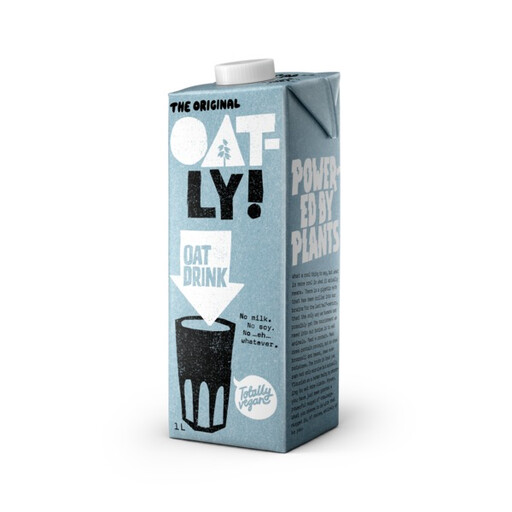 Image unavailable
For a baking recipe, the listing recommends it for cooking and baking.
It contains 1.5 g of fat per 100 ml, exactly at the threshold for liquids. The listing also gives a sugar content of 3.5 g per 100 ml, from oats.
Contains oats; check the exact label if a child has an allergy.
 Image unavailable
This multipack could be useful if you’re planning several recipes; the listing recommends it for cooking and baking.
The listing gives a fat content of 1.5 g and 3.5 g of sugars from oats per 100 ml. It also provides storage instructions for each carton after opening, which you should follow.
Contains oats; check the label if a child has an allergy.
 Image unavailable
If fat content is your main priority, this variant contains 1.2 g per 100 ml. Check that it’s suitable for the baking recipe you have planned.
The listing gives a sugar content of 0 g per 100 ml and names water, oats, sunflower oil and salt among the ingredients. So ‘0%’ doesn’t mean ‘fat-free’.
Contains oats and may contain traces of soya and nuts. Check the label before cooking for a child with an allergy.
No. An oat drink with this claim may still contain naturally occurring sugars. To manage the added sugar in your baking, also check the ‘of which sugars’ figure for the product you choose.
Oatly France says you can replace 10 cl of milk with 10 cl of its No Sugars drink in a sweet or savoury recipe. This advice applies to that particular variant. If you’re using another drink or making a recipe where texture is especially important, try it out first.
No. The term ‘oat drink’ alone doesn’t tell you what’s in a carton. Some products are described as dairy-free, but the Joybuy listing for NATRUE ‘0%’ warns of possible traces of soya and nuts, among other things. Check the ingredients and allergen information for the exact product.
No. Anses states that regular plant-based drinks are not a substitute for foods specially designed for infants, and highlights the risks of using them as a replacement outside this context.