What should you check first?
For a packaged cake, check the label. For a homemade recipe, consider all the ingredients and quantities used, rather than looking at the nutritional value of just one ingredient.
| Criterion |
What to check |
Who is it for? |
| Low fat |
For a solid cake carrying this claim, check that the “fat” line shows no more than 3 g per 100 g. A reduction in saturated fat alone does not meet this requirement. |
If you’re looking for a cake that genuinely meets this claim, simply being described as light isn’t enough; around 42% of consumers would make this their priority. |
| A recipe you can adapt |
Choose the ingredients and quantities, then consider the whole recipe before describing the finished cake as low fat. |
If you’re baking with children, you may prefer to decide what goes into the mixture; around 33% of consumers would prioritise this option. |
| Allergens and overall composition |
Read the ingredients, allergen information and any warnings about possible traces. Also compare sugars per 100 g and, if shown, the Nutri-Score. |
If a child needs to avoid certain ingredients, you’ll want to check every product without overlooking its nutritional composition; around 25% of consumers would put this need first. |
Brands and products to know
These products help you distinguish a baking ingredient from a finished cake, and compare the nutritional information for specific products.
Carrefour Sensation
Carrefour Sensation 0% Skyr is a dairy ingredient you could use in a homemade recipe, not a finished cake.
- Carrefour’s product listing states that the skyr contains 0.5 g of fat per 100 g and lists pasteurised skimmed milk and lactic cultures.
- The fat content of the finished cake also depends on the other ingredients, their quantities and the recipe’s yield. Skyr contains milk.
Auchan
Auchan marble cake is an example of a packaged cake whose product listing shows nutritional values per 100 g.
- Auchan’s product listing shows that this marble cake contains 21 g of fat and 27 g of sugars per 100 g.
- At 21 g of fat per 100 g, this particular product is above the 3 g threshold for the “low fat” claim on a solid food.
St Michel
St Michel individual white chocolate brownies show how portioned packaging differs from low fat content.
- The individual packaging makes it easy to serve the portions separately.
- St Michel’s product listing states that the brownies contain 29 g of fat per 100 g. It also flags gluten, milk, soya and egg, as well as possible traces of nuts and sesame.
For baking a cake at home
This Joybuy pick is a flour for baking a cake with children. It’s an ingredient to add to a recipe and bake, not a ready-to-serve cake or one with an established final fat content.
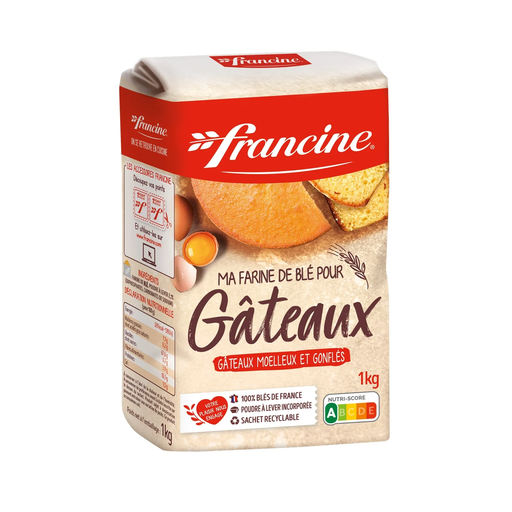 Image unavailable
FRANCINE Cake Flour 1 kg
This flour can be used as the base for a homemade cake, with you choosing the other ingredients. The finished cake’s fat content will depend on the full recipe and the quantities used.
View on Joybuy
Frequently asked questions
What is the threshold for calling a cake “low fat”?
For a solid cake carrying the “low fat” claim, EU Regulation (EC) No 1924/2006 sets a maximum of 3 g of fat per 100 g. Check the value per 100 g on the packaging, even if an individual portion is also listed.
Does less saturated fat mean less total fat?
No. A reduction in saturated fatty acids doesn’t prove that the total fat content meets the 3 g per 100 g threshold. Auchan’s product listing for Harrys P’tits Moelleux au yaourt claims 60% less saturated fatty acids, but also shows 17 g of fat per 100 g.
Is the Nutri-Score enough to help you choose a cake?
No. When shown, the Nutri-Score gives an indication of overall nutritional quality. It doesn’t replace checking the fat and sugar content per 100 g, or reading the ingredients and allergen information.
What should you check if a child needs to avoid an allergen?
Check the ingredients and allergens listed on every product you use, along with any warnings about possible traces. If an allergy has been diagnosed, follow your healthcare professional’s advice for the specific product.
Does a homemade cake always contain less fat?
No. Baking at home lets you control the quantities, but the finished cake’s fat content depends on the whole recipe and its yield. The nutritional value of flour or a dairy product on its own isn’t enough to describe the cake as “low fat”.


