People keeping an eye on fat
You’re looking for an almond drink whose value per 100 ml lets you check whether it meets the ‘low fat’ claim requirements for liquids.


To choose a low-fat almond drink, start with the value per 100 ml: Regulation (EC) No 1924/2006 sets a maximum of 1.5 g of fat per 100 ml for liquids to carry this claim. Then check the sugars, ingredients and any added nutrients separately. An organic drink or one with no added sugars won’t necessarily meet the same needs. Almond drinks are not suitable for anyone with an almond allergy.
You’re looking for an almond drink whose value per 100 ml lets you check whether it meets the ‘low fat’ claim requirements for liquids.
You want to compare fat and sugar without confusing ‘sugar-free’ with ‘no added sugars’. France’s Directorate General for Competition Policy, Consumer Affairs and Fraud Control points out that nutrition information allows you to compare products per 100 ml.
You’re choosing cartons for different uses and comparing pack size, ingredients, organic status or added calcium according to your priorities. None of these factors tells you about the others on its own.
If you’re looking for a low-fat almond drink, start with the values per 100 ml, then compare the recipes against the other things that matter for your shop.
| Criteria | What to check | Who is it for? |
|---|---|---|
| Fat | The value per 100 ml and, if shown on the product, the ‘low fat’ claim. | I want to assess this feature on the same basis for every drink; around 42% of consumers would put fat at the top of their list of criteria. |
| Sugars | The ‘of which sugars’ line per 100 ml and the ingredients list. | If I’m looking for a sugar-free recipe, ‘no added sugars’ on its own isn’t enough; around 33% of consumers would make sugars their priority. |
| Ingredients | The ingredients, any added calcium and the allergens listed on the packaging. | I want to know what’s in the carton before choosing a recipe, especially if its ingredients call for particular care; around 17% of consumers would prioritise this criterion. |
| Pack size | The carton volume and storage instructions after opening. | For my weekly shop, I prefer a size that suits how I’ll use it and storage instructions I can follow; around 8% of consumers would make this their top criterion. |
A drink with no added sugars can still contain sugars. This claim also tells you nothing about its fat content.
Check the ‘of which sugars’ line per 100 ml and the ingredients, rather than relying on the front of the carton.
Organic status and fat content are based on different criteria. For example, Carrefour’s product listing for Bjorg Amande Sans Sucres Bio shows 1.7 g of fat per 100 ml.
If low fat is your priority, check the value per 100 ml before comparing other features.
The threshold for the claim on liquids is expressed per 100 ml. A value shown only per 100 g isn’t enough on its own to check whether the drink meets this requirement.
Look for the value per 100 ml on the packaging before deciding whether the drink meets this criterion.
The Alpro Amande Sans Sucres UHT 1 L product listed on Joybuy contains 1.1 g of fat and 0 g of sugars per 100 ml.
The range includes a 1 L carton of almond drink listed on Carrefour’s product page.
Carrefour’s product page lists a 1 L carton of almond drink with no added sugars.
Carrefour’s product page for Bjorg Amande Sans Sucres Bio 1 L states that it contains 2.8% organic almonds.
Carrefour’s product page lists a 1 L carton of organic almond drink with no added sugars.
These two 1 L Alpro cartons are different options for your weekly shop: one is described as sugar-free, while the sugar content in the other recipe is worth bearing in mind.
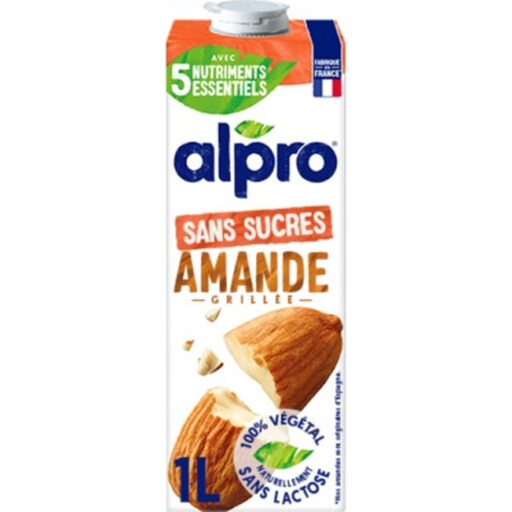 Image unavailable
An option to consider if you’re looking for both low fat and a recipe showing 0 g of sugars per 100 ml.
The Joybuy product page states 1.1 g of fat per 100 ml, as well as added calcium and vitamins. The product contains almonds and may contain traces of other nuts; check the label on the carton you receive.
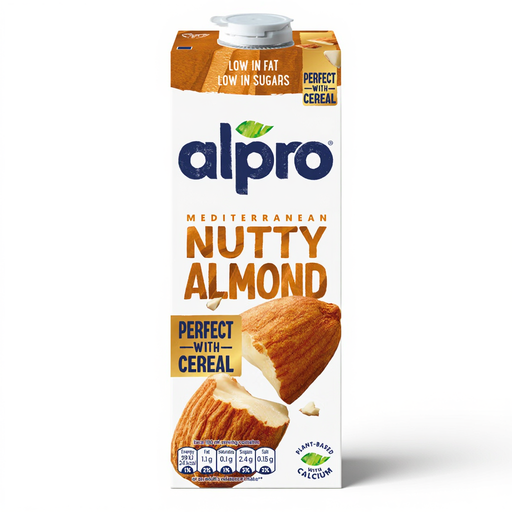 Image unavailable
This 1 L carton of almond drink is worth comparing if sugar-free isn’t a requirement for your purchase.
Don’t confuse it with the sugar-free version: compare the ‘fat’ and ‘of which sugars’ lines per 100 ml on the label. It contains almonds.
In the European Union, this claim requires a liquid to contain no more than 1.5 g of fat per 100 ml, under Regulation (EC) No 1924/2006, published in the Official Journal of the European Union. Compare drinks using this same unit.
No. A drink with no added sugars may still contain naturally occurring sugars. To see how much, check the ‘of which sugars’ line in the nutrition information per 100 ml.
No. A drink containing almonds isn’t suitable for anyone with an almond allergy. Also check the carton for any warnings about traces of other nuts.
Compare the amount of calcium per 100 ml shown on each pack, rather than assuming the amount from the word ‘enriched’ alone. Also check the ingredients and any other nutritional values that matter to you.
Follow the instructions on the carton you buy. For Alpro Amande Sans Sucres UHT, the Joybuy product page says to keep it refrigerated at no more than 7 °C after opening.