Small households mindful of opened cartons
If you live alone or with one other person and use only a little almond drink, compare the carton size with the recommended time to use it after opening. A 1 L carton may not suit your routine.


To choose a low-fat almond drink, start by checking the value per 100 ml: Regulation (EC) No 1924/2006 sets the maximum for making this claim on a liquid at 1.5 g of fat per 100 ml. Product listings published by Auchan show 1.1 g for Auchan Unsweetened and Alpro Roasted Almond Unsweetened, and 1.5 g for Ethiquable Organic Unsweetened Almond. If you live in a small household, then compare the recipes based on their nutritional information, ingredients, carton size and how long they keep after opening.
If you live alone or with one other person and use only a little almond drink, compare the carton size with the recommended time to use it after opening. A 1 L carton may not suit your routine.
A ‘no added sugars’ or ‘unsweetened’ claim tells you nothing about fat content. For a liquid, the maximum for a ‘low-fat’ claim is 1.5 g per 100 ml, in accordance with Regulation (EC) No 1924/2006.
Whether you add it to cereal or coffee, or use it in a recipe, almond drink can become a regular purchase. Compare the calcium, any added vitamins and the protein content of the product you choose, without assuming it has the same nutritional profile as milk.
First check the fat content per 100 ml, then look at the features that matter for how you’ll use it: ingredients, nutritional information and how much you can get through after opening.
| Criteria | What to check | Who it matters to |
|---|---|---|
| Fat | Check the value per 100 ml. Under Regulation (EC) No 1924/2006, the maximum for a ‘low-fat’ claim on a liquid is 1.5 g per 100 ml. | I want the fat content to meet the criteria I’m looking for, rather than relying on a ‘no added sugars’ or ‘unsweetened’ claim alone; around 33% of consumers would make this their top priority. |
| Calcium, vitamins and protein | Compare the amounts stated per 100 ml and look for added vitamins. Don’t assume every recipe has the same nutritional profile. | If I regularly use this drink instead of milk at breakfast, I want to compare the nutrients listed; calcium and vitamins would be the top priority for around 27% of consumers. |
| Sugars and ingredients | Check the sugars per 100 ml, ingredients list and allergen information separately on the packaging. | An unsweetened recipe appeals to me, but I also want to know what’s in it before I choose; around 20% of consumers would prioritise the sugar content and a clear ingredients list. |
| Size and storage | Choose a carton size that suits how much you usually drink, and check the refrigeration instructions and how long it keeps after opening. | If there are only one or two of us, I might not finish a large carton in time; around 20% of consumers would put a suitable size and storage life first. |
These claims relate to different nutritional values. Bjorg and Carrefour Bio product listings each show 1.7 g of fat per 100 ml, while Regulation (EC) No 1924/2006 sets the maximum for a ‘low-fat’ claim on a liquid at 1.5 g per 100 ml.
Check the ‘sugars’ and ‘fat’ figures separately, using the same 100 ml serving size each time.
The amount of added calcium and vitamins varies between recipes. The product listings we checked also show different protein levels for different products.
If you drink it regularly, compare the nutritional values per 100 ml for the product you’re considering, particularly its calcium and protein content.
If you live alone or with a partner and only use almond drink occasionally, you may not finish a carton within the recommended time after opening.
Choose a size that suits how much you drink, and check the storage instructions for each product.
Almond drink contains almonds; the Bjorg product listing also warns that it may contain other tree nuts.
If you have a tree nut allergy, check the ingredients and information on the carton you buy.
The values below apply to the specific products named, not to every drink sold under each brand.
The Auchan listing for Alpro Roasted Almond Unsweetened shows 1.1 g of fat and 0 g of sugars per 100 ml.
The Auchan Unsweetened Almond Drink in a 1 L carton lists 1.1 g of fat per 100 ml.
The Auchan listing for Ethiquable Organic Unsweetened Almond Drink shows 1.5 g of fat per 100 ml—exactly the maximum for making this claim on a liquid.
Bjorg Organic Unsweetened Almond Drink is available in a 1 L carton and a pack of three 250 ml cartons.
Carrefour Bio Organic Unsweetened Almond Plant Drink is listed in a 1 L carton.
This 1 L almond drink is worth considering in light of your fat-content requirements and how much you’ll use after opening. Check the values per 100 ml and the instructions on the carton you choose.
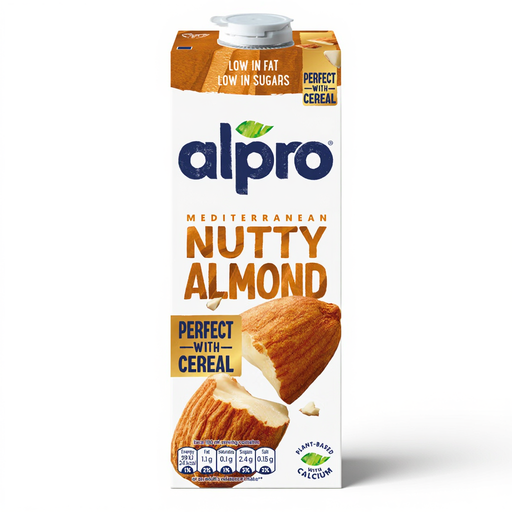 Image unavailable
If you’re considering this almond drink for a small household, think about whether the 1 L carton suits how much you drink.
Size: 1 L. Check the packaging for the fat content per 100 ml and how long the drink keeps after opening.
For a liquid, a ‘low-fat’ claim—or one with the same meaning—requires no more than 1.5 g of fat per 100 ml under Regulation (EC) No 1924/2006. Check the value per 100 ml rather than relying on an ‘unsweetened’ claim alone.
Follow the storage instructions and use-by guidance on the carton you buy. Auchan listings for Auchan Unsweetened, Alpro Roasted Almond Unsweetened and Ethiquable Unsweetened say to refrigerate and use within five days of opening.
No—you’ll need to check the specific recipe. The Auchan listing for Alpro Roasted Almond Unsweetened shows 120 mg of calcium per 100 ml, along with added vitamins. These values don’t automatically apply to other almond drinks.
Check the ingredients list and any warnings about the possible presence of other tree nuts on every carton. France’s Directorate General for Competition Policy, Consumer Affairs and Fraud Control (DGCCRF) states that allergenic ingredients must be highlighted on labels; the Bjorg listing warns that the product may contain other tree nuts.