
Livraison le jour même ou le lendemain

Qualité garantie

Débloquez vos offres de bienvenue: Livraison GRATUITE | Jusqu'à -80 % | 30 jours d'essai gratuits à JoyPlus
Téléchargez l'application
Winter is approaching, and with it, the age-old dilemma: how do you keep your home cozy without your electricity bill skyrocketing? The low-energy, quiet space heater is the ideal solution for warming up a bedroom, a home office, or a chilly living room. However, the market is a jungle of marketing promises that too often end in disappointment.
As a Product Specialist at Joybuy, my mission is to help you see things more clearly. Let's cut through the jargon and get down to specifics. Here's a breakdown of the pitfalls to avoid and the real criteria that matter, so you won't regret your purchase.
On the surface, all heaters look alike. In practice, their performance varies dramatically. Here are three common and costly mistakes.
For a successful and lasting purchase, focus on these three objective parameters.
The heart of the machine is its heating element. Models of ceramic fan heaters based on PTC (Positive Temperature Coefficient) technology are the best choice. Unlike old filament-based heaters, PTC ceramic elements are self-regulating: their resistance increases with temperature, naturally limiting their own heat output.
The power, in Watts (W), must be suited to the size of the room. The basic rule is simple: allow about 100W per square meter for a room with standard insulation.
A good space heater shouldn't just produce heat; it should distribute it intelligently and without being noticed.
To move from theory to practice, here are models that perfectly meet specific needs.
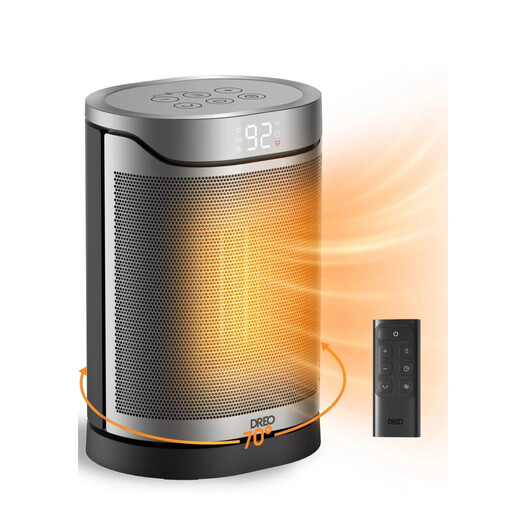
Why it stands out: Perfect for an office, a student's room, or as a personal heater. Its compact size and power levels (900W/1300W/1500W) allow you to heat a small area while keeping consumption under control.
It shatters the myth of raw power by offering multiple modes for tailored consumption. Its clearly stated noise level (25-42 dB) is the best guarantee against the false promise of "silence."
Precise thermostat adjustable from 5 to 35°C and 8 levels of protection (Shield360?), including tip-over and overheat safety features.
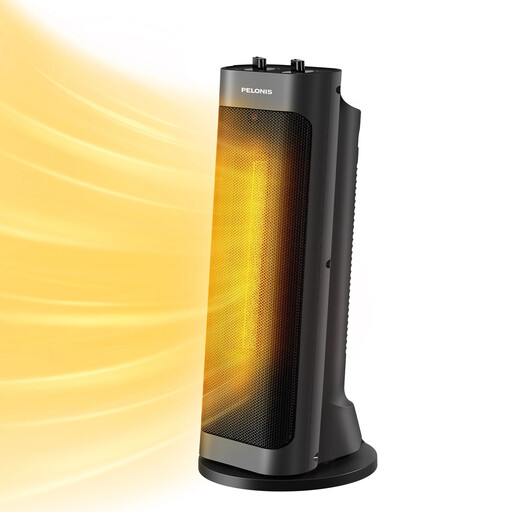
Why it stands out: Designed for families' peace of mind. Its multiple safety features and cool-touch housing make it a reassuring choice for a living room or playroom. Its 70° oscillation ensures well-distributed warmth.
It directly addresses the pitfall of neglected safety by incorporating multiple protections (tip-over, overheat) and displaying its CE and RoHS certifications.
Triple safety system and flame-retardant ABS material. Heats up in 3 seconds flat thanks to PTC technology.
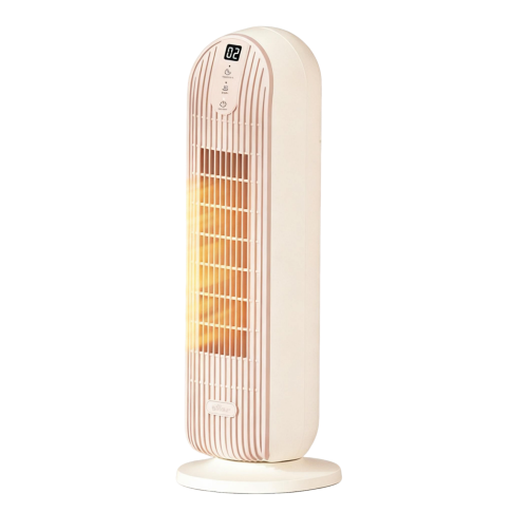
Why it stands out: Ideal for living rooms or shared offices. Its wide 90° oscillation and upward-tilted airflow ensure ample and even heat distribution, eliminating cold spots in larger areas.
It provides a concrete solution to the problem of poorly distributed heat with its record-breaking oscillation angle. The smart timer (up to 12h) and two modes (1200W/2000W) allow for precise consumption management.
Maximum heating coverage thanks to 90° oscillation and wide-angle airflow. Programmable timer and digital display for total control.
Explore our complete selection of space heaters, all approved according to our performance and safety criteria.
The power depends on the size of your room and its insulation. The basic rule is simple: allow about 100 watts per square meter for a room with standard insulation. For a room of 15 to 20 m?, a 1500W to 2000W device is a good starting point. But the most important feature is the thermostat: it will adjust consumption to maintain the temperature without running unnecessarily at full power.
Consumption is linked to power (watts) and duration of use. A 2000W heater consumes 2 kWh for every hour at full power. However, the intelligence of an energy-efficient space heater with PTC technology lies precisely in its thermostat. It doesn't run continuously: it quickly reaches the target temperature, shuts off, and then restarts in short cycles to maintain it. In the end, the overall consumption is much lower than that of a model without regulation.
For a bedroom or office, silence is golden. Aim for a model with a noise level below 45 decibels (dB). The best-in-class models go below 40?dB, or even 35?dB in eco mode, which is the equivalent of a whisper. This is the threshold to aim for to avoid disturbing your sleep. Always check this technical data before buying.