
Livraison le jour même ou le lendemain

Qualité garantie

Débloquez vos offres de bienvenue: Livraison GRATUITE | Jusqu'à -80 % | 30 jours d'essai gratuits à JoyPlus
Téléchargez l'application
For parents in the UK, finding disposable nappies that are gentler on the skin and kinder to the environment can quickly become a headache. Terms like "natural", "eco-friendly" or "hypoallergenic" don't always mean the same thing. A nappy that contains some bio-based materials isn't necessarily compostable or fully biodegradable.
Before ordering a large pack, there are three pitfalls to avoid:
Love & Green nappies are among the references sought by families who want to combine organic baby nappies, renewable raw materials and a fragrance-free formula. Here are the points to check before choosing a model.
The different references cover several stages: size 1 from 2 to 5 kg, size 2 from 3 to 6 kg, size 3 from 4 to 9 kg, size 4 from 7 to 14 kg and size 5 from 11 to 25 kg. Nappy pants are available in sizes 4, 5 and 6.
A nappy that is too big can let moisture escape around the legs. Conversely, one that is too tight can press on the tummy and leave marks on the skin. For a newborn, the cut-out designed for the umbilical cord, present on some size 1 and 2 nappies, makes changing easier during the first few weeks.
The Love & Green models shown here claim a variable proportion of bio-based ingredients, from 61% to 71% depending on the reference and size. On several models, the topsheet in contact with the skin uses PLA and Green PE of plant origin.
Parents looking for fragrance-free baby nappies can check the absence of perfume and lotion in the corresponding product descriptions. Some references also state the absence of dyes, chlorine or chlorine derivatives. The absorbent cellulose is presented as FSC certified and bleached using a TCF process, meaning without elemental chlorine.
This information does not mean the nappy is entirely natural. The elastics, adhesives, outer film and some absorbent components may still be synthetic. So it's best to check the detailed composition rather than relying solely on the claims printed on the pack.
Depending on the product, the descriptions mention certifications or labels such as EU Ecolabel, FSC, Dermatest, Vegan and Cruelty Free. These claims should be distinguished from general statements about the product's performance.
An eco-friendly nappy is not automatically an eco-friendly compostable nappy. Used disposable nappies should neither be composted nor flushed down the toilet. They must go into an appropriate bin, in line with local guidelines. The packaging, on the other hand, may be stated as made from recycled and recyclable plastic, depending on the reference.
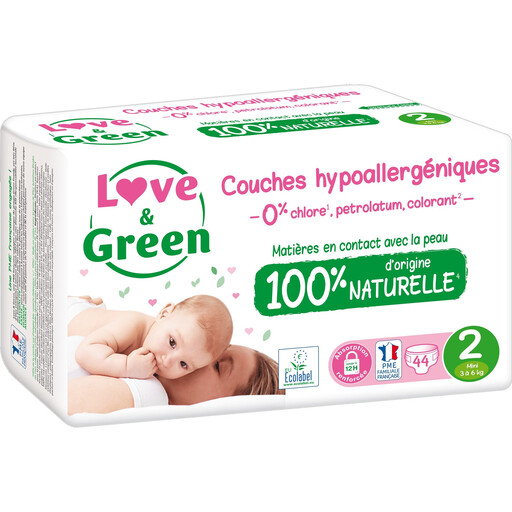
Why this choice suits this profile: A pack of 44 nappies lets you test the size, fit and skin tolerance before moving to a larger quantity.
The standard format means you don't build up a stock that might no longer fit a growing child.
For babies from 3 to 6 kg, with a naturally sourced topsheet, FSC cellulose and stated absence of fragrance and lotion.
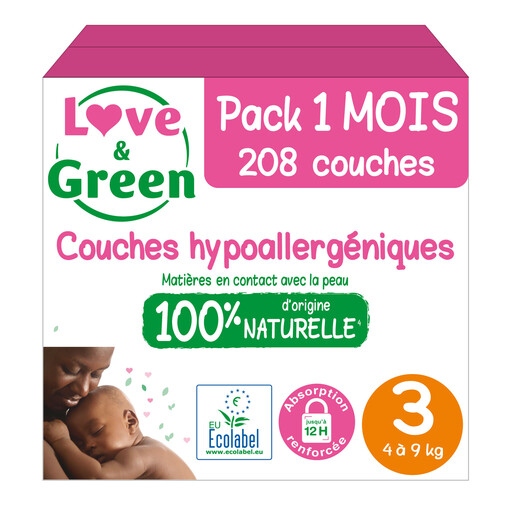
Why this choice suits this profile: With 208 nappies, this monthly pack is for households that want to cut down on repeat orders and stick with a reference they know.
The 4 to 9 kg range and four separate packs make stock management easier without mixing different sizes.
68% bio-based ingredients stated, FSC and TCF cellulose, with packaging described as recycled and recyclable.
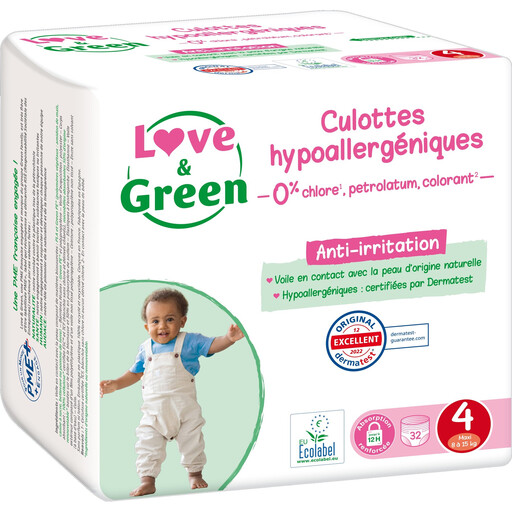
Why this choice suits this profile: Nappy pants are easier to put on when your child is very active or starting potty training.
The stretchy waistband means you don't have to choose a size that's too tight, and it makes standing changes simpler.
Size 4 from 8 to 15 kg, naturally sourced materials against the skin, with no lotion, dyes or chlorine according to the product description.
Why this choice suits this profile: With 160 nappies, this format is for families who already know their child's size and want to space out their purchases.
The 11 to 25 kg range gives you plenty of room for use, as long as you regularly check that the fit is still right.
71% bio-based ingredients stated, bio-based absorbent core and no fragrance or lotion according to the product description.
We've put together a complete, real-time selection of products that meet these exacting criteria, while complying with European safety regulations.
The references are described as hypoallergenic and some are stated as dermatologically tested. Depending on the model, they are also described as fragrance-free, lotion-free and dye-free. That said, no nappy suits every child in the same way. It remains essential to monitor your baby's skin carefully.
The disposable models shown here should not be considered compostable. Their composition may include bio-based materials, certified cellulose and other renewable elements, but the used nappy must be disposed of in an appropriate bin, never in the toilet or compost.
A monthly pack can lower the price per nappy and reduce the number of orders, but only if the size has already been confirmed. For a newborn or during a period of rapid growth, a small pack lets you check the fit before building up a stock.