People who compare fat content first
You’re looking for a long-life soup and checking the fat and saturated fat content of the exact recipe, rather than relying on the word ‘vegetable’ on the packaging.


If fat content is your main priority when choosing a long-life soup, compare the fat and saturated fat figures on a like-for-like basis, then check the sugars, salt and ingredients in each recipe. A claim about sugar content alone tells you nothing about fat. If you’re specifically looking for soup in a metal tin, check the details for that exact product: the figures for soup in a carton won’t tell you about a different recipe.
You’re looking for a long-life soup and checking the fat and saturated fat content of the exact recipe, rather than relying on the word ‘vegetable’ on the packaging.
You want to check the sugar content separately, without mistaking a possible ‘reduced sugar’ claim for information about fat content.
Salt, the ingredients list or certain allergens also matter to you. You need the information for the specific variant you’re buying, as it can differ from one recipe to another.
Start with the factor that’s behind your purchase, then check the other lines on the label: each one tells you something different. Manger Bouger states that the nutritional values of prepacked foods are given per 100 g or per 100 ml. Compare soups using the same unit before considering the portion you’ll eat.
| Criterion | What to check | Who is it for? |
|---|---|---|
| Fat | Fat and saturated fat per 100 ml, comparing recipes that are both ready to eat; the ingredients in the variant. | If I’m mainly looking to compare fat content, the words ‘vegetable soup’ aren’t enough to distinguish between two recipes. Around 31% of consumers would put this first. |
| Sugars | Sugars per 100 ml and the exact meaning of any claim relating to sugar. | I also want to compare sugars, without confusing the amount with the fat content. This would be the priority for around 25% of consumers. |
| Salt | Salt per 100 ml, even when a recipe meets your fat-content criteria. | A soup may catch my eye for its fat content, but I also want to compare recipes by their salt content. Around 25% of consumers would make this their main concern. |
| Ingredients and storage | Allergens listed, number of portions and instructions for after opening. | I need to check the ingredients and choose a pack size I can use in line with the storage instructions. This would come first for around 19% of consumers. |
Sugars and fat appear on separate lines in the nutritional information. A claim about sugar therefore tells you nothing about the amount of fat or salt.
If fat is your priority, check the fat and saturated fat figures first, then compare the sugar content of different recipes on a like-for-like basis.
Depending on the product, vegetable soup recipes from Auchan, Carrefour and E.Leclerc may contain milk, butter, cream or cheese. Some also list celery, wheat or egg. The soup’s name is no substitute for checking its ingredients list.
Check the ingredients and allergens for the exact variant, then use its nutritional information to compare it with other soups.
Anses lists soups and broths among the food categories that contribute to salt intake. Comparing fat content alone means overlooking this factor.
If salt matters to you too, compare the amount per 100 ml for the products you’re considering.
The packaging and storage instructions determine how to use the soup once it’s open, and they may differ between products.
Check the number of portions and follow the storage instructions on the packaging you buy.
A pack that’s larger than your planned portions may leave some soup to use after opening.
A product range can help you find recipes to compare, but it’s the label on each product that tells you about its fat, sugar and salt content, as well as its ingredients.
Royco has several ranges, including Classique, Exotique, Crémeux and Vermicelles.
Liebig offers ready-to-eat soups in a range of vegetable recipes, including one labelled ‘low salt’.
Carrefour sells soups under its own brands, including Carrefour Bio vegetable recipes.
Auchan offers a smooth vegetable soup with vermicelli in a two-portion pack, among other options.
E.Leclerc offers soups in cartons under the Regal Soupe, Bio Village and Eco+ brands.
ALDI France offers a puréed soup made with seven vegetables and a smooth vegetable soup with red lentils, among other options.
These products show two different long-life soup options: a Liebig vegetable soup in 30 cl portions and a Natura Konjac miso soup preparation. For the latter, check the unit used for its nutritional information before comparing it with a soup whose values are given per 100 ml.
 Image unavailable
Worth considering if you’re looking for a vegetable soup in two portions. Compare the fat and saturated fat figures for this recipe with those of the other soups you’re considering.
Check the ingredients and allergens for the variant before buying too. Its name doesn’t mean it’s reduced in sugar.
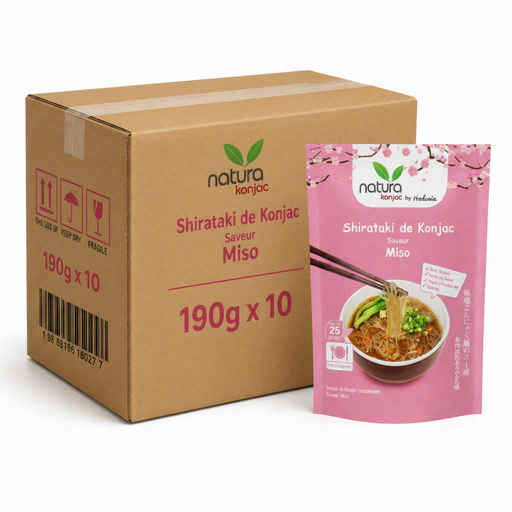 Image unavailable
Consider this if you’d like to look at a konjac and miso soup preparation rather than a traditional vegetable soup. The pack contains ten 190 g portions.
To compare it with soup in a carton, check the unit used for the nutritional information, as well as the salt and allergens listed on the packaging.
No. A claim about sugar doesn’t tell you how much fat the soup contains. Check the fat and saturated fat figures separately for the recipe you’re interested in. Sugars and salt are also shown on their own lines in the nutritional information.
Compare their values on the same basis, using per 100 ml figures if both are given that way. Manger Bouger states that the nutritional values of prepacked foods are given per 100 g or per 100 ml. Don’t treat these units as interchangeable, then consider the portion you plan to eat.
Because salt is a separate consideration from fat. Anses lists soups and broths among the food categories that contribute to salt intake. If salt matters to you too, compare the amount in each recipe on a like-for-like basis.
Check the ingredients and allergens for the exact product, particularly if you need to avoid milk, celery, wheat or egg. Listings for vegetable soups from Auchan and Carrefour include some of these ingredients, but what’s included varies by recipe.
Follow the instructions on the packaging of the soup you buy. The fact that a product has a long shelf life before opening doesn’t tell you how to store it afterwards. Choose a pack size that also suits the number of portions you plan to serve.