
当日/次日达

品质保障

开启新人专享福利: 全场免邮 | 低至 2 折 | 免费试用 30 天 JoyPlus 会员
下载 Joybuy
A side table? It seems like a simple purchase. Yet, this small piece of furniture is often where the worst design flaws are found. Between flattering photos and marketing jargon, it's easy to end up with a wobbly product, poorly thought-out dimensions, or one that gets damaged in just a few months. As Head of Product Curation at Joybuy, my mission is to help you decode the technical specs to make a smart, practical, and durable choice.
Before we get to our selection, let's identify the 3 most common pitfalls when buying a living room side table:
To avoid these disappointments, you just need to focus on a few objective technical criteria.
You don't need to be a furniture expert to analyse a side table. You just need to know where to look. Here are the three checkpoints you should never overlook.
The sturdiness of a small table depends on the combination of its materials and structure.
A small living room table should be well-proportioned. The first step: measure the available space. The ideal height for an end table is level with or just below your sofa's armrest.
Next, think about its use. Do you just need a surface to place a cup and the remote? Or are you also looking for a discreet storage solution? A side table with storage (shelf, drawer, fabric basket, etc.) is perfect for keeping a living room tidy without adding clutter.
While design is subjective, certain styles follow specific codes. An industrial-style side table will typically pair a raw wood-look top with a black metal frame. A designer nightstand or a modern round side table will focus on clean lines, neutral tones (grey, beige), and materials like metal or a linen-look fabric. The goal is to find the piece that complements your decor without overwhelming it.
Rather than an impersonal list, here is a selection curated for different needs, to help you better visualise the perfect piece of furniture for your daily life.
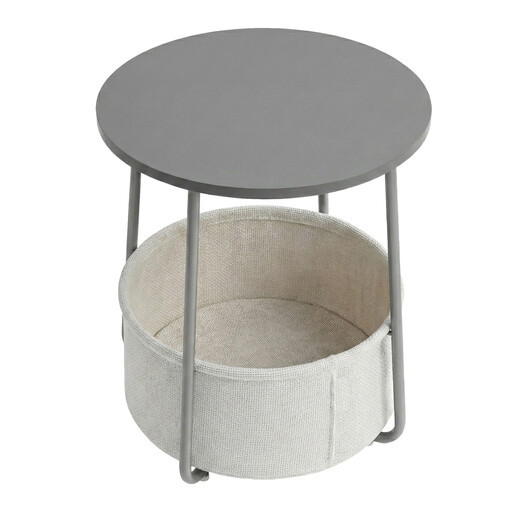
Why we chose it : Ideal for apartments or for setting up a reading nook. Its 45 cm diameter is just right for the essentials, and its integrated basket provides clever vertical storage for throws, magazines, or tablets. The result: your floor space is freed up.
Its U-shaped steel frame and 4 adjustable feet guarantee rock-solid stability. The double-layer polyester basket is built to last and won't sag over time.
The perfect 2-in-1: a side surface and real storage in an ultra-compact design. Assembly is promised in 5 to 10 minutes flat.
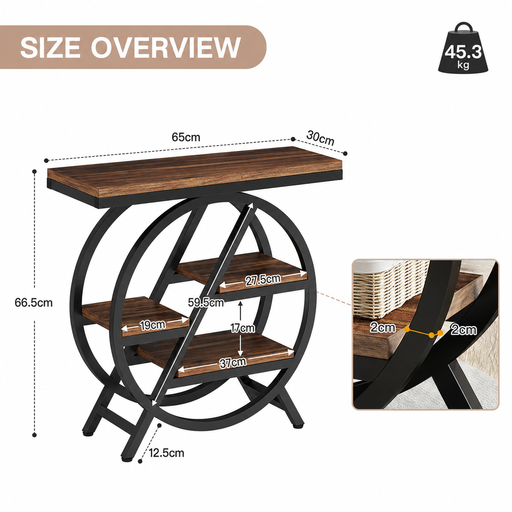
Why we chose it : Perfect for lovers of industrial style who want visible and accessible storage. Its three shelves allow you to organise books, plants, and decorative objects, creating a true focal point in your living room.
The sturdy metal frame and geometric design ensure excellent stability. The E1-grade particleboard shelves (1.5 cm thick) can support a significant weight (up to 13.6 kg), preventing the "bowing shelf" effect.
Maximum vertical storage with a minimal footprint. Its bold design makes it a real statement piece.
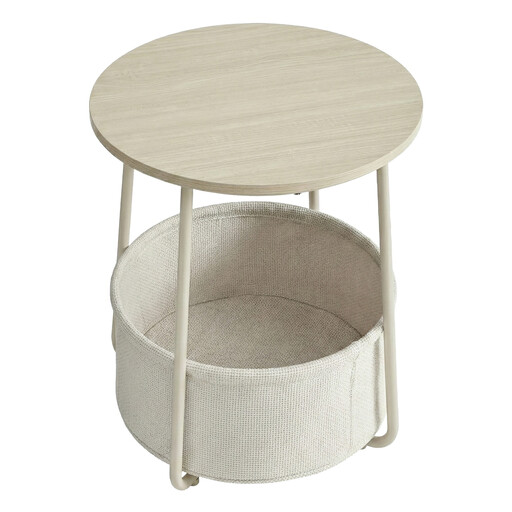
Why we chose it : For those seeking a soft, minimalist aesthetic. The combination of the natural wood-coloured top, linen-look basket, and white metal legs fits perfectly into a Scandinavian or contemporary decor. It's just as at home as an end table as it is as a designer nightstand.
Don't be fooled by its lightweight appearance: its steel frame and adjustable feet give it the same stability as an industrial model. The quality fabric basket won't lose its shape, avoiding the "pretty but flimsy" trap.
Its versatility. With its clean design and neutral tones, it adapts to any room and any style.
We've put together a complete selection of products that meet our quality and safety criteria.
The most reliable solution is to choose a model equipped with adjustable feet. In addition to ensuring stability on a floor that isn't perfectly level, they are made of plastic or rubber to protect delicate surfaces like hardwood. If the model of your dreams doesn't have them, adding adhesive felt pads is a simple and inexpensive solution.
In practice, the two terms are often used interchangeably. The end table, as its name suggests, is designed to be placed at the end of a sofa, with a height generally aligned with the armrest. The side table is a more generic term: it's a small table that can be placed anywhere in a room (between two armchairs, in a corner, as a nightstand, etc.).
No, most current models are designed for quick and easy assembly by a single person. Manufacturers provide clear instructions, numbered parts, and all the necessary tools (like the famous Allen key). For the models in our selection, you can expect it to take less than 15?minutes, even if you're not a DIY pro.