
Livraison le jour même ou le lendemain

Qualité garantie

Débloquez vos offres de bienvenue: Livraison GRATUITE | Jusqu'à -80 % | 30 jours d'essai gratuits à JoyPlus
Téléchargez l'application
Redness, itching, overpowering fragrance or stains that won’t budge: choosing a liquid laundry detergent for sensitive skin isn’t just about spotting the word “gentle” on the packaging. The ingredients, dosage, wash temperature and the fabrics involved all deserve a closer look.
Some marketing claims can be misleading, too:
To choose a detergent suited to sensitive skin, start by examining the ingredient list and any precautions on the label. If you’re looking for a detergent without MIT or BIT, check this explicitly in the composition: simply seeing “sensitive skin” on the front isn’t enough.
A hypoallergenic fragrance is formulated to reduce the risk of a reaction, but that doesn’t make it a fragrance-free detergent. For baby clothes or people who are particularly reactive, a formula without fragrance and free from listed allergens may be preferable. If a skin problem persists, seek advice from a healthcare professional.
The EU Ecolabel is an official environmental benchmark. However, it doesn’t guarantee safety if ingested or if it comes into contact with the eyes: like all detergents, the product must be kept out of reach of children.
A detergent that works well at low temperatures can help reduce energy consumption, provided the type of laundry and its level of soiling are suitable. Several products claim effectiveness from 20 °C, thanks in part to the action of enzymes.
These enzymes target different kinds of soiling, including food residues and grease. However, they won’t work miracles on an old stain and don’t always replace a pre-wash. For a stain-removing detergent, you can apply a small amount directly to the stain if the product label allows it, then start the wash promptly, following the garment’s care instructions.
Depending on its concentration and the recommended dosage, a 1.5-litre bottle can cover between 32 and 38 washes. To compare prices, divide the price by the number of cycles stated, rather than by the bottle volume.
A refillable detergent can reduce packaging waste, provided you actually use the refills with the intended bottle. Also consider the space available in your cupboard, how reliable the closure is, and how easy the dosage is to measure. Using more product doesn’t necessarily clean your laundry better and can even leave more residue on the fibres.
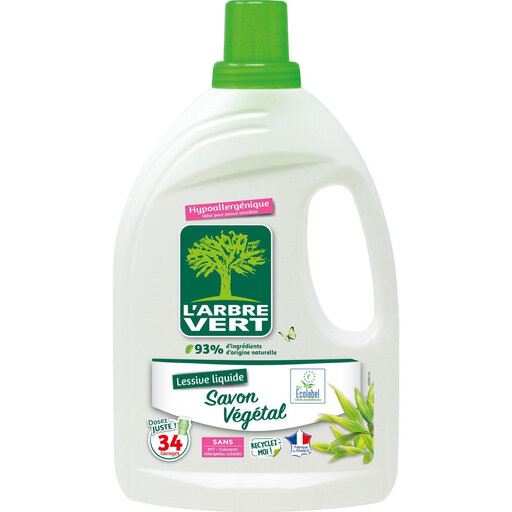
Why this choice suits this profile: Its 1.53 L bottle offers 34 washes and works well for both white and coloured laundry. A simple choice to get started with hypoallergenic detergents.
The formula is stated to be free from dyes, optical brighteners, phosphonates and MIT. The hypoallergenic claim should be understood as a reduced risk, not a medical guarantee.
93 % naturally derived ingredients stated, EU Ecolabel, recyclable bottle and refillable.
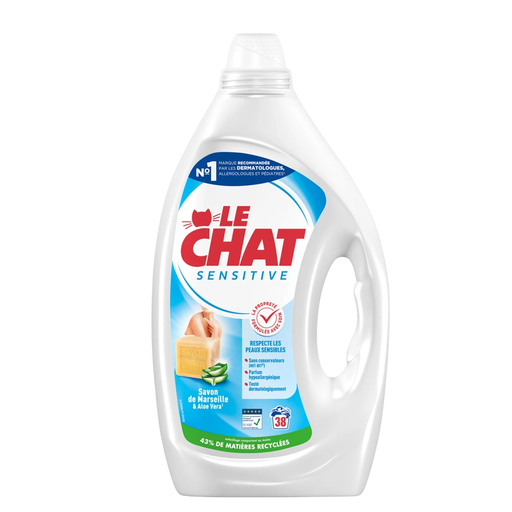
Why this choice suits this profile: This product focuses on a polished presentation, Marseille soap and aloe vera. Its 1.71 L bottle delivers 38 washes.
The manufacturer states that no MIT or BIT have been added, and that it contains a hypoallergenic fragrance. Still, check the full ingredient list before purchasing.
Marseille soap, aloe vera, 85 % naturally derived ingredients stated and 38 washes per bottle.
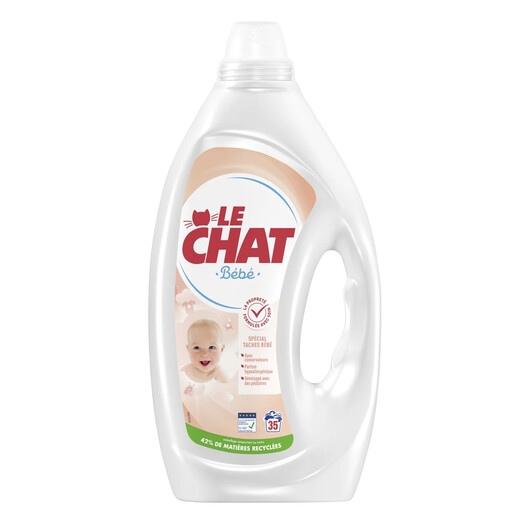
Why this choice suits this profile: Designed for baby clothes, this detergent works in both machine and hand washing and covers up to 35 washes.
The formula is stated to be free from preservatives and contains a hypoallergenic fragrance. The usual precautions still apply and are essential: avoid contact with eyes and keep the product out of reach of children.
ECARF certification stated, bottle made from 42 % recycled material and suitable for machine or hand washing.
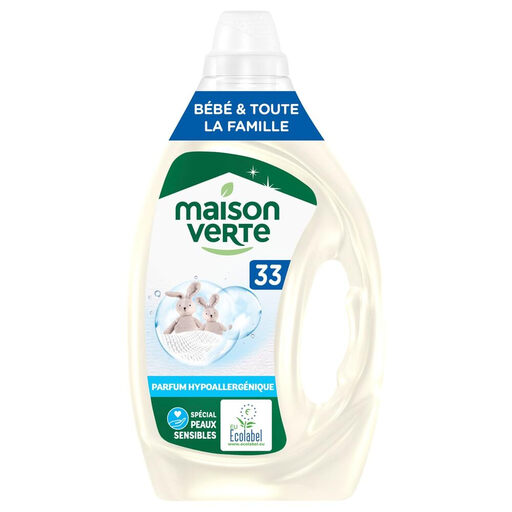
Why this choice suits this profile: Its 1.485 L bottle offers 33 washes and is designed for both family laundry and baby clothes.
This product claims effectiveness from 20 °C and states it is free from MIT, BIT, dyes and added microplastics. However, it is not suitable for delicate fabrics such as wool and silk.
Five naturally derived enzymes stated, EU Ecolabel and a fragrance described as hypoallergenic.
We’ve put together a comprehensive, real-time selection of products that meet these exacting standards and European safety regulations.
Opt for a formula clearly intended for sensitive skin, check for preservatives and fragrances, then follow the dosage carefully. The garment label and an effective rinse cycle matter just as much as choosing a baby detergent.
No. “Hypoallergenic” means the formula is designed to minimise the risk of a reaction. It may therefore contain a fragrance described as hypoallergenic. To reduce the presence of scented substances, look for a product explicitly labelled as fragrance-free.
Not always. A 20 °C recommendation applies to compatible products and programmes. Set-in stains, heavily soiled laundry or certain hygiene requirements may call for a different temperature. Always follow the garment label and the manufacturer’s instructions.