To order honey that’s easy to dispense, look for a product explicitly described as liquid and sold in a squeezy bottle. A 250 g bottle may suit occasional use, while 500 g means you won’t need to replace it as often. In either case, check the countries of harvest and type of honey separately, and don’t assume the dispensing cap will prevent leaks.
Who is this option for?
People who use honey every day
If you often drizzle honey over toast, stir it into yoghurt or add it to a drink, a squeezy bottle can make serving easier. Auchan describes this packaging as practical and easy to spread, although it doesn’t guarantee that there won’t be drips.
People who pay close attention to where their honey comes from
If the countries where the honey is harvested influence your choice, check the origin details for each product. Carrefour and Auchan list honeys of French origin, while other products are described as blends from several countries.
People who choose a size to suit how much honey they use
The squeezy bottles listed by Carrefour and Auchan include 250 g options; E.Leclerc and Monoprix also list 500 g products. Choose a size to suit how often you use honey.
What should you check before ordering?
First, check that the honey is liquid and comes in a squeezy bottle. Then look at the origin and size of the product you’re considering.
| What to consider |
What to check |
Who this matters to |
| Dispensing |
Look for the words “liquid” and “squeezy bottle” or “squeeze”; check the cap is in good condition when it arrives. |
I want to be able to drizzle honey easily over my toast or into my drinks, without assuming the bottle will never leak. Around 42% of consumers would make this their top priority. |
| Origin and type of honey |
Check the countries where the honey was harvested and the stated type of honey. Check for an organic label separately if that matters to you. |
If I’m looking for honey harvested in France, the retailer’s name or the place where it was packed isn’t enough. Around 33% of consumers would make origin their top priority. |
| Size |
Choose between 250 g and 500 g based on how often you use honey. |
I only use honey occasionally and prefer a small bottle, or I use it regularly and want to replace it less often. Around 25% of consumers would put size first. |
Mistakes to avoid
-
Assuming a squeezy bottle will never leak
The dispensing nozzle makes serving easier, but honey can leak if the cap isn’t closed properly or the bottle is damaged during delivery.
Choose this packaging for ease of dispensing, then check the bottle and cap as soon as it arrives.
-
Confusing organic honey, packed in France and harvested in France
Auchan’s product listing for organic honey in a squeezy bottle says it’s a blend from Central America, South America and Europe. So the organic label alone doesn’t mean the honey was harvested in France.
Check the countries of harvest listed for the product you’ve chosen, regardless of its label or where it was packed.
-
Relying on the name of the honey alone
Carrefour’s listing for Miel Besacier 250 g uses “flower” in the product name, but mentions “acacia” in the description. It’s worth checking this difference if the type of honey matters to you.
Check the product description and the information on the product you receive before using it.
Retailers to consider for honey in a squeezy bottle
Carrefour
Carrefour lists a 250 g Miel Besacier in a squeezy bottle, described as being of French origin.
- The listing gives the ingredients, size and origin.
- The listing refers to both “flowers” and “acacia”, so check the product you receive if that distinction matters to you.
E.Leclerc
E.Leclerc lists a 500 g bottle of liquid Nid d’Abeille flower honey in a squeezy bottle.
- The listing gives the size and says that the main ingredients are 80% from Ukraine and 20% from Argentina.
- Check whether this product is available for collection from your chosen Drive or store.
Auchan
Auchan lists several liquid honeys in 250 g squeezy bottles, including one described as being of French origin and an organic option.
- These two options let you compare the size, origin and organic label separately.
- The organic option is described as a blend of honeys from Central America, South America and Europe: organic does not mean French origin.
Monoprix
Monoprix lists a 500 g bottle of Lune de Miel flower honey in a squeezy bottle for home delivery.
- The listing gives the weight, packaging type and ingredients.
- It states that the honey comes from Ukraine and Argentina, which is different from products of French origin.
A squeezy bottle to consider on Joybuy
This 250 g size is suited to anyone looking for liquid honey with a dispensing nozzle for serving small amounts.
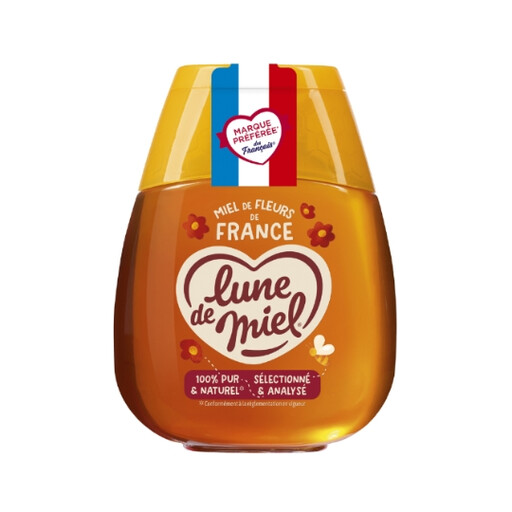 Image unavailable
Lune de Miel liquid honey with dispensing nozzle, 250 g
The dispensing nozzle and 250 g size are a good choice if you want to serve small amounts of liquid honey.
Joybuy’s listing describes this product as French flower honey. Check the bottle and cap are intact when it arrives: a dispensing nozzle doesn’t guarantee that it won’t leak.
View on Joybuy
Frequently asked questions
How can you check where honey ordered online comes from?
Read the country or countries where the honey was harvested, then check the label on the product you receive. The DGCCRF says the country of origin must be included on honey labels; honey packed in France hasn’t necessarily been harvested there.
Does a squeezy bottle prevent all waste?
No. This type of packaging makes honey easier to dispense, but it can’t guarantee that not a single drop will leak. Close the cap and check that the bottle wasn’t damaged during delivery.
Should you order 250 g or 500 g of honey?
A 250 g bottle may suit occasional use; 500 g means you won’t need to replace it as often if you use honey regularly. Check the type of honey and its origin too, as the size won’t tell you either.
Does the organic logo mean the honey is from France?
No. Auchan’s listing for organic honey in a squeezy bottle describes a blend of honeys from Central America, South America and Europe. Check the organic label and countries of harvest separately.
Can you give honey to a baby under one year old?
No. The Anses advises against giving honey of any origin to babies under one year old because of the risk of infant botulism.


