
Livraison le jour même ou le lendemain

Qualité garantie

Débloquez vos offres de bienvenue: Livraison GRATUITE | Jusqu'à -80 % | 30 jours d'essai gratuits à JoyPlus
Téléchargez l'application
A lined A5 notebook can be used for taking lecture notes, preparing meetings, keeping a diary or organising your ideas. Yet two models of the same size can offer a very different experience. A pretty cover doesn't necessarily make up for paper that's too thin, an impractical binding or a format that doesn't suit your daily routine.
Before you buy, take the time to check a few concrete features: paper weight, number of pages, type of cover, binding and included accessories. Here are the main criteria to look at, along with a selection of models suited to different uses in the UK.
Some listings say "120 pages", while the specification mentions 60 sheets. These figures aren't contradictory: one sheet usually has two sides, giving you 120 usable pages.
To compare two notebooks properly, check both:
An A5 notebook with 96 sheets can therefore offer 192 pages, while a spiral-bound model with 60 sheets will give you 120.
A hard, fabric or faux leather cover may feel nice to the touch, but it doesn't guarantee the notebook's durability on its own. Also check the type of binding:
A hardcover notebook with an elastic band and bookmark will generally be better suited to daily use than a purely decorative model without accessories.
Paper weight is a verifiable detail, but it doesn't sum up all the paper's characteristics on its own. 100 gsm paper is thicker than 70 gsm paper and often feels nicer under the pen. That doesn't mean it will suit all felt-tip pens or fountain pens, though.
The paper's shade also matters. Ivory or cream slightly reduces contrast and gives a warmer look, while white will suit those who prefer perfectly crisp reading.
The A5 size measures approximately 14.8 × 21 cm. It offers enough space for lectures, meeting notes, office work or journaling, while still being easy to carry in a backpack or large bag.
The A6 size, which measures approximately 10.5 × 14.8 cm, is better suited to quick notes, lists and jotting down ideas on the go. An A6 pocket notebook takes up less space, but its lines are shorter and the writing surface more limited.
The models featured here mainly use 70 gsm or 100 gsm paper:
If you use highlighters, liquid inks or a fountain pen, check the product details and test on a page at the back of the notebook before committing.
For a notebook that will stay open on a desk, spiral binding can be very practical. For a diary or a notebook carried every day, a hard cover with an elastic closure will better protect the pages from accidental opening.
An integrated bookmark saves you from dog-earing pages. Some A6 models also have a pen loop, handy for keeping your writing instrument with the notebook at all times.
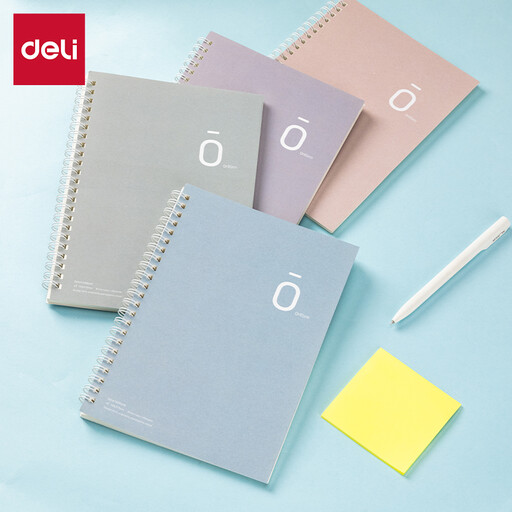
Why this choice fits: This pack of four A5 notebooks lets students separate subjects, families share uses or take notes in several places.
The specification states 60 sheets and 120 pages per notebook: the volume is clearly presented, without mixing the two measurements.
The spiral binding, A5 size and four units make it easy to organise several projects or subjects.
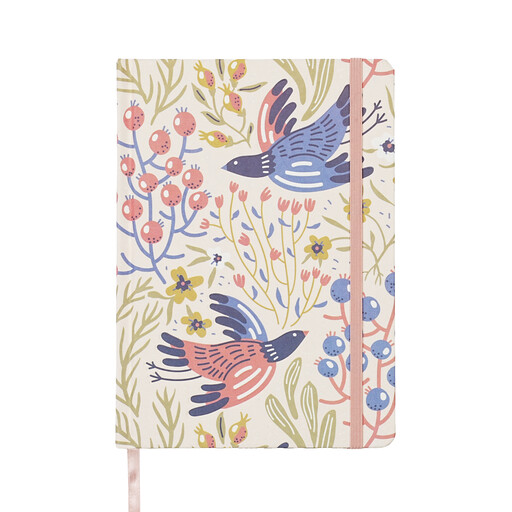
Why this choice fits: Its floral textile cover will appeal to those looking for an elegant notebook for journaling, personal writing or a stationery gift.
The specification details the A5 size, 96 sheets, 192 pages and 100 gsm ivory paper.
The hard cover, ribbon bookmark and elastic closure make the notebook more practical for everyday use.
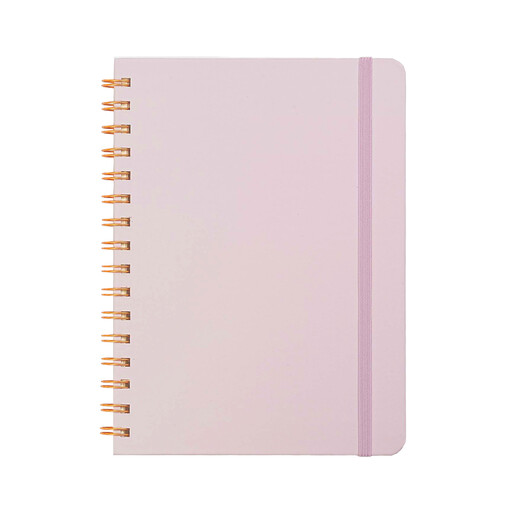
Why this choice fits: This notebook suits people who write a lot at the office, track projects or like to lay their notebook flat while taking notes.
The twin-wire binding is clearly stated, along with the 96 sheets and 100 gsm paper.
The A5 size, hard cover and elastic closure offer both a large writing surface and secure storage.
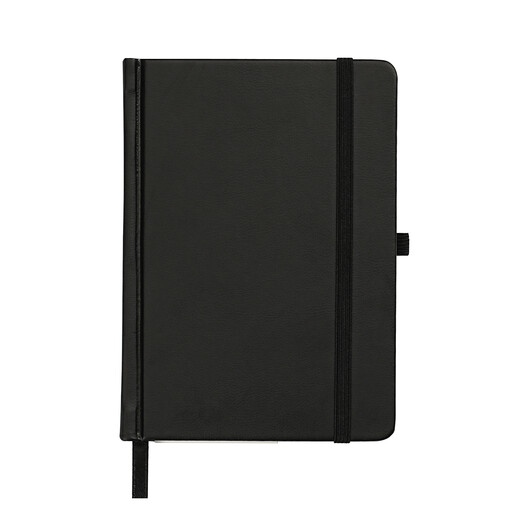
Why this choice fits: Its compact size is ideal for lists, ideas jotted down on the fly and notes taken on public transport, in a café or between appointments.
The specification details the A6 size, 80 sheets, 160 pages and 100 gsm lined paper.
The bookmark, elastic closure and pen loop are all integrated. Several colours are available.
We've put together an updated selection of notebooks and notepads suited to different uses, sizes and paper weights.
Yes. The A5 size offers enough room for lectures, revision cards and meeting notes, while remaining easy to carry. A spiral binding can be practical for writing on a narrow desk or viewing several pages at once. To separate subjects, a pack of A5 notebooks can also be simpler to manage than one thick volume.
The 100 gsm weight is thicker than 70 gsm, but the result also depends on the ink and pen you use. Check the level of show-through stated on the product page and test it before filling the notebook. No paper weight guarantees zero ink bleed-through with every instrument.
Its lifespan depends on how often you use it, how you carry it and the humidity. A hard cover, elastic closure and storing it away from water will help preserve it for longer. Avoid forcing it open, overloading the pages or leaving the notebook in a car exposed to high temperatures.