
Livraison le jour même ou le lendemain

Qualité garantie

Débloquez vos offres de bienvenue: Livraison GRATUITE | Jusqu'à -80 % | 30 jours d'essai gratuits à JoyPlus
Téléchargez l'application
A lined A5 hardcover notebook can accompany you through lectures, meetings, journaling, or simply help you organise your thoughts. But behind an attractive cover or a pretty design lie criteria that directly affect writing comfort and the notebook's lifespan.
Before placing an order, take the time to check the paper weight, the quality of the cover, the type of binding and the presence of genuinely useful accessories. This approach will help you tell the difference between an A5 notebook that's practical for everyday use and one that's mostly photogenic but ill-suited to your habits.
A floral, decorated or fabric-covered cover immediately gives a polished impression. However, this says nothing about its durability. A hardcover, a laminated finish and a textile covering all react differently to scuffs, repeated handling and moisture.
If the notebook needs to travel in a bag, make sure it holds up well after many openings and closings. Delicate finishes, such as hot foil stamping or embossing, can look stunning, but they require more care.
Two notebooks with a similar capacity can offer a very different experience. Some listings mention sheets, others pages: 96 sheets usually equates to 192 pages (printed on both sides). This distinction is worth checking to compare models properly.
The type of binding also matters. A sewn or glued binding works well for standard note-taking. A spiral binding often makes it easier to lay flat, but it's bulkier in a bag and can snag on other items.
An elastic band stops the notebook from opening at the bottom of your bag. A bookmark lets you instantly find your current page. As for the pen loop, found on some A6 formats, it saves you hunting for your writing instrument when you need it.
With dimensions of roughly 14.8 × 21 cm, the A5 format offers a comfortable writing surface. A pocket-sized A6 notebook, measuring about 10.5 × 14.8 cm, will be easier to carry but leaves less room on each page.
Expressed in g/m², the weight refers to the mass of one square metre of paper. At 100 g/m², the paper is more substantial than school paper at 60 or 70 g/m². It generally feels more pleasant with a ballpoint pen, rollerball or certain felt-tips.
However, this doesn't guarantee no show-through with all inks. For a fountain pen or wet marker, check the manufacturer's guidance and, if possible, test on a page. The Jubiluu models featured here use 100 g/m² cream-coloured offset paper.
A hardcover protects the pages better when the notebook is used at the office, in class or on the go. Fabric adds a pleasant texture and a warmer finish, but it should be kept away from moisture. A printed cover with a textured laminate will be easier to clean with a dry cloth.
For daily use, also consider how the notebook opens. A spiral binding allows you to lay it flat on your desk easily. A classic hardcover model is generally more compact and better suited to a professional environment or as a stationery gift.
A notebook with a bookmark and elastic band addresses two very practical needs: quickly finding your current page and keeping the notebook securely closed. For an A5 journal, a bullet journal or meeting notes, these small details save time.
If your goal is planning rather than free writing, an undated 18-month planner will provide structure with its monthly and weekly pages. Since it isn't tied to fixed dates, you can start it whenever you like and avoid leaving unused pages after a break.
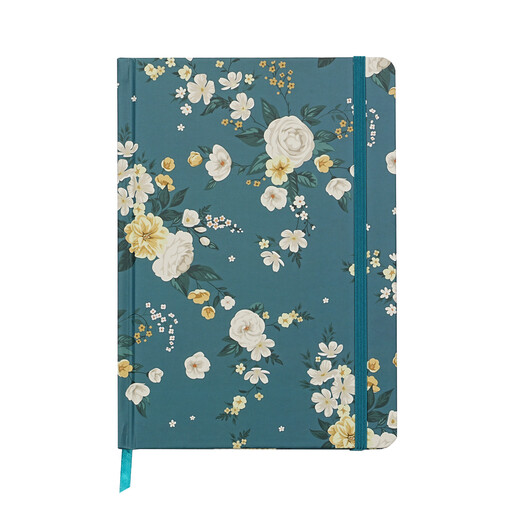
Why this choice suits this profile: its A5 format works well for studies, the office or getting started with journaling. Its decorative design adds character without requiring a sophisticated layout.
The listing mentions a hardcover, 96 sheets, 100 g/m² offset paper, a ribbon bookmark and an elastic closure.
A format of approximately 14.8 × 21 cm, 192 pages and a botanical design available in several variations.
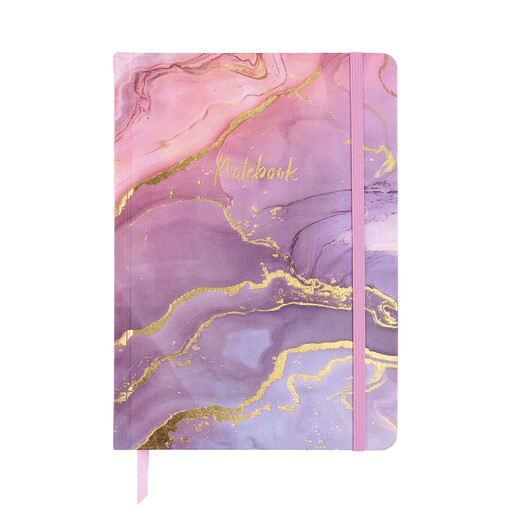
Why this choice suits this profile: its fabric cover and decorative details will appeal to those seeking a beautiful tactile experience for writing, creating or gifting.
The description specifies the cover material, the 100 g/m² cream offset paper and the precautions needed to keep it away from moisture.
96 sheets, i.e. 192 pages, a ribbon bookmark, an elastic band and several fabric designs with floral or nature-inspired patterns.
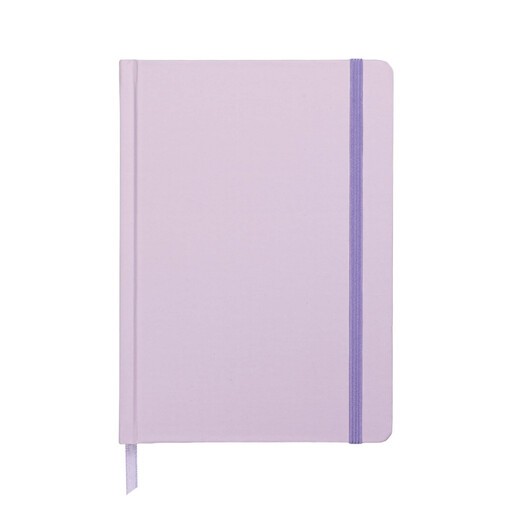
Why this choice suits this profile: its monthly and weekly organisation is ideal for tracking studies, professional projects or personal goals over a long period.
The undated format prevents wasted weeks when the planner goes unused for a while. The hardcover and elastic band are well suited to frequent travel.
112 sheets, 224 pages, 100 g/m² lined offset paper, undated monthly and weekly pages, a bookmark and an elastic closure.
We've selected a comprehensive, real-time updated range of products that meet these exacting criteria, while also taking European safety regulations into account.
It generally works well for everyday writing with ballpoint pens, rollerballs and pencils. With a fountain pen, felt-tip or marker, the result depends on the ink and the pressure you apply. It's best to test on a page before heavy use.
It all depends on how often you open it, how you carry it and where you store it. A hardcover, an elastic band that isn't constantly stretched and keeping it in a dry place will all help preserve it. Also avoid leaving it under a pile of heavy objects or near a source of moisture.
The A5 offers a more generous writing surface and is particularly well suited to lectures, work and journaling. The A6 slips more easily into a pocket or small bag, but limits how much you can write. The right choice therefore depends mainly on how you travel and how much you plan to write.