
Livraison le jour même ou le lendemain

Qualité garantie

Débloquez vos offres de bienvenue: Livraison GRATUITE | Jusqu'à -80 % | 30 jours d'essai gratuits à JoyPlus
Téléchargez l'application
A lined A5 floral notebook can accompany you to class, meetings, journaling or creative writing. But looks aren't everything. A pretty cover can hide paper that's too thin, an impractical binding, or a size that doesn't fit well in your bag.
Before buying an A5 notebook, consider three often-overlooked criteria: paper quality, cover durability and the closure system. This will help you avoid a purchase driven purely by a floral pattern or a vague marketing promise.
Product listings sometimes state the number of pages without specifying the number of sheets. So a notebook advertised as having 192 pages may actually contain 96 sheets that can be written on both sides. This distinction matters if you write every day or want to keep a lined personal diary for several months.
A soft cover is lightweight, but it doesn't protect your notes as well when the notebook lives in your bag or sits on a cluttered desk. For regular use, a hardcover notebook provides a more stable base and resists creasing. You should also check the finish: a printed or fabric surface is less resistant to moisture and rubbing.
Without a page marker, a notebook can quickly become less practical as the weeks go by. On the other hand, a notebook with an elastic closure and bookmark lets you find your last note quickly and keeps the pages securely closed during travel. Spiral binding generally allows the notebook to lie flat, but it takes up more space on a desk and the rings need to be handled with care.
The A5 format measures approximately 14.8 × 21 cm. It slips easily into a student bag or a professional briefcase, while offering enough space for structured note-taking. It works well for the office, school, a personal journal or a bullet journal, although lined pages are better suited to writing than free-form layouts.
A paper weight of 100 gsm is a good benchmark if you're looking for a sheet that's more substantial than standard thin paper. The models featured here use 100 gsm ivory or off-white offset paper. This shade, often referred to as 100 gsm ivory paper, offers a softer contrast with ink.
However, paper weight alone doesn't guarantee that ink won't show through with all writing instruments. If you use a heavily saturated felt-tip pen, a marker or a fountain pen, always test the ink on a few pages before writing anything important.
A laminated hard cover protects your notes effectively and can be cleaned with a soft, dry cloth. A fabric cover with embossing, debossing or metallic detailing adds a more decorative finish, but it needs to be kept dry and away from prolonged exposure to sunlight.
The elastic isn't just a decorative feature: it keeps the notebook closed in your bag. As for the ribbon bookmark, it lets you find a page quickly without dog-earing the sheets.
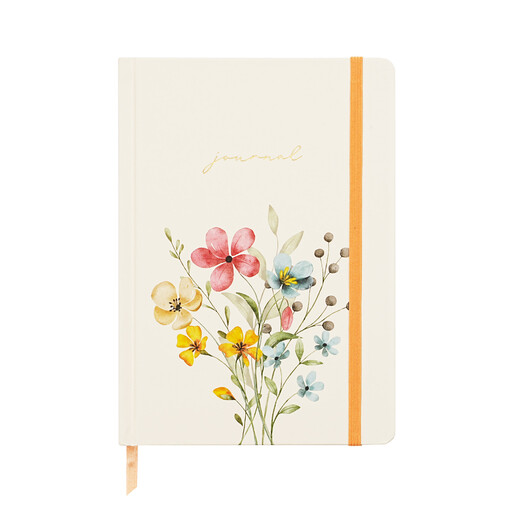
Why this choice suits this profile: This model offers a simple setup for starting out with note-taking, keeping a personal diary or enjoying creative writing, without lots of extra accessories.
The hard cover prevents the notebook from warping quickly, while the elastic closure stops it from opening accidentally in your bag.
A5 format, 96 sheets of 100 gsm off-white offset paper, 192 pages, ribbon bookmark and elastic closure.
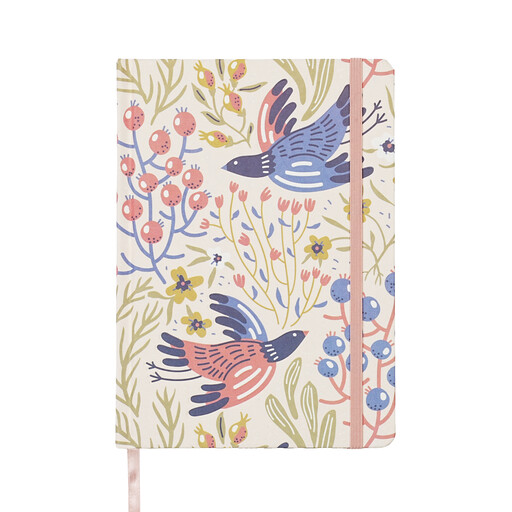
Why this choice suits this profile: Its decorative fabric cover appeals to those looking for a beautiful stationery item to use at home or give as a gift.
The listing specifies the paper type, number of sheets and cover finishes, rather than just a visual description.
100 gsm lined ivory paper, 96 sheets, floral fabric cover and storage accessories as per the product listing.
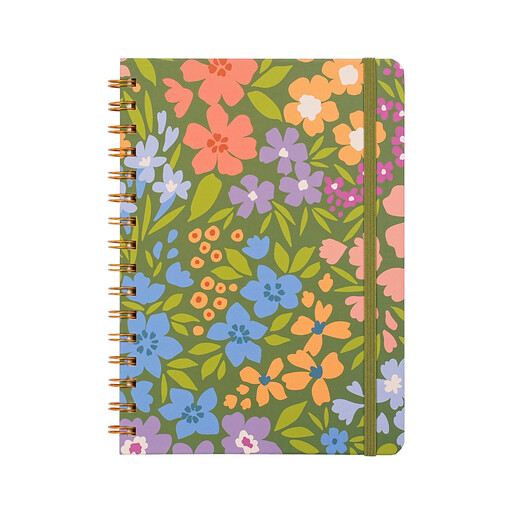
Why this choice suits this profile: The spiral binding is ideal for students and professionals who often refer back to their notes and appreciate a notebook that lies completely flat.
The twin-wire binding is clearly stated, and the elastic keeps the notebook closed during travel.
148 × 210 mm format, 96 sheets of 100 gsm lined cream paper, laminated hard cover and elastic closure.
We've put together a comprehensive, real-time selection of products that meet these exacting criteria as well as European safety standards.
Its lifespan depends on how often you write, storage conditions and how the binding is handled. A hard cover, keeping it dry and using the elastic closure all help to reduce wear. Also avoid leaving the notebook in a hot car or near liquids.
100 gsm offset paper provides a more substantial base for everyday writing. However, the result varies depending on the type of ink and the pressure you apply. With a very wet highlighter or a felt-tip pen, test it on a page near the back of the notebook.
Yes, it makes it easier to refer back and write when the notebook needs to stay wide open. On the downside, the rings can catch on certain bag compartments and take up more space on your desk. So the right choice really depends on how you take notes.