
Livraison le jour même ou le lendemain

Qualité garantie

Débloquez vos offres de bienvenue: Livraison GRATUITE | Jusqu'à -80 % | 30 jours d'essai gratuits à JoyPlus
Téléchargez l'application
A limescale-removing toilet cleaner should tackle a very real problem: white deposits, marks beneath the rim, unpleasant odours or frequent cleaning in a busy household toilet. However, packaging does not always make it easy to distinguish between a simple maintenance gel and a genuine toilet descaler designed to remove stubborn build-up.
The Joybuy Product Recommendation Officer selection is designed to help you make an informed choice, based on useful criteria rather than marketing claims alone.
A limescale-reducing toilet block releases its active ingredients with every flush and helps keep the bowl clean between washes. However, it does not necessarily replace a toilet gel applied directly to a well-established layer of limescale.
If your toilet bowl is heavily marked, check that the product contains a descaling formula and consult the recommended dwell time. A toilet cleaner intended for everyday maintenance may struggle with older deposits.
A lemon, marine or floral fragrance makes the product more pleasant to use, but does not guarantee disinfecting action or particular effectiveness against limescale. Similarly, abundant foam does not necessarily mean that the product cleans better.
Looking for a disinfecting toilet gel? Read the label and instructions for use carefully. Microbiological claims must relate to a specific use and a clearly stated standard indicated by the manufacturer, rather than simply creating a feeling of freshness.
Chlorine-based products, acidic formulas and certain disinfectants must never be mixed. Combined with bleach, an acidic descaler or ammonia, they can release dangerous gases. Always read the label, ventilate the room and wear suitable gloves.
To treat visible deposits beneath the waterline or under the rim, choose a sufficiently adhesive toilet gel. Its texture keeps it in contact with the surfaces for longer, unlike a liquid that runs off quickly.
The presence of hydrochloric acid or sodium hypochlorite requires particular care. These substances are not suitable for all surfaces and may damage certain metals.
Limescale and residue often build up beneath the rim, an area that is difficult to reach with a straight bottle. An angled nozzle or precisely directed active foam makes application considerably easier.
Also check for a safety cap, accurate dosing and the ability to reseal the bottle properly. These details help prevent splashes and avoid wasting product.
A toilet disinfectant, toilet descaler and bathroom limescale remover do not necessarily have the same intended use. Some shower cleaners are designed for tiles, chrome or glass screens, but not for the inside of the toilet bowl.
For professionals, hotels, restaurants or offices, compare the volume, replacement frequency, dwell time and storage conditions. A 1 to 1.5 litre container can reduce the need for restocking, while a block is better suited to continuous maintenance.
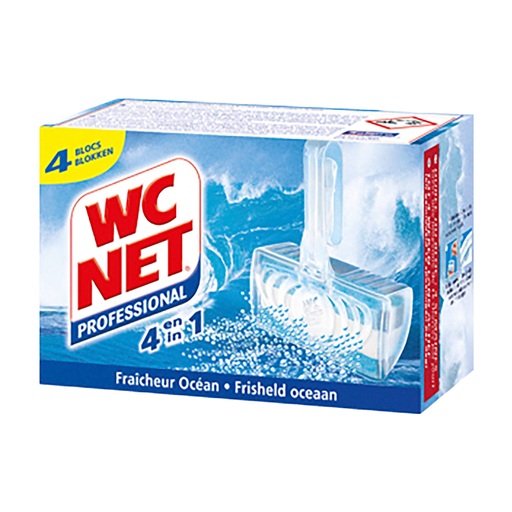
Why this choice suits this profile : This format requires minimal effort and includes four blocks, each claimed to last 4 to 6 weeks according to the product information. It is suitable for regular maintenance, without having to apply product by hand every time you clean.
It does not claim to replace occasional descaling: its role is to maintain the bowl with every flush. You should therefore keep a separate toilet gel for stubborn deposits.
Pack of 4 blocks, claimed action against limescale, active foam beneath the rim and a fresh fragrance with oceanic notes.
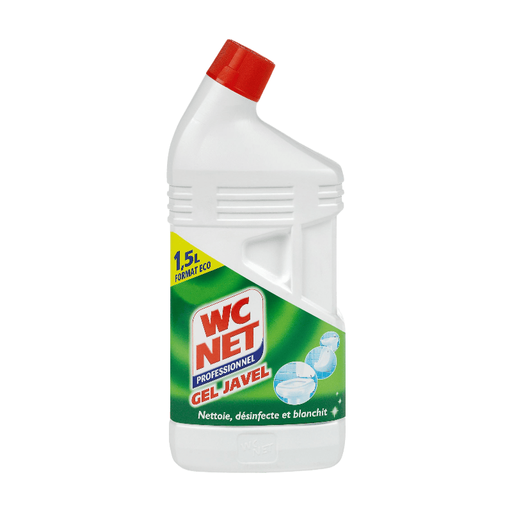
Why this choice suits this profile : Its professional 1.5-litre bottle and directional nozzle make it easy to target the sides and underside of the rim. The product information states bactericidal activity in accordance with EN 1276, using the undiluted product at 20 °C and under specific soiling conditions.
The standard is cited with specific conditions: this result must not be generalised to all uses or dilutions. This chlorine-based product must never be mixed with another cleaner.
Adhesive gel, bottle made in France, application beneath the rim and a 15-minute dwell time stated in the product information.
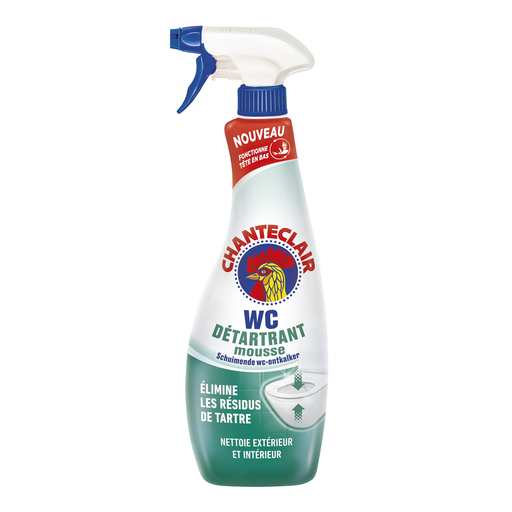
Why this choice suits this profile : The active foam reaches beneath the rim and can be applied quickly in heavily used toilets. The instructions call for a dwell time, brushing and rinsing, with a longer dwell time for stubborn marks.
Foam does not remove the need to scrub when limescale is firmly ingrained. The 625 ml bottle is suitable for targeted application, but a professional-size format is more practical for cleaning several toilet bowls.
625 ml format, active foam, application beneath the rim and a fresh fragrance. Product made in France according to its product information.
We have put together a complete, real-time updated list of products that fully meet these strict selection criteria and European safety regulations.
For washbasins, showers, tiles and glass screens, choose a bathroom limescale remover suitable for these materials instead. A toilet bowl cleaner is not necessarily suitable for chrome, natural stone or delicate surfaces.
An adhesive descaling gel is generally more suitable than a toilet block for treating a specific area. Check its composition, dwell time and compatible materials. When dealing with an old layer of limescale, several applications spaced apart may be necessary; never leave the product to work for longer than the manufacturer recommends.
It depends on the flush volume and the number of uses. The models presented generally claim to last for several weeks or a specified number of flushes. Replace the block once it has dissolved and follow the recommendations on its packaging.
Not necessarily. A toilet disinfectant claims microbiological action under specific conditions, whereas a descaler targets mineral deposits. Some gels combine several functions, but it is better to check the label, the stated standard and the instructions for use rather than relying solely on the “4-in-1” claim.