
Livraison le jour même ou le lendemain

Qualité garantie

Débloquez vos offres de bienvenue: Livraison GRATUITE | Jusqu'à -80 % | 30 jours d'essai gratuits à JoyPlus
Téléchargez l'application
A lightweight folding camping table is meant to make life easier, not become another awkward item to carry. Yet some product listings focus solely on low weight or quick folding, without specifying stability, maximum load or how much space the table takes up when stored.
Before buying a folding picnic table, it is worth keeping a few potential pitfalls in mind.
For regular use when camping, at the beach, while fishing or in the garden, it is better to compare precise specifications than rely on general promises.
A portable camping table should suit the way you travel. When hiking, every gram counts. In a car, however, you can prioritise a wider tabletop, provided you have enough room to transport it.
Remember to check the following every time:
The Woltu model featured below weighs 2,5 kg, measures 63 × 43 × 56 cm when set up and 15,5 × 15,5 × 67 cm when folded. This information makes it easier to assess whether it is suitable for a car trip, a picnic or a touring holiday.
The maximum load is a limit that must not be exceeded, not a target to aim for every time you use the table. Add together the weight of your crockery, drinks, stove and food to get a realistic idea.
A metal frame generally offers a good balance between strength and portability. The Oxford fabric tabletop helps keep the overall weight down, but requires a few precautions: avoid sharp objects, direct flames and very hot containers.
The Woltu model states a maximum load of 30 kg. This value must nevertheless be respected by distributing items across the entire tabletop, rather than concentrating a heavy load in one spot.
With a folding table with cup holders, accessories should remain practical without taking up the main surface. Two integrated cup holders can help prevent a drink from being knocked over when a plate or stove is already occupying the tabletop.
Also check for:
The non-slip feet fitted to all four legs, as on the Woltu model, can improve the table’s grip on different surfaces. However, they do not remove the need to choose a surface that is as level as possible.
The cards below feature a portable table along with a few complementary products. Some are intended more to complement an outdoor setup than to replace a proper camping table.
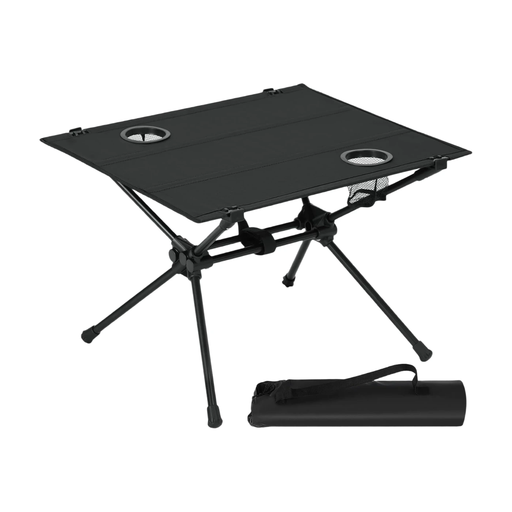
Why this choice suits this profile : Weighing 2,5 kg, with a compact folded format and tool-free assembly, it is ideal for a first camping setup, picnics and car-based trips.
The maximum load of 30 kg and the folded dimensions are clearly stated. You can therefore check before buying whether it will fit easily in your boot or among your other equipment.
Metal frame, Oxford fabric tabletop, two cup holders, four non-slip feet and carry bag included.
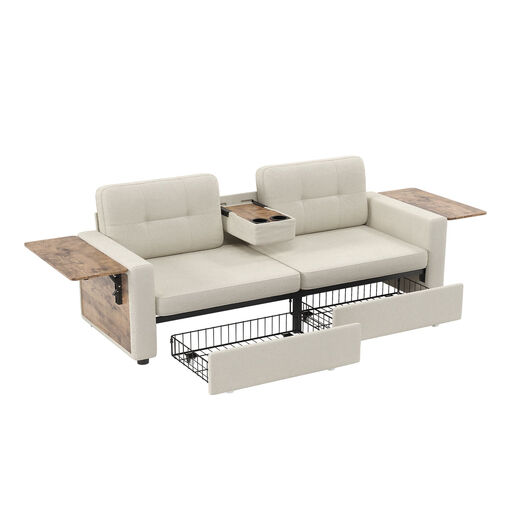
Why this choice suits this profile : In a furnished outdoor space or a room dedicated to leisure, this two-seater sofa provides genuine comfort with its folding trays and cup holders.
Its dimensions of 178 × 71 × 57,5 cm are stated so you can assess how much space it takes up. This is an occasional-use piece of furniture, not an ultra-lightweight hiking table.
Two storage compartments and two integrated folding trays, one on each side.

Why this choice suits this profile : Compact and easy to carry, this mug complements a folding table for coffee breaks while hiking, fishing or travelling in a motorhome.
Its 240 ml capacity and stainless-steel construction are clearly specified. This helps you avoid choosing a container that is too bulky for a compact setup.
Stainless steel, double-wall vacuum insulation and a format that is easy to carry.
We have put together a complete, real-time-updated selection of products that meet these demanding criteria as well as European safety requirements.
To set up a portable folding camping table:
After each use, clean the surface with a damp cloth. Avoid abrasive products, immersing the table in water and storing it while the fabric is still wet. For a folding table intended for the beach or fishing, remove as much sand as possible from the joints before folding it away.
It depends on the model. The Woltu table states a maximum capacity of 30 kg. This limit must not be exceeded, even temporarily, and items should be distributed across the entire tabletop.
Yes, provided its feet and construction are suitable for soft ground. On sand, place it on a levelled area and avoid putting a heavy load on one side only. Non-slip feet can improve grip, but they will not provide the same stability as on a hard surface.
Dry the tabletop before storing the table, remove any sand and gravel caught in the joints, and observe the maximum load. Carry it in its bag to limit rubbing and knocks while travelling.