
Livraison le jour même ou le lendemain

Qualité garantie

Débloquez vos offres de bienvenue: Livraison GRATUITE | Jusqu'à -80 % | 30 jours d'essai gratuits à JoyPlus
Téléchargez l'application
Choosing a LEGO F1 set isn't simply about picking your favourite team's colour. Between a compact LEGO Formula 1 car, an imposing LEGO Technic F1 model and a collector's helmet, the experience is completely different. A set that's too complex risks frustrating a child, while a highly detailed model can quickly become cumbersome if there's no room for it in a display cabinet.
Here are the criteria to consider before treating a Formula 1 fan.
Not all LEGO F1 ranges serve the same purpose. A LEGO Speed Champions F1 model is usually around 20 centimetres long. It can be built, displayed, and also handled for play. In contrast, a LEGO Technic F1 model at 1:8 scale can exceed 60 cm in length and requires more time, space and patience.
Before placing an order, it's best to determine whether the recipient is looking for a car to race around or a LEGO race car model intended primarily for display.
A high number of pieces doesn't guarantee a set will be more suitable. A child of 7 or 8 might prefer a transport truck complete with minifigures and play functions. A passionate teenager or adult will be more interested in functional steering, suspension or a detailed engine.
The recommended age remains an essential indicator: several Speed Champions models are recommended from age 10, helmets from age 14, and some Technic models from age 18.
The dimensions of the model once built matter more than those of the box. A small model will easily find a place on a shelf or desk. A large Mercedes-AMG, Ferrari, Red Bull Racing or McLaren car will need a stable surface, away from dust and direct sunlight.
Stickers and printed elements also deserve some care. A dry cloth is usually enough to dust them: avoid immersing them in water and using harsh household cleaning products.
Start by looking at the recommended age, then consider the recipient's patience and experience. The paper instructions and the LEGO Builder app allow you to zoom, rotate the model in 3D and track progress. For younger children, though, they don't always replace the help of an adult.
For a child, the LEGO City 60493 F1 Display Truck with Audi F1 Race Car offers 508 pieces, a truck and a car, with plenty of play around loading and unloading. The more technical models are aimed more at experienced builders.
For playing together, choose a consistent range like Speed Champions: the cars share a similar format and can be lined up on the same starting grid. For a model intended for display, check the length and width of the model, as well as whether a stand is included.
The main features to look out for are:
Small pieces make it essential to respect the stated age and the warnings on the packaging. References intended for the European market mention toy safety requirements such as EN 71, as well as REACH regulations, where this information appears on the product page.
A LEGO F1 set doesn't usually require batteries: the construction, steering and various mechanisms are operated manually. This makes use, storage and maintenance simpler, but appropriate supervision is still needed with young children.
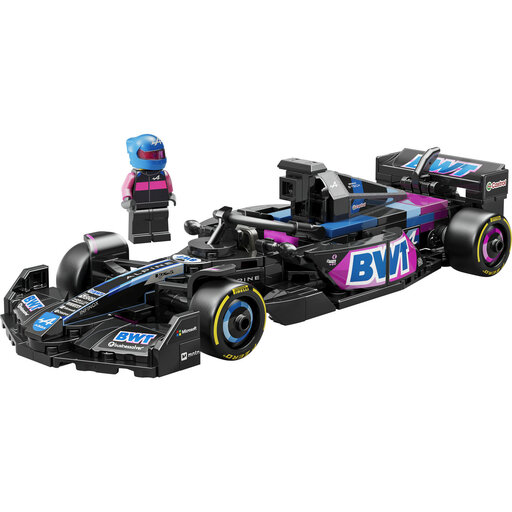
Why this choice suits this profile: With its 254 pieces and roughly 20 cm in length once assembled, this model offers an accessible entry point into the world of race cars, without needing a large display cabinet.
The product page states a recommended age of 10 years and over, the piece count and the fact that no batteries are needed: it's easier to assess the building level without relying solely on the model's appearance.
The product page mentions an opening cockpit, the halo, a rear wing, suspension and an Alpine driver minifigure.
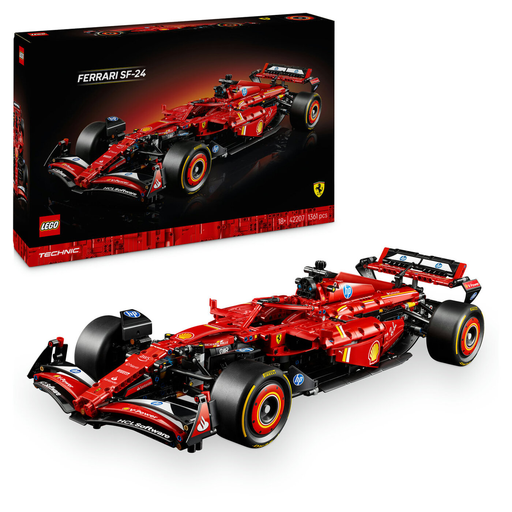
Why this choice suits this profile: Its 1:8 scale construction and mechanisms are aimed at adults who want the enjoyment to last long after the final piece is placed.
The product page states an age of 18 years and over, a length of over 61 cm and a weight of 2.33 kg: enough to give a concrete idea of the build time and space required.
The product page mentions steering, suspension, a DRS wing, a V6 engine with rotating MGU-H and a two-speed gearbox.

Why this choice suits this profile: From age 8, children can play with a transporter, two cars and several minifigures, instead of building a car designed purely for display.
The description details the 1,086 pieces, 5 minifigures and the 44 cm truck with its trailer: the buyer knows exactly what to expect in terms of size.
The trailer has opening panels, ramps and a simulator, while the two cars are inspired by Red Bull Racing and Aston Martin.
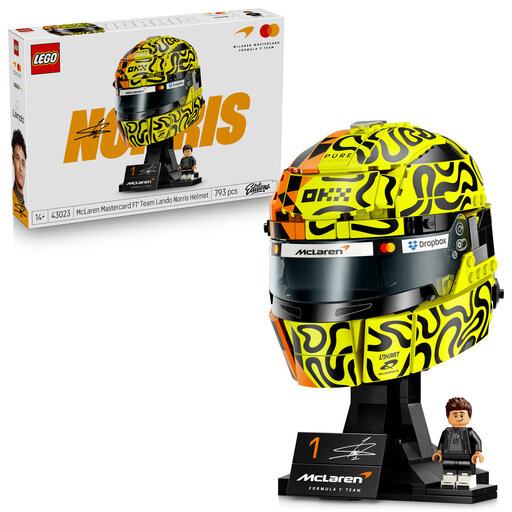
Why this choice suits this profile: This LEGO F1 helmet is aimed at teenagers and adults who want to display an item in a team or driver's colours, without necessarily buying a full car.
The recommended age of 14 years and over, the 793 pieces and the helmet's dimensions are clearly stated: the choice is made with full knowledge, for collecting rather than motorised play.
The helmet features McLaren colours and comes with a Lando Norris minifigure as well as a decorative plaque with his signature, number and the LN logo.
We've put together a complete selection, updated in real time, of products that meet these exacting criteria as well as European safety regulations.
Fans of LEGO Ferrari F1 may be torn between the Ferrari SF-24 Speed Champions and the Ferrari SF-24 Technic, two models that appeal to different audiences. For a more compact version, the Ferrari Speed Champions 77242 offers 275 pieces and a minifigure.
Enthusiasts of LEGO Mercedes-AMG F1 can look to the Speed Champions 77244 model. The Technic 42171 Mercedes-AMG F1 W14 E Performance is in a different league, with its 1,642 pieces, steering and visible V6 engine.
The LEGO Red Bull Racing F1 and LEGO McLaren F1 ranges also come in Speed Champions and Technic versions. Before choosing a colour or a team, always check the recommended age, final dimensions and intended use.
A LEGO City model like the 60493, recommended from age 7, is suitable for role-play around the truck and car. For a younger child, always follow the recommended age and the warnings about small pieces.
Speed Champions offers compact models, often accessible from age 10, with a minifigure and careful attention to exterior details. Technic focuses more on mechanisms, suspension and large models, generally aimed at older teenagers and adults.
The references presented here are operated manually and don't need batteries. The steering, pistons, ramps and wings are all moved directly by hand.