
Livraison le jour même ou le lendemain

Qualité garantie

Débloquez vos offres de bienvenue: Livraison GRATUITE | Jusqu'à -80 % | 30 jours d'essai gratuits à JoyPlus
Téléchargez l'application
LED strip lighting has revolutionised how we personalise our homes, gaming setups, and even our vehicles. Promising a customised atmosphere and a modern touch, these decorative lighting solutions have become incredibly accessible. But be warned?: the market is flooded with options of widely varying quality, and it's easy to fall into common traps that quickly turn the dream into a disappointment and a waste of money.
Before you buy, it's crucial to know how to decode the features that separate a reliable product from a mediocre one. To help you avoid any unpleasant surprises, here are the most common pitfalls and our tips for avoiding them.
Being tempted by a rock-bottom price without checking a few technical details is often the quickest path to regret. Here are the most classic let-downs?:
To ensure you don't regret your purchase, focus on a few key technical specifications. These are the true guarantees of the quality and durability of your future decorative lighting.
Density, expressed as the number of LEDs per metre, is fundamental to achieving uniform lighting.
The chip type also matters. SMD 5050 chips, which are larger and brighter than SMD 2835s, are particularly well-suited for RGB LED lighting. The reason?? They integrate all three colours (red, green, blue) into a single chip, ensuring much more uniform colour mixing.
Control methods vary enormously from one product to another.
Always check the operating voltage. For home use, strips are usually powered via a power adapter (12V or 24V). For a car LED strip, it must be specifically designed to connect to the vehicle's 12V system. Finally, make sure the product complies with European safety standards (CE marking).
To help you see things more clearly, we've selected products that meet specific needs, taking into account the quality criteria mentioned above.
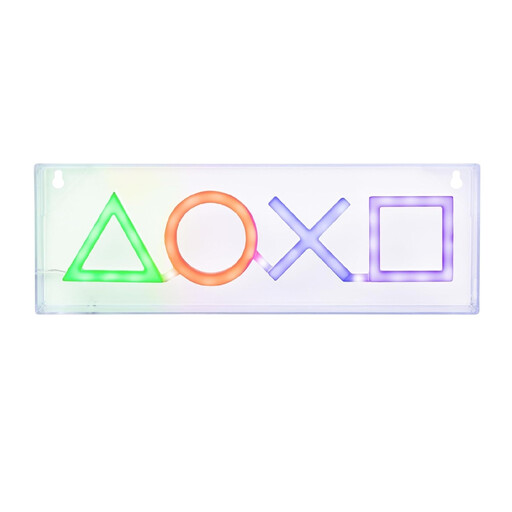
Why we chose it: Perfect for finishing off a gaming setup or decorating a bedroom, this LED neon light adds an instant thematic touch. Its USB power supply makes it incredibly easy to install near a console, PC, or a simple wall charger.
As a ready-to-use neon lamp, it provides perfectly diffused and uniform light, with no "hot spots". No need to worry about adhesive or cutting.
An officially licensed PlayStation product, which guarantees a faithful design and quality construction. It can be placed on a surface or mounted on the wall.
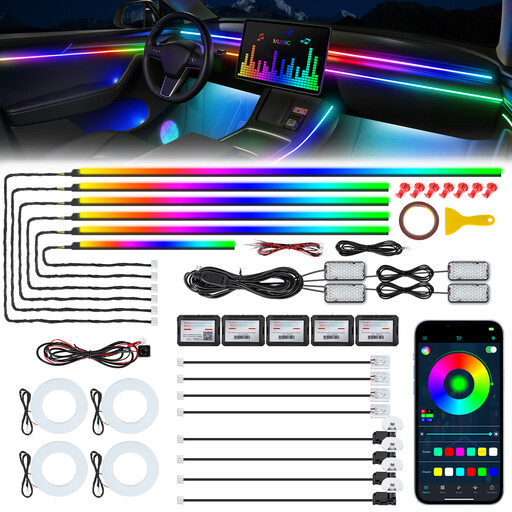
Why we chose it: This comprehensive kit is designed for advanced customisation of the car's interior. It includes light guides for the dashboard, doors, handles, and footwells, all controlled by a single app for a perfectly synchronised look.
It uses acrylic fibre-optic guides that diffuse light very evenly, creating a neon effect with no visible dots. The system is natively designed for a stable 12V power supply.
The RGBIC (Dreamcolor) technology allows for dynamic effects (chasing, rainbow) and smooth colour gradients. Everything is controlled via the app, which includes music sync.
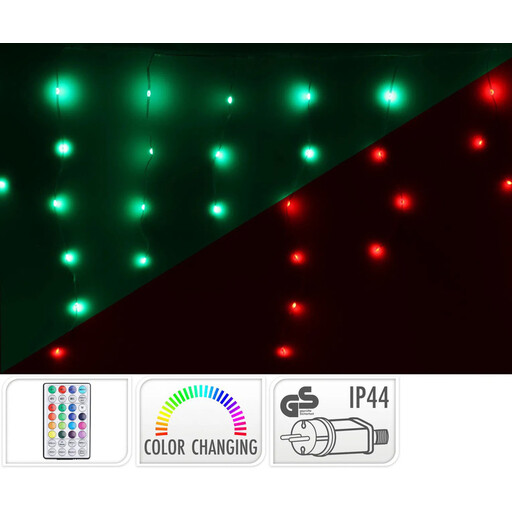
Why we chose it: A simple and effective option for a multitude of home projects: lighting under a kitchen cabinet, behind a TV, or around a mirror. Its 5-metre length offers great flexibility.
With 172 LEDs over 5 metres (approx. 34 LEDs/m), the density is sufficient for ambient lighting without a pronounced dot effect. The simple but reliable remote control avoids the connection issues of a low-end app.
An all-in-one, plug-and-play solution, delivered with its self-adhesive backing, power supply, and remote control. The 16 preset colours and brightness control cover most essential needs.
We have put together a complete and up-to-date selection of products that meet our selection criteria and current safety standards.
The average lifespan of a good quality LED strip is between 30,000 and 50,000 hours of use. This longevity depends on several factors, including the quality of heat dissipation (overheating is its worst enemy) and the frequency of use.
No, and that's one of the great advantages of LED technology. Compared to halogen or incandescent bulbs, LED strips consume up to 80% less electricity for equivalent brightness. The impact on your electricity bill will therefore be minimal, even with daily use.
Yes, most LED strips are cuttable. They have cut marks (often a scissors icon) at regular intervals, usually every 5 or 10 cm. It is imperative to cut only at these specific points to avoid damaging the circuit. Once cut, the unpowered section will no longer work unless you solder a new connector to it—an operation that requires some equipment and know-how.