
Livraison le jour même ou le lendemain

Qualité garantie

Débloquez vos offres de bienvenue: Livraison GRATUITE | Jusqu'à -80 % | 30 jours d'essai gratuits à JoyPlus
Téléchargez l'application
The LED strip has become a must-have for personalising your home's interior. Whether you want to create ambient lighting in a bedroom, enhance a TV stand, design an immersive gaming setup, or even equip a car's interior, its versatility is undeniably appealing. But there's a catch: the market is saturated with options, and it's easy to fall for the classic pitfalls that turn a promising purchase into a real disappointment.
As the head of product selection at Joybuy, my mission is to help you see things more clearly. Let's forget the marketing jargon and focus on the practical details that make all the difference in daily use. Here's a rundown of the most common mistakes and, more importantly, how to avoid them.
To ensure you make the right choice, a few technical specifications need to be closely monitored. These are what will determine the quality, durability, and final look of your installation.
This is the number one criterion for achieving perfectly uniform light.
The type of control determines the creative potential of your multicolour LED light strip.
An LED kit for a car's interior is not subject to the same constraints as a wall-mounted LED neon sign for a bedroom. Car kits are designed for a 12V power supply and to withstand vibrations. Decorative neon signs, on the other hand, are ready-to-use products. Often powered by USB, they prioritise design over modularity. Always keep the final environment of your installation in mind.
Here are a few models that meet specific needs, selected according to the quality criteria we've just discussed.
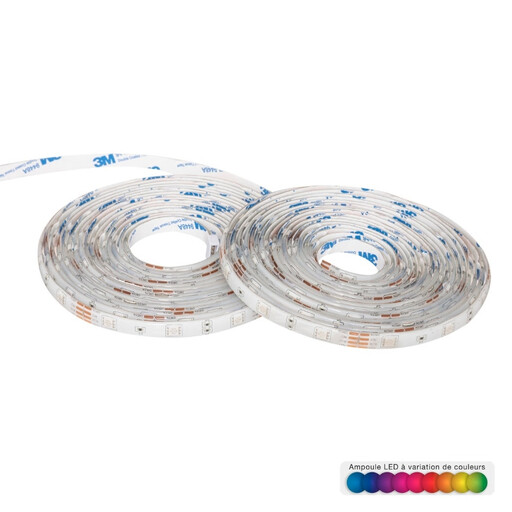
Why we love it: Perfect for those who want a simple and effective solution to adorn a large room, a bookshelf, or a walk-in wardrobe. No app, no fuss: just plug it in and it works.
It sidesteps the issue of complex controls by relying on a simple yet effective infrared remote for essential needs. Its generous 10 m length (2x5 m) gives it an excellent price-to-length ratio.
Generous 10-metre length to cover large areas. Mains powered for a permanent installation without worrying about a battery or USB port.
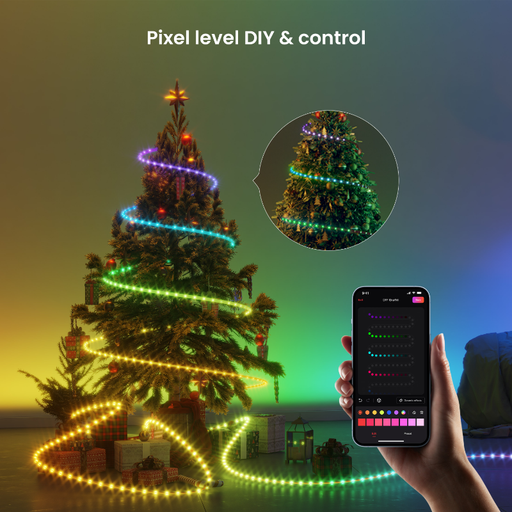
Why we love it: Tailored for gaming setups and desks, this strip offers advanced control via a reputable app and RGBIC technology. The result: dynamic lighting effects that can sync with games or music.
It solves the problem of limited controls with its RGBIC technology and comprehensive app. Its build quality ensures more uniform light and an adhesive that lasts.
RGBIC technology for smooth, multicolour gradients. App-based control and compatibility with gaming ecosystems.
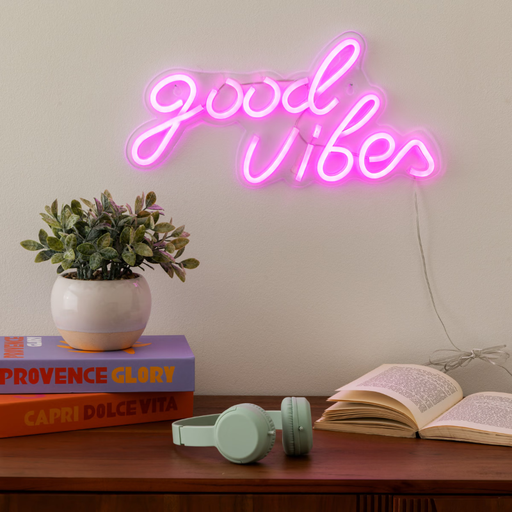
Why we love it: For those looking for a high-impact decorative piece without the installation hassles of a strip. This **wall-mounted LED neon sign** is perfect for an entryway, a teen's room, or a living room, where it will add a warm, pop-art touch.
This is a plug-and-play product that bypasses the problems of installation, adhesive, or cutting. Its USB power and integrated battery make it incredibly easy to place anywhere.
Ready-to-use decorative object.Rechargeable via USB for 100% wireless placement. Trendy design and a positive message.
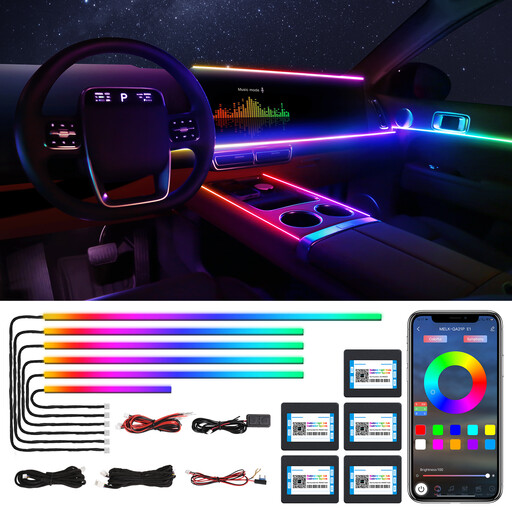
Why we love it: A complete **interior car LED kit**, specifically designed for the cabin. It includes light guides (fibre optics) for a clean finish and is controlled via a Bluetooth app.
This kit is designed for a 12V power supply and for integration into the gaps of the dashboard and door panels. No more worries about compatibility or adhesive issues from strips designed for home use.
Complete kit with multiple controllers for a synchronised installation. Dreamcolor technology and app control with music sync.
We have put together a complete and up-to-date selection of products that meet our selection criteria and current safety standards.
The average lifespan of a good quality LED strip is between 30,000 and 50,000 hours of use. This longevity depends on several factors: the quality of the components, heat dissipation (a strip that overheats will wear out faster), and the frequency of use.
Yes, most LED strips are cuttable. They have cutting marks (often a scissors icon) at regular intervals, usually every 5 or 10 cm. It is crucial to cut only at these specific points to avoid damaging the circuit. The offcuts can sometimes be reused with specific connectors.
No, LED technology is known for its very low energy consumption. For equivalent brightness, an LED strip consumes infinitely less than an incandescent or halogen bulb. The exact consumption depends on the length, the density of the LEDs, and the chosen brightness level, but it remains very modest and will have only a minimal impact on your electricity bill.