
Livraison le jour même ou le lendemain

Qualité garantie

Débloquez vos offres de bienvenue: Livraison GRATUITE | Jusqu'à -80 % | 30 jours d'essai gratuits à JoyPlus
Téléchargez l'application
LED strips have become the go-to solution for personalising your home's interior. Whether you're creating an immersive gaming room setup, a soft ambient light in the living room, or practical under-cabinet lighting in the kitchen, their versatility is compelling. But the market is saturated with options, and it's easy to fall into common traps that turn a promising purchase into a disappointment. Before you commit, let's review the mistakes to avoid to make a truly informed choice.
Adhesive that doesn't deliver: This is the number one problem, by far. An LED strip with poor-quality adhesive will peel off in a matter of weeks, or even days, especially on slightly textured surfaces or when exposed to the heat generated by the LEDs. The result: an LED strip that dangles pitifully, ruining the entire desired visual effect.
The unsightly "hotspot" effect: A low LED density (the number of chips per metre) creates discontinuous lighting, looking more like cheap Christmas lights than a seamless halo of light. Product descriptions often omit this crucial information, leaving the buyer with a multicolour LED string with a disappointing finish.
The false promise of "smart" LEDs: An LED strip marketed as "smart" can quickly turn into a nightmare. Unstable mobile apps, limited compatibility with voice assistants, and music sync that only picks up every other beat—the hidden flaws are numerous. Connectivity should be a genuine feature, not a faulty gimmick.
To avoid making a mistake, it's best to focus on a few objective technical specifications. These are what truly determine a product's quality and its suitability for your project.
Density, expressed as the number of LEDs per metre, is a fundamental criterion.
The chip type also matters. SMD 5050 chips, which are larger and brighter, can produce a true white and vibrant colours. This is the standard to look for in a quality RGB LED strip.
Your needs will determine the most suitable type of control:
Instead of a random laundry list, we've selected products tailored to specific user profiles to help you find the ideal solution for your project.
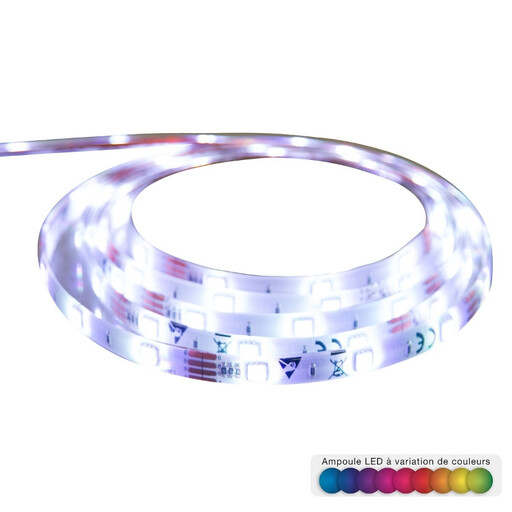
Why we chose it: Ideal for a first ambient lighting project. Its 3-metre length is perfect for accenting a headboard, desk, or small TV stand. No complex app is needed; the included remote gets straight to the point.
This model avoids the "false connectivity" trap. It relies entirely on a dependable infrared remote and a stable mains power supply, ensuring flawless operation, far from the frustration of a buggy app.
Simplicity and efficiency: With 90 LEDs over 3 metres (a density of 30 LEDs/m), it provides great accent lighting. Ready to use in minutes.
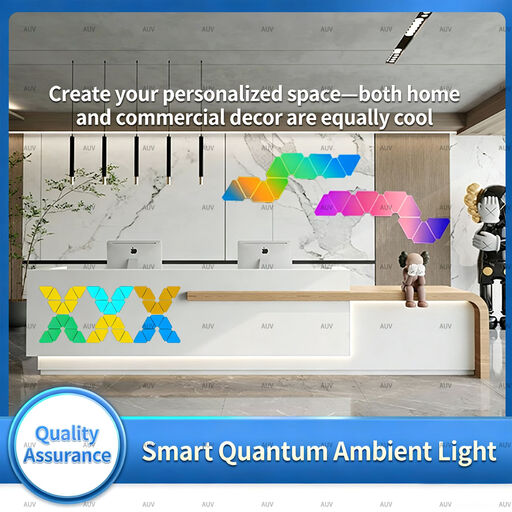
Why we chose it: To create a gaming room decor worthy of the name, this wall-mounted LED panel kit is a much more creative option than a simple strip. Its modular nature allows you to design unique patterns on your wall. It's no longer just lighting, but a decorative feature in its own right.
Here, the advanced features aren't a gimmick. The music sync and app control are central to the product, ensuring the performance and reliability needed for a truly immersive gaming lighting experience.
Customisation and immersion: The freedom to create your own shapes and the music sync feature transform any room into a dynamic gaming arena.
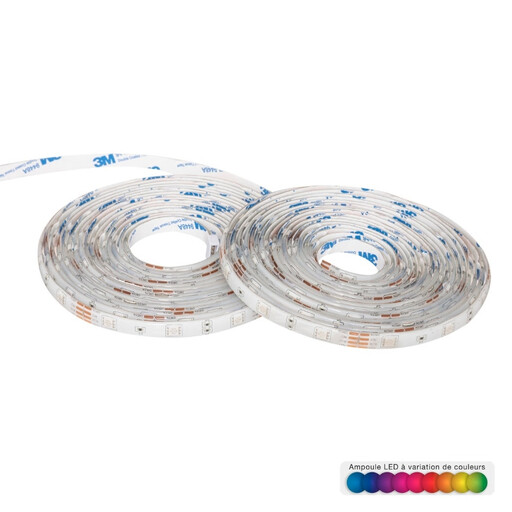
Why we chose it: To outfit a large room, a long hallway, or the underside of a bar, you need to think big. This 10-metre kit (composed of two 5m strips that connect) offers a complete and powerful solution for covering large areas in a single, continuous run.
It avoids the "hotspot" trap over a long distance. With 300 LEDs spread over 10 metres, it ensures a much denser and more uniform light diffusion than many competitors at this length, thus preventing a sparse and cheap-looking result.
Maximum coverage: The total length of 10 metres and the 24W mains power supply make it a robust solution for ambitious lighting projects that demand consistent brightness along the entire line.
Discover our complete and up-to-date selection of products that meet our quality criteria and current safety standards.
The lifespan of an LED strip depends heavily on the quality of its components. Generally, you can expect between 15,000 and 50,000 hours of operation. Moderate use and good heat dissipation (avoid enclosing it in a non-ventilated housing) are key to extending its longevity.
Yes, most LED strips are cuttable. They have cutting marks (often a small scissor icon) at regular intervals. It is crucial to cut only on these marks to avoid damaging the circuit. The leftover piece can sometimes be reused with specific connectors, which are usually sold separately.
No, LED technology is renowned for its excellent energy efficiency. A 5-metre strip typically consumes between 12 and 24 watts, which is far less than a traditional incandescent bulb. This makes it a very cost-effective lighting solution, even with daily use.