
Livraison le jour même ou le lendemain

Qualité garantie

Débloquez vos offres de bienvenue: Livraison GRATUITE | Jusqu'à -80 % | 30 jours d'essai gratuits à JoyPlus
Téléchargez l'application
A dark cupboard, a poorly lit worktop, or a hallway with a hard-to-reach switch can quickly become a daily annoyance. An LED motion sensor cupboard light solves the problem without running cables or getting the drill out. Wireless, USB-rechargeable models that attach with magnets or adhesive can be installed in minutes.
However, not all models are created equal depending on your use. Too-short battery life, a poorly placed sensor, or insufficient length can turn a good idea into a disappointing purchase. Here are the points to check before choosing an under-cabinet LED light or a wireless LED strip.
An LED light equipped with a PIR sensor typically detects heat variations caused by movement within its field of view. It therefore won't necessarily react to a door opening in the way a dedicated magnetic device would.
For a cupboard, check the stated detection distance as well as the sensor's position. Models with a range of 3 to 5 metres can work for a wardrobe or a hallway, but the actual range depends on the detection angle, any obstacles, and the room's layout.
A large number of diodes doesn't guarantee even lighting. The length of the strip, the light output measured in lumens, and the quality of the diffusion all play a part. A very short light risks leaving shadowy areas in a wide cabinet.
For a drawer or a small shelf, 20 cm may be enough. In a kitchen cabinet or a wardrobe, a length of 30 to 60 cm will generally distribute the light better.
A USB-rechargeable cupboard light needs to stay easily accessible for charging. A permanent adhesive fix can be convenient, but it sometimes makes removing the product a hassle. A magnetic LED strip can usually be detached more easily, provided it comes with a metal plate or suitable base.
Before installation, clean and thoroughly dry the surface. An adhesive will hold much less well on a dusty, greasy, damp, or uneven surface.
Measure the available space before ordering. The stated dimensions should cover the area you want to light without obstructing a door closing or interfering with your storage organisation.
Light output is expressed in lumens (lm). As a guide, a bar rated at 190 lm is suitable for task lighting covering a relatively large area. For a small drawer or mainly decorative lighting, a lower output can be perfectly adequate.
A cabinet light offering three colour temperatures gives you more flexibility depending on the room and time of day:
Colour temperature doesn't measure power, but the shade of the light. For preparing food or distinguishing clothing colours, a natural or cool light will often be more practical.
A USB-rechargeable cupboard light should state its battery capacity, the type of port used, and the charging voltage. The models featured here recharge via USB and have capacities of 450, 800 or 1,100 mAh depending on the model.
Battery life varies depending on how often the light is triggered, the brightness selected, and the automatic shut-off delay. A bar installed in a busy hallway will need recharging more often than a light that only comes on for a few seconds a day in a drawer.
For indoor use, also remember to check the protection rating. The KYF model is rated IP20, which means it's intended for a dry indoor environment. It should therefore not be installed near a sink, a shower, or in an area exposed to water splashes.

Why this choice suits this profile: This pack of two 20 cm lights lets you equip yourself at a low price to automatically light a drawer, a small cabinet, or two separate areas.
Its dimensions of 200 × 38 × 10 mm make it easy to install in a narrow space, without cluttering the cabinet with a bar that's too long.
PIR sensor, stated 800 mAh battery, USB charging and three colour temperatures.
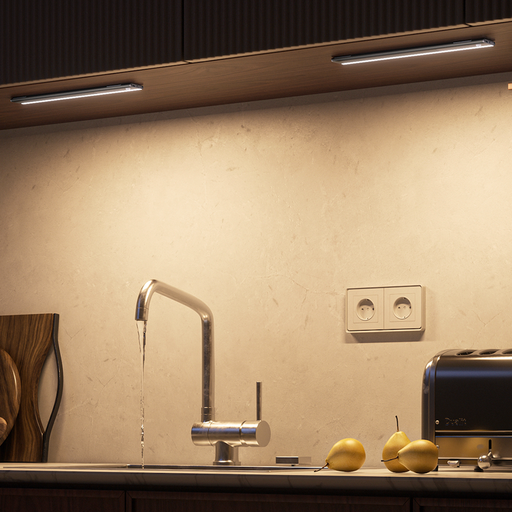
Why this choice suits this profile: This 30 cm format fits easily into a kitchen, dressing room, or several cabinets where discretion and visual consistency matter as much as the lighting itself.
The pack of two lets you equip similar areas with the same format, without mixing visually different lights.
Ultra-thin 30 cm format and design suited to cabinet lighting.
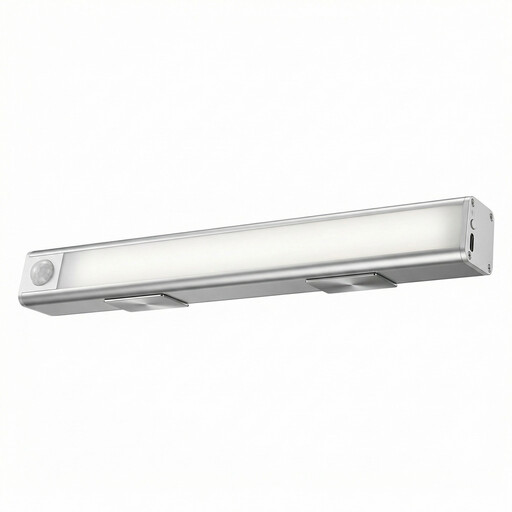
Why this choice suits this profile: At 60 cm, this bar is suitable for a long shelf, a worktop, or an indoor hallway that requires wider light coverage.
The spec states 190 lm, detection up to 3 m, and automatic shut-off after approximately 30 seconds without movement.
114 LEDs, USB-C charging stated in under 1.5 hours, magnetic fixing and three colour temperature modes.
Why this choice suits this profile: The two 40 cm bars can light the underside of wall units, a kitchen, or wider shelves without requiring any drilling.
At 400 mm, this bar limits shadowy areas compared to a small light placed under a wide cabinet.
61 LEDs, stated 1,100 mAh battery, PIR sensor with a range of 3 to 5 m, and adhesive fixing without drilling.
We've put together a complete selection, updated in real time, of products that meet these criteria and European safety requirements.
Avoid water, abrasive products, and very damp environments, unless the spec sheet indicates a suitable protection rating. Do not dismantle the light and stop using it if the battery swells or the casing is damaged.
For a small drawer, a 20 cm light may be enough. A standard wardrobe or kitchen cabinet will more likely need 30 to 40 cm. For a long shelf or worktop, a 60 cm bar will distribute the light better.
The interval between charges depends on the battery capacity, the brightness selected, and the number of detections. Occasional use in a cupboard consumes less energy than frequent passes in a hallway. Check the product spec and recharge the light as soon as its brightness starts to drop.
Its consumption is generally low, as it runs on battery and switches off automatically after a period without movement. The cost mainly depends on how often you recharge it and your electricity tariff. A short shut-off delay helps avoid prolonged and unnecessary illumination.