
Livraison le jour même ou le lendemain

Qualité garantie

Débloquez vos offres de bienvenue: Livraison GRATUITE | Jusqu'à -80 % | 30 jours d'essai gratuits à JoyPlus
Téléchargez l'application
By the Joybuy Editorial Team
Driving at night with old halogen headlights can quickly turn a familiar drive into an ordeal. Diminished visibility, a yellowish halo, and bulbs that constantly need replacing are frustrations all too common for many drivers. Upgrading to LEDs is no longer a luxury, but a significant improvement in safety, performance, and even style for your vehicle.
This guide is here to help you navigate the complex world of LED car kits. We'll break down the essential technical criteria and present our selection of the best products on the market, helping you make the right choice every time.
Before taking the plunge, a few key points should be checked to ensure optimal compatibility and performance.
The first step is to check the base type of your original bulbs. References like H7, H4, H11, or D1S are not interchangeable, as each corresponds to a specific connector. You can find this information in your vehicle's manual or by simply examining the bulb you need to replace.
A word of caution for modern cars (generally those made after 2005): they incorporate a multiplex system (CAN bus) that monitors the proper functioning of electrical components. Since an LED bulb consumes far less power than a halogen one, the onboard computer might register it as a faulty bulb and display an error message. To avoid this headache, opt for an error-free LED headlight, often called a CAN bus-ready LED bulb. These models include a built-in resistor or a dedicated circuit to trick the onboard computer.
Luminous output, measured in lumens (lm), is the primary performance indicator. The higher the number, the more powerful the light. But raw power isn't everything. A good bulb must, above all, produce a sharp, precise beam that effectively illuminates the road without ever dazzling other drivers.
Colour temperature, measured in kelvins (K), defines the hue of the light:
A 6000K LED bulb produces a very white light, close to natural daylight, which significantly improves the perception of contrasts and details. It is now the gold standard for LED low beams.
The key advantage of LEDs is their longevity. While a halogen bulb barely lasts 1,000 hours, a good LED kit can achieve a theoretical lifespan of 30,000 to 50,000 hours.
But this longevity is only possible with an excellent cooling system. Heat is the number one enemy of LED chips. A quality kit is recognisable by its thermal dissipation system: an aerospace-grade aluminum body, cooling fins, or even an integrated fan for the most powerful models. Optimal cooling guarantees consistent brightness and maximum lifespan.
Here is a selection of models that stand out for their performance and design, catering to different needs and vehicles.

Why It Stands Out This kit is a premium solution for replacing original D1S-type Xenon bulbs. It delivers impressive light output with a 360-degree beam, designed to mimic the original light pattern while dramatically increasing range. Its integrated CAN bus system ensures compatibility with the vast majority of vehicles equipped with this type of headlight.
Key Features
Who Is It For?? For drivers of vehicles with original D1S Xenon headlights who want to upgrade to LED technology for more powerful lighting, a more modern colour (6000K), and a hassle-free installation.
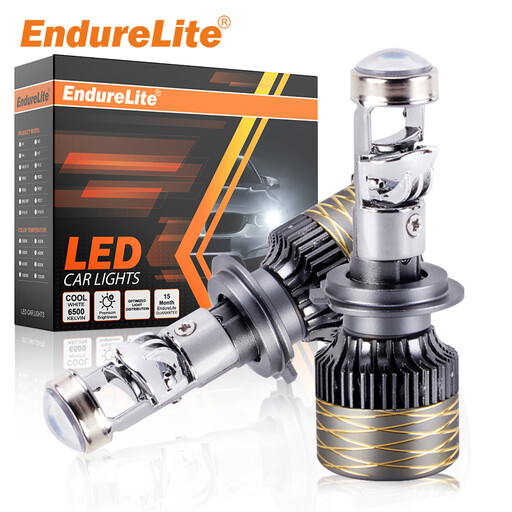
Why It Stands Out Versatility is the key feature of this ENdureLite kit, available in the most common base types (H7, H4, H11, etc.). It focuses on a precise beam and instant-on capability to ensure safety for everyone. The manufacturer claims a brightness 300% greater than original bulbs, thanks to latest-generation CSP chips.
Key Features
Who Is It For?? For the driver who wants to modernise their halogen headlights (H7, H4...) with a reliable, high-performance, and easy-to-install solution that offers an excellent balance between brightness and safety.

Why It Stands Out Similar to the first model, this version from Bullvision is distinguished by its "1:1 size" design, which is identical to the original bulb. This is a crucial detail for ensuring a perfectly aligned beam pattern within the headlight housing, with no dark spots or glare.
Key Features
Who Is It For?? For owners of vehicles with D1S/R headlights who want a "zero-modification" installation and a beam pattern faithful to the original, but with the power and white light of LEDs.
Our selection is an excellent starting point, but the automotive lighting market is full of hidden gems. If your vehicle requires a different bulb base or if you want to compare other models, numerous solutions are available.
? Explore our full range of lighting accessories to find the model that perfectly matches your needs and budget.
This can be a complex issue. In many regions, replacement bulbs for on-road use must meet specific certification standards (like ECE or DOT). However, many aftermarket "retrofit" LED kits may not have this vehicle-specific approval. It is crucial to check your local laws and, regardless, ensure the installation is done perfectly to avoid dazzling other drivers.
If your car was made after 2005, there's a high probability it uses a CAN bus system. In that case, a CAN bus-ready LED bulb is almost essential to avoid dashboard error messages or flickering headlights. For older vehicles, a standard LED kit is usually sufficient.
Good news: the installation is often DIY-friendly and doesn't require complex tools. The steps are generally as follows: