
Livraison le jour même ou le lendemain

Qualité garantie

Débloquez vos offres de bienvenue: Livraison GRATUITE | Jusqu'à -80 % | 30 jours d'essai gratuits à JoyPlus
Téléchargez l'application
By the Joybuy team, your product experts.
Driving at night or in poor weather with old halogen headlights can turn even the shortest drive into an ordeal. Beyond the discomfort, reduced visibility is a real danger. That's why more and more drivers are switching to LED headlight bulbs: an effective way to modernise their vehicle and, most importantly, to see and be seen better.
But with an overwhelming number of options on the market, it's hard to know where to start. This guide is here to help you decode the technical specs and choose the perfect LED kit for your car.
Before you make a purchase, there are a few essential points to check to ensure you make the right choice.
The essential starting point: your original bulb's base type. Each vehicle uses specific standards. The most common are H1, H4, and H7 bases, or for newer systems, D1S, D2S, etc. An H1 LED bulb will never fit into a headlight designed for an H7 bulb.
To find out your car's bulb base type:
This step is crucial to ensure a "plug-and-play" installation without any modifications.
To judge the performance of an LED headlight, there are two key values to consider:
LEDs generate a lot of heat, which must be dissipated effectively to preserve their lifespan and performance. There are two main systems:
The choice will therefore depend on the space available in your headlight housing and your priorities: absolute silence or maximum power.
To help you upgrade from halogens or xenons to LEDs, here are three models that caught our eye.
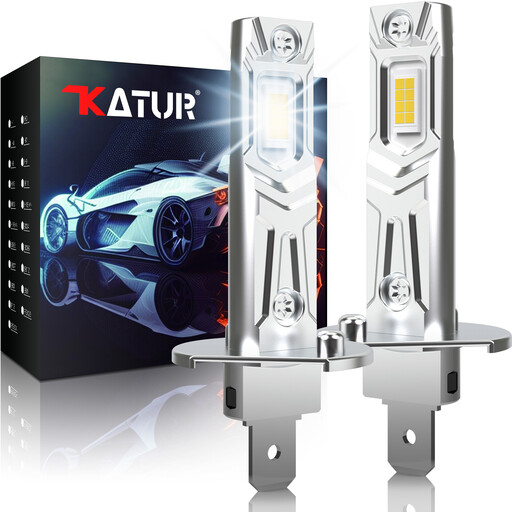
Why it stands out This model focuses on simplicity and reliability. Its fanless design eliminates any risk of mechanical failure and ensures completely silent operation. With dimensions modelled after a halogen H1 bulb, installation is instant and requires no adjustments, even in the tightest headlight housings. The 6000 K white light offers a dramatic improvement in visibility.
Pros
Who is it for? For drivers looking to replace their H1 halogens with a simple, reliable, and silent solution, without worrying about fitment issues.
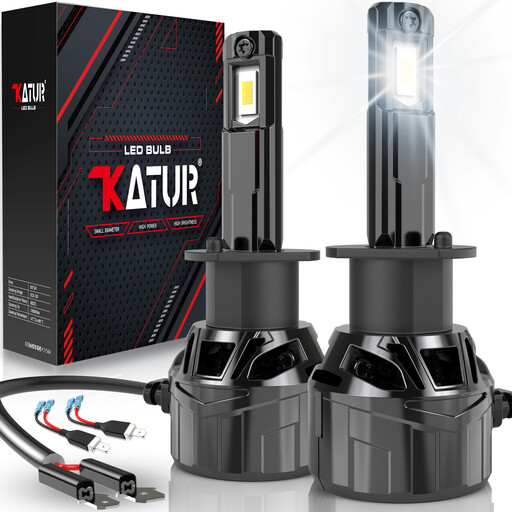
Why it stands out This kit is for those who are primarily looking for maximum light output. With an advertised 120W and 30,000 lumens for the pair, the visibility boost is radical. To manage this power, it incorporates an active cooling system with a 16,000 RPM turbo fan, ensuring rapid heat dissipation and an extended lifespan.
Pros
Who is it for? For drivers who often travel on poorly lit roads and want maximum light output to anticipate hazards from far away.
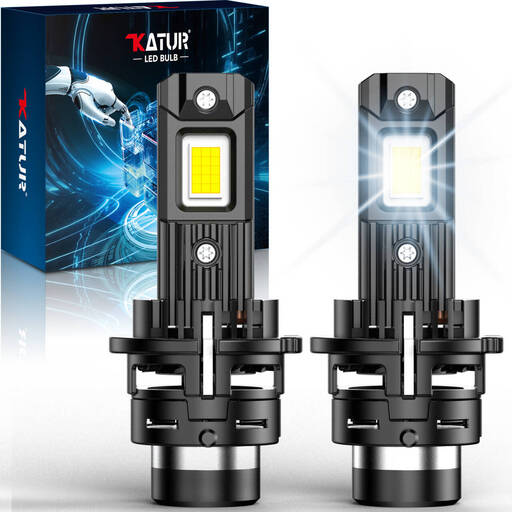
Why it stands out Specifically designed to replace xenon bulbs, this D2S LED bulb fits directly in place of original HID bulbs. Its main advantage is its instant-on capability (0.01s), which eliminates the warm-up time characteristic of xenon bulbs. The 6500 K white light modernises the lighting while offering extended visibility. Cooling is handled by an aluminium body, copper tubes, and a quiet fan.
Pros
Who is it for? For owners of vehicles with factory-installed xenon (HID) headlights who want the benefits of LED technology (instant-on, whiter light) without having to change the entire headlight assembly.
If your vehicle is equipped with another standard, like D1S, it's crucial to choose a compatible model. To find a suitable model, feel free to check out our dedicated selection.
? Discover our range of D1S headlight bulbs
Regulations are very strict on this point. In theory, any modification to a type-approved lighting device requires the vehicle to be re-certified. However, more and more high-quality aftermarket LED kits are being designed to respect the original beam pattern and avoid causing glare. It is recommended to choose products that guarantee a sharp beam pattern and to always have your headlights professionally aligned after installation. It's always wise to check the latest local regulations before making any modifications.
High light output (measured in lumens) is not necessarily synonymous with glare. The key factor is the design of the bulb itself and how it distributes light. A quality LED headlight bulb must perfectly mimic the position and size of a halogen bulb's filament. This is the only way for the headlight housing (reflector or projector) to form a precise beam pattern with the famous sharp cut-off line that prevents blinding others. Poorly aligned LED chips or improper installation will project light too high, guaranteed to cause glare.
On many modern vehicles, the on-board computer (OBC) monitors the status of the bulbs. Since LEDs consume far less power than halogens, the OBC might think a bulb is burnt out and display a dashboard error message. The CAN bus decoder (sometimes called an "anti-error canceller") is a small module that is installed in-line to "trick" the computer by simulating the power consumption of a standard bulb. The good news is that many recent LED kits, like the ones in our selection, integrate it directly, which greatly simplifies installation.