
Livraison le jour même ou le lendemain

Qualité garantie

Débloquez vos offres de bienvenue: Livraison GRATUITE | Jusqu'à -80 % | 30 jours d'essai gratuits à JoyPlus
Téléchargez l'application
Upgrading your car to LED lighting is an excellent way to boost visibility and safety. The problem? The market is flooded with options and confusing marketing promises. Our mission is to help you cut through the noise. Let's break down the pitfalls to avoid and the essential criteria for a successful purchase.
Too many drivers regret their purchase due to often-overlooked technical details. Here are the most common mistakes that turn a great idea into a bad experience.
Manufacturers love to advertise astronomical lumen figures. While a high-power LED bulb for cars looks impressive on paper, excessive and poorly directed brightness is completely counterproductive. A poorly focused beam glares at other drivers and creates dark spots, which paradoxically reduces your own visibility. Beam quality is far more important than raw light output.
On most modern vehicles (generally those made after 2005), the on-board computer (OBC) monitors the lighting system. Since LEDs consume far less power than halogens, the computer may think a bulb is burnt out and display an error message. Choosing an error-free Canbus bulb is therefore essential to avoid this issue and ensure stable, flicker-free operation.
The classic rookie mistake: ordering an LED kit with a bulb that's too bulky to fit inside the headlight housing or prevents the dust cover from closing. Furthermore, an LED's lifespan depends entirely on its ability to dissipate heat. A poor cooling system (a low-quality fan or an undersized heat sink) will drastically shorten the bulb's life, meaning it will never reach the 50,000 hours promised on the box.
To make the right choice, focus on these three technical points. They are your guarantee of compatibility, performance, and reliability for your new lighting.
This is fundamental. The base of your new bulb must be identical to your headlight's original one. The two most common types are:
To find out which base type you need, consult your vehicle's owner's manual or, even simpler, examine the original bulb.
Color temperature, measured in Kelvin (K), defines the hue of the light. Standard halogen bulbs emit a yellowish light (around 3200K). For a modern look and visibility that mimics daylight, opt for a 6000K cool white LED. This pure white hue enhances contrast and improves the perception of details on the road at night.
A "1:1" design ensures the LED bulb has the exact same dimensions as the original halogen. This is a major advantage for a simple, "plug-and-play" installation with no modifications to the headlight. Also, verify that the bulb includes a quality cooling system, whether active (integrated fan) or passive (aluminum heat sink), as this is what guarantees its longevity.
Here is our selection of models that check all the boxes for performance and reliability, tailored for different types of users.
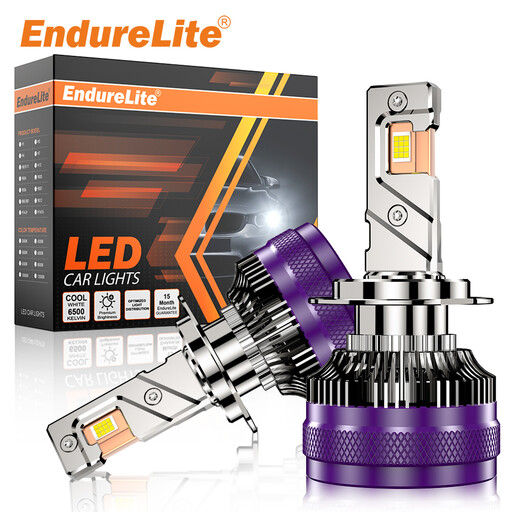
Editor's Pick: Perfect for those who want to switch to LEDs without the hassle. The installation is direct, with no modifications needed, making it the ideal solution for a first-time upgrade.
Its 1:1 design eliminates any risk of physical incompatibility. Its integrated Canbus Ready system prevents dashboard errors on most vehicles.
Its "Plug and Play" installation is a breeze. The integrated cooling fan ensures efficient heat dissipation for maximum lifespan.
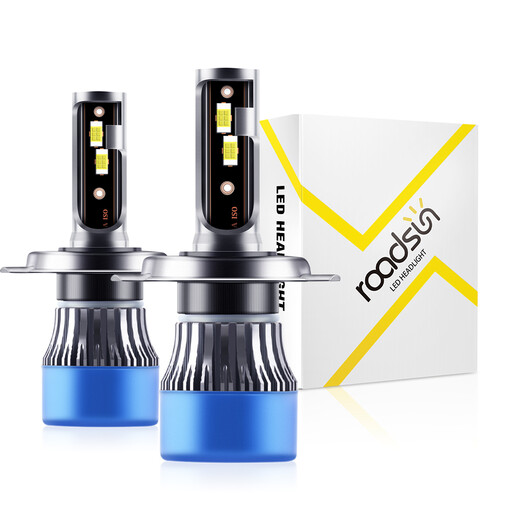
Editor's Pick: The all-in-one solution for vehicles with H4 housings, which manage low and high beams with a single bulb. A complete and simplified upgrade.
Its dual-beam function is perfectly calibrated for H4 housings, ensuring a sharp beam cutoff to avoid glaring at others. The discreet, integrated fan handles cooling.
Its wide compatibility (H4/9003/HB2) and intelligent decoding system, advertised as compatible with 98% of vehicles, minimize the risk of OBC errors.
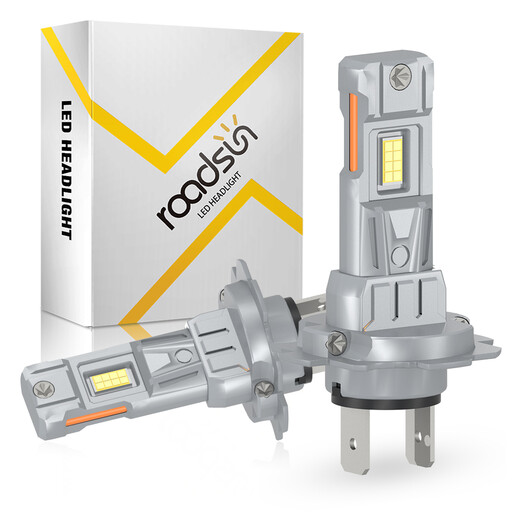
Editor's Pick: For those who make no compromises on visibility. This model focuses on maximum light intensity without sacrificing installation simplicity or compatibility.
Its ultra-compact "Real 1:1 Mini Size" design ensures near-universal physical compatibility. The installation requires no external adapter, eliminating complications and potential points of failure.
It boasts a spectacular brightness increase compared to halogen. Yet, the beam pattern remains precisely cut to prevent glare, combining power with safety.
Explore our full selection of products that meet our selection criteria and safety standards.
Regulations regarding aftermarket LED bulbs are strict in many regions. For an LED replacement bulb to be street legal, it often needs to meet specific standards (like ECE in Europe or DOT/SAE in the US) for your vehicle's specific headlight housing. Warning: Most LED kits sold online are designated for "off-road use only" (on tracks or private property). Before any purchase, it is crucial to check the product's compliance and research the latest regulations in your area.
If your vehicle was manufactured after 2005, it almost certainly has a Canbus monitoring system. In this case, an error-free Canbus bulb is essential to prevent dashboard error messages or flickering headlights. For older vehicles, it is generally not necessary.
Manufacturers often advertise staggering lifespans, typically between 30,000 and 50,000 hours. Of course, this is an estimate under ideal lab conditions. In reality, longevity directly depends on the quality of the cooling system (fan, heat sink), your usage frequency, and driving conditions. A well-designed model with good thermal management will offer a lifespan incomparably longer than a halogen bulb (which rarely exceeds 1,000 hours).