
Livraison le jour même ou le lendemain

Qualité garantie

Débloquez vos offres de bienvenue: Livraison GRATUITE | Jusqu'à -80 % | 30 jours d'essai gratuits à JoyPlus
Téléchargez l'application
Driving at night or in bad weather can quickly become a nightmare when your car's lighting leaves much to be desired. Worn-out or low-quality halogen bulbs mean a reduced field of vision and slower reaction times when faced with the unexpected. Upgrading to LEDs is no longer a luxury; it's an essential upgrade for your safety and driving comfort.
This guide is here to help you choose your next LED headlight bulb kit. We'll break down the technical criteria that really matter and present a selection of products to help you see more clearly, all without the unnecessary marketing jargon.
Before making the switch, there are a few key points to check to ensure the compatibility and performance of your future lighting system.
First, and crucially: the base type. Your vehicle uses a very specific bulb format (H7, H4, H11, or HB4 / 9006 LED bulbs, for example). You can find this information in your car's manual or, even more simply, by looking directly at the original bulb. Choosing the right base type is non-negotiable for a “plug and play” installation without any modifications.
On modern vehicles (generally post-2005), there's another element to watch out for: the error-free CAN bus system. The on-board computer, which constantly monitors the proper functioning of the bulbs, can get confused. Because LEDs consume far less power than halogens, the computer might think a bulb is burnt out and trigger a dashboard warning. An LED kit with an integrated CAN bus prevents this kind of issue in most cases.
The performance of a high-power LED headlight depends on two key indicators:
A powerful LED generates heat, and this heat must be dissipated effectively to ensure its longevity and consistent performance. Two technologies compete:
Rest assured, replacing a halogen bulb with a car LED kit is now an operation within anyone's reach. It's most often a simple “plug and play” process that requires no mechanical skills.
We have selected a few models that stand out for their performance and design, catering to different needs and budgets.
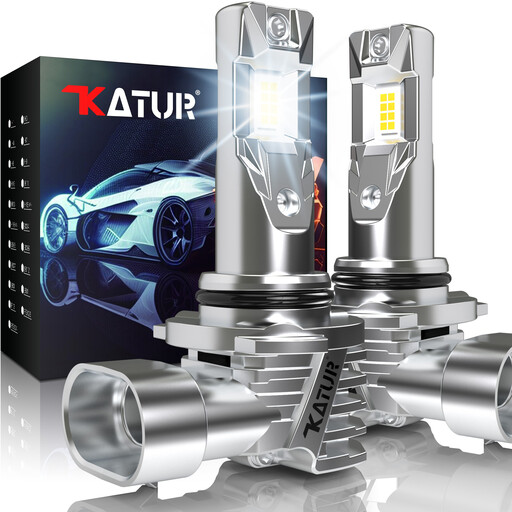
Why it stands out: What's immediately striking is its ultra-compact, fanless design. Its 1:1 “mini” format, identical to a halogen bulb, makes installation a breeze, even in the tightest headlight housings.
Advantages:
Who is it for? For drivers who want a reliable, completely silent, and above all, ultra-simple LED conversion kit for a DIY installation.
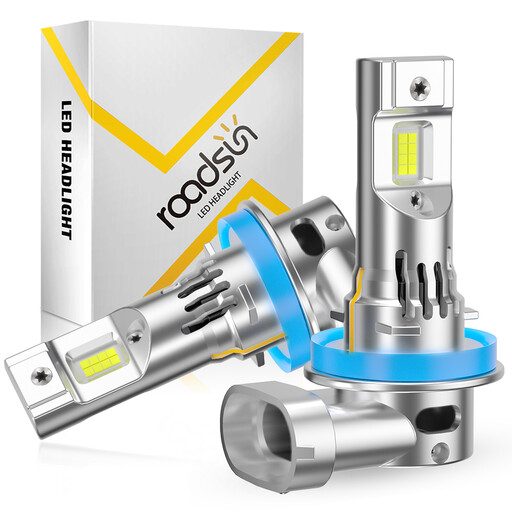
Why it stands out: This kit bets everything on robust cooling, with a fan spinning at 16,000 RPM, and promises 5 times the brightness of halogen. The little extra that DIYers will appreciate: its non-polarity design.
Advantages:
Who is it for? An excellent option for those who want the peace of mind of active cooling and a dead-simple installation, without worrying about connection polarity.
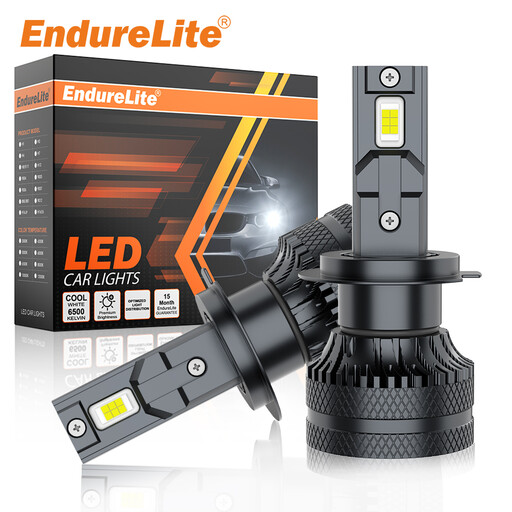
Why it stands out: This model's key advantage is its ultra-focused beam pattern. Its design seeks to replicate the exact position of a halogen bulb's filament. The goal: to project maximum light onto the road, without ever dazzling oncoming traffic.
Advantages:
Who is it for? For owners of vehicles with 9006/HB4 fittings who won't compromise on beam quality and respect for other road users.
Passive cooling bulbs are an excellent alternative. Their key advantage? The complete absence of noise and moving parts, which eliminates any risk of fan-related failure. If simplicity and durability are your number one criteria, these models are made for you.
? Discover our selection of fanless LED bulbs
No, the vast majority of LED conversion kits are designed to be “plug and play.” You just remove the old bulb and plug the new one in its place. The operation rarely takes more than a few minutes and requires no special tools. However, it's a good idea to check your vehicle's manual to learn how to access the headlights.
The CAN bus is, in a way, your car's electronic brain. Since LEDs are far less power-hungry, the system might interpret this as a fault (a burnt-out bulb) and display a warning. If your car was made after 2005, choosing a car LED kit that includes an error-free CAN bus decoder is almost essential for peace of mind.
Yes, the use of white light bulbs is perfectly legal in France. What the law prohibits is glare. It is therefore imperative that your new bulbs are installed correctly and the light beam is properly adjusted to illuminate the road, not oncoming drivers. Choosing a quality bulb whose design respects the original beam pattern is the key to a successful and 100% legal installation.