
Livraison le jour même ou le lendemain

Qualité garantie

Débloquez vos offres de bienvenue: Livraison GRATUITE | Jusqu'à -80 % | 30 jours d'essai gratuits à JoyPlus
Téléchargez l'application
Still driving at night with old, yellowish halogen headlights? You're not alone. Many drivers complain about poor visibility, washed-out colours, and a disappointing beam range. It's a combination that seriously undermines confidence and safety at the wheel. Upgrading to an LED headlight bulb is the ideal solution to modernise your vehicle, boosting both performance and style.
This guide is here to help you see things more clearly. We'll review the essential technical criteria and present our selection of the best products for replacing a halogen bulb with an LED without making any mistakes.
Before taking the plunge, a few technical checks are necessary to ensure compatibility and performance.
The number one criterion is the base type of your original bulb. The most common are the H7 LED bulb (often for low beams) and the H4 LED bulb (which combines low and high beams in a single bulb). To find out which you have, check your vehicle's manual or simply remove the existing bulb to identify the model (H1, H11, 9005, etc.).
On recent vehicles (generally post-2005), the onboard computer (OBC) can cause issues. By detecting lower power consumption, it may display an error message. The solution? A Canbus LED bulb (Controller Area Network). It integrates a resistor that simulates the power draw of a halogen, thereby tricking the onboard electronics. No more unwanted alerts!
The output of a powerful car LED is expressed in lumens (lm). A higher lumen count means more light is emitted. But be warned, raw power isn't everything! A precise, well-defined beam pattern is crucial for effectively illuminating the road without dazzling other drivers.
Colour temperature, measured in Kelvin (K), defines the hue of the light. While halogens top out at 3200K (a warm white with a yellowish tint), a 6000K LED emits a pure white light, very close to daylight. The result: contrasts and colours on the road are rendered much better. This is the preferred choice for LED low beams.
Contrary to popular belief, LEDs get hot! This heat, concentrated at their base, must be dissipated to ensure their lifespan. There are two main systems:
The bulb's lifespan, which can reach tens of thousands of hours, is directly linked to the performance of this cooling system.
Here are a few models that stand out for their technical specs and design, catering to different needs.
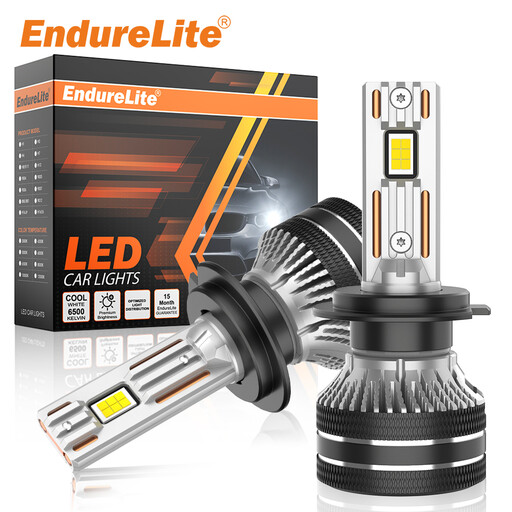
ENdureLite 9012 H7 H4 H11 H1 9005 9006 Headlight Bulbs, 20000 LM
Its key advantage: This bulb was designed for one thing: simplicity. With a size modelled after a standard halogen, it installs in minutes into the original housing without any modifications. Its beam pattern is designed to replicate the original cutoff, ensuring precise lighting that doesn't blind others.
Key points:
Who is it for?: For drivers who want an immediate visibility boost with an easy-to-install car LED kit, without any hassle over compatibility or complicated adjustments.
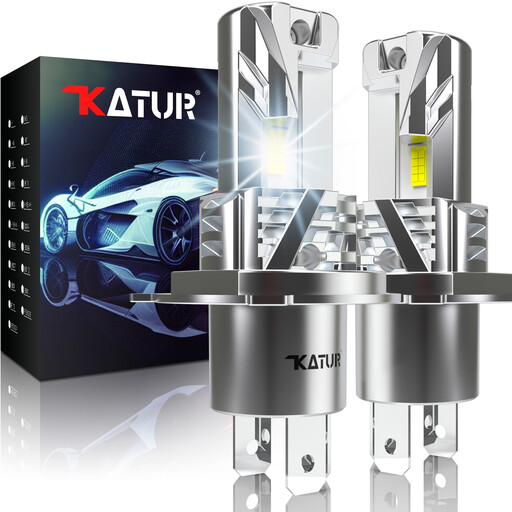
KATUR H4 LED Headlight Bulbs, 26000LM 80W per pair
Its key advantage: This model focuses on compactness and silence with its passive cooling. The absence of a fan guarantees completely silent operation and eliminates any risk of mechanical failure. Its mini size is a real plus for headlight housings where space is tight.
Key points:
Who is it for?: For those whose vehicles lack space behind the headlight, or who are looking for a 100% silent and reliable solution. The perfect choice for a compact and high-performance H4 LED bulb.
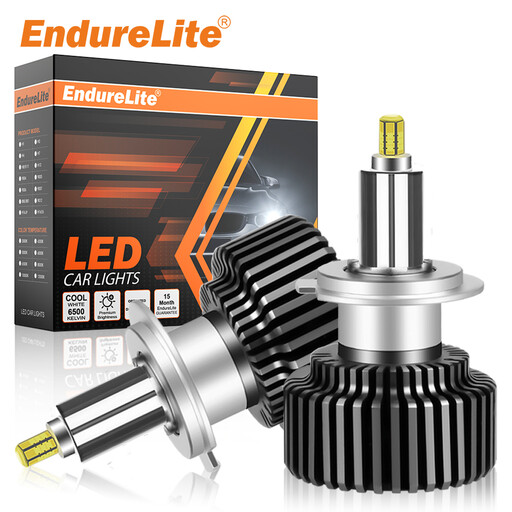
ENdureLite H1 H4 H7 H11 9005 9006 9012 Headlight LED Bulbs, 50000LM
Its key advantage: With an advertised output of 50,000 lumens, this kit is for those who make no compromises on performance. It features CSP (Chip Scale Package) LED chips and a 360-degree design to generate a beam of formidable width and intensity.
Key points:
Who is it for?: For automotive enthusiasts and high-mileage drivers who often travel on unlit country roads. This is the most powerful option on the market for those who want the best without sacrificing installation simplicity.
Cooling is the cornerstone of an LED bulb's performance and longevity. Models with active ventilation (via a fan) are often the highest performing, as they better dissipate heat from the most powerful chips.
If this technology interests you, feel free to browse our full selection. Explore our dedicated category to discover more models.
The issue is complex. In theory, European regulations require any replacement bulb to be type-approved (ECE marking). Installing an aftermarket LED kit in a housing originally designed for a halogen bulb is not always permitted. In practice, many kits are tolerated, but it is crucial to choose a quality model with a well-defined beam pattern to avoid dazzling others. Check the current legislation and your local vehicle inspection requirements before you start.
If your car was manufactured after 2005, the answer is most likely yes. It is probably equipped with a Canbus system that monitors the proper functioning of the bulbs. Using a Canbus LED bulb is therefore almost mandatory to avoid dashboard error messages or an unpleasant strobing effect. For older vehicles, a standard model is usually sufficient.
The majority of current kits are "plug-and-play." Installation often comes down to unplugging the old bulb and clipping the new one in its place. Be aware, however, that accessing the headlights can be a real headache on some car models! A quick look at the vehicle's manual is always a good idea. Also, remember to wear gloves: even a halogen bulb can be scorching hot after just a few seconds of operation.