
Livraison le jour même ou le lendemain

Qualité garantie

Débloquez vos offres de bienvenue: Livraison GRATUITE | Jusqu'à -80 % | 30 jours d'essai gratuits à JoyPlus
Téléchargez l'application
The promise is alluring: a spa-quality facial treatment, but at home. The LED face mask has become the must-have accessory for anyone looking to revive their skin's radiance, combat the signs of ageing, or fade imperfections. But with an overwhelming number of options on the market, it's easy to make the wrong choice and invest in a device that will just end up at the back of a drawer.
As the Head of Product Curation at Joybuy, my mission is to help you see things more clearly. Let's cut through the marketing jargon and focus on what truly makes a difference. Here are the two classic mistakes to avoid when choosing your light therapy device.
To ensure your purchase is a worthwhile investment and not a disappointment, you need to look at a few key technical specifications. These objective parameters are the best way to choose an at-home facial treatment device that is both effective and durable.
The effectiveness of a phototherapy mask doesn't depend on the colour visible to the naked eye, but on the wavelength of the light it emits, measured in nanometres (nm). Each wavelength penetrates the skin at a different depth and interacts with cells in a specific way.
Comfort is not an option. To see results, an LED face mask must be used very regularly.
The number of light-emitting diodes (LEDs) is a good indicator of coverage quality. A mask with over 100 LEDs will offer much more even and intense light distribution than a model with only thirty or so. Ensure the LEDs are spread across the entire mask to treat the forehead, cheeks, nose, and chin uniformly.
Keeping these criteria in mind, one model stands out from the crowd with its comprehensive approach and user-centric design.
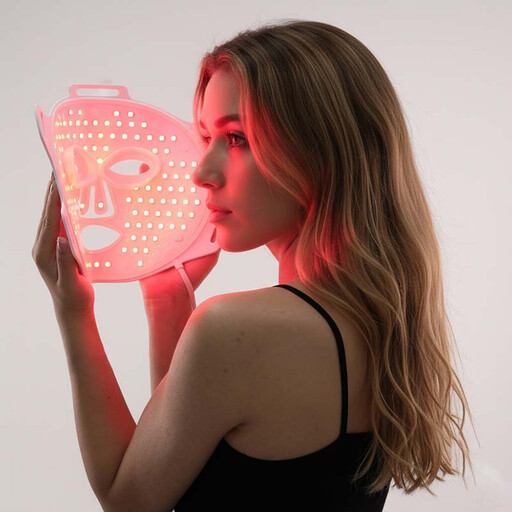
Why it stands out: Perfect for those seeking a complete, comfortable solution worthy of professional treatments. Its flexible silicone design and curated selection of relevant wavelengths make it a long-term investment for a serious beauty routine.
Unlike rigid masks, its medical-grade silicone structure perfectly moulds to the face for even light distribution. It focuses on 4 essential wavelengths, thus avoiding the "rainbow" gadget trap.
Absolute comfort: its flexible silicone encourages regular, hassle-free use. Cutting-edge technology: it incorporates near-infrared light (850 nm) in addition to red, blue, and yellow light for deep-level action.
For every need and budget, we have curated a complete selection of devices that meet our selection criteria and current safety standards.
Most manufacturers recommend 3 to 5 sessions per week, each lasting 10 to 20 minutes. Read your device's user manual carefully, as consistency is key to achieving visible results.
They are safe, provided you follow the instructions. Quality devices are designed for risk-free home use and usually come with eye protection (either built-in or separate). It is recommended to keep your eyes closed during the session and to always use this protection.
Patience is required. As LED light therapy works at a cellular level, the changes are not immediate. For issues like acne, an improvement may be visible within a few weeks. For signs of ageing (skin texture, fine lines), it often takes 1 to 3 months of consistent use to notice a real difference.