
Livraison le jour même ou le lendemain

Qualité garantie

Débloquez vos offres de bienvenue: Livraison GRATUITE | Jusqu'à -80 % | 30 jours d'essai gratuits à JoyPlus
Téléchargez l'application
An LED ceiling light can transform the atmosphere of your home while keeping electricity consumption under control. However, an appealing product description does not guarantee the right choice. Unsuitable wattage, an incompatible dimmer or insufficient ingress protection can quickly turn a bargain into a disappointing purchase.
Here are the key criteria to consider before choosing an LED ceiling light for your living room, bedroom, kitchen, hallway or bathroom.
Watts indicate electricity consumption, but they do not directly measure the amount of light produced. To compare two light fittings, look instead at the luminous flux expressed in lumens (lm).
As a general guide, a small space or hallway may only need a few hundred lumens. A living room or kitchen will generally require more light, depending on its size, the colour of the walls and whether other light sources are present.
An LED dimmable ceiling light is not necessarily compatible with every wall dimmer. Some require a dimmer specifically designed for LED modules, while others can only be controlled with a remote control or app.
Check the dimming method specified in the technical details carefully. For example, the Nordlux Oja 29 states that a compatible wall dimmer is required. Without checking this first, you may experience flickering or uneven dimming.
An ultra-slim LED ceiling light is ideal for low ceilings, but installation may require precise cutting or a particular type of connection. Recessed LED spotlights also require you to measure the cut-out diameter, available depth and whether insulation is present.
Always switch off the power before making any fixed 230 V connection. If the installation is beyond your capabilities, it is best to call a qualified electrician.
Wattage, expressed in watts, gives an indication of energy consumption. Luminous flux, expressed in lumens, helps you assess the amount of light produced. Colour temperature is measured in kelvins:
An LED ceiling light with adjustable colour temperature allows you to adapt the lighting effect to the time of day. Some models also offer smart lighting that can be controlled remotely.
The IP rating indicates how well the light fitting is protected against solid objects and water. An IP44 LED ceiling light withstands water splashes, while an IP65 model provides enhanced protection against water jets.
In a bathroom, the required IP rating depends on the installation zone. IP44 or IP65 does not mean that the light fitting can be installed anywhere. You must comply with the room’s electrical zones, French regulations and the manufacturer’s instructions.
For a bathroom, check in particular:
Measure the available diameter, the height of the light fitting and the space required for the connections. For a recessed product, check the cut-out diameter precisely. For example, some spotlights require an opening of 68 to 78 mm, while others need 75 to 85 mm.
A surface-mounted or directly fixed model often avoids the need to modify the ceiling. Conversely, a recessed LED spotlight provides a more discreet finish but requires more careful preparation.
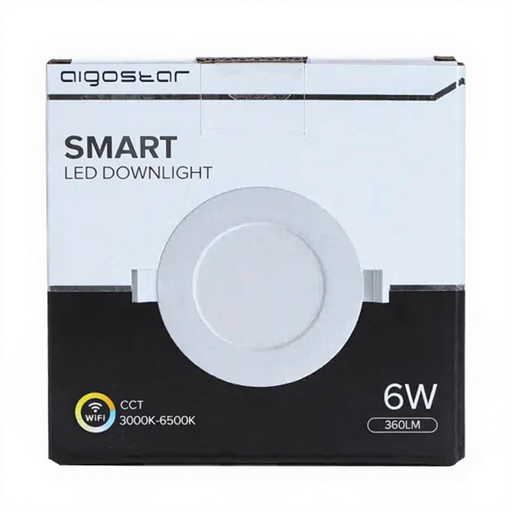
Why this choice suits this profile : With its 115 mm format and 360 lm luminous flux, it is suitable for small spaces. Its Wi-Fi connection lets you adjust the lighting without adding a dedicated remote control.
The product details clearly state the luminous flux, colour temperature range and cut-out diameter, which is between 100 and 110 mm.
6 W, 360 lm, adjustable temperature from 3 000 to 6 500 K, 110° beam angle and Wi-Fi control.
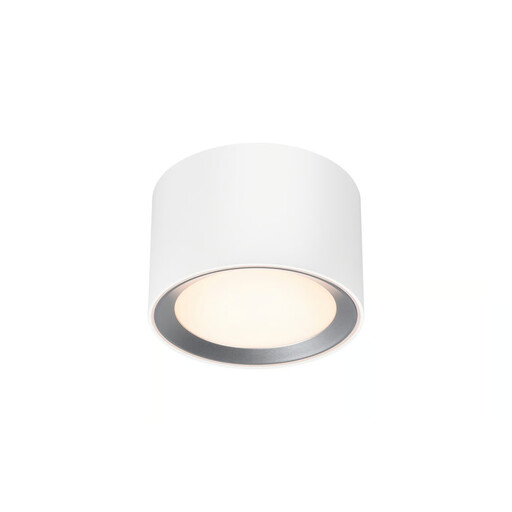
Why this choice suits this profile : This compact smart ceiling light combines app control, brightness adjustment and two adjustable light rings.
The control functions are clearly detailed : on/off, dimming, colour temperature adjustment and saving settings via the Nordlux Smart app.
8 W, 700 lm, from 2 700 to 6 500 K, IP44, Class II, tool-free connection and a stated LED lifespan of 25,000 hours.
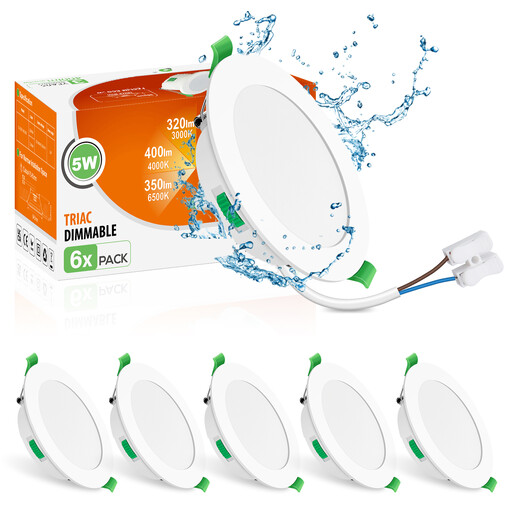
Why this choice suits this profile : This six-spotlight pack is suitable for installations requiring several light sources, particularly in a bathroom or an area exposed to moisture.
The IP65 rating, 30 mm depth and 75 to 85 mm cut-out are specified, making it easier to check suitability before installation.
5 W, 400 lm per spotlight, choice of 3 000, 4 000 or 6 500 K, dimming from 10 to 100% with compatible equipment and a 120° beam angle.

Why this choice suits this profile : With a stated height of 2.3 cm and a diameter of 29.4 cm, this ultra-slim LED ceiling light fits easily where ceiling space is limited.
The product details specify that the light fitting is not compatible with hook mounting and requires a suitable wall dimmer.
1 600 lm, warm 2 700 K light, IP54, Class II, backlighting effect and a stated LED lifespan of 30,000 hours.
We have selected a comprehensive, real-time updated list of products that meet these demanding criteria and European safety standards.
Consumption depends on the wattage and how long the light is used. A 6 W model will use less electricity per hour than a 60 W model, but it will generally produce less light. Always compare watts and lumens, then choose the wattage according to the size of the room.
Light of 2 700 to 3 000 K creates a warm atmosphere, which is often appreciated in a bedroom or living room. An adjustable temperature from 3 000 to 6 500 K offers greater flexibility, particularly in a smart home or a multi-purpose room.
A simple installation may seem within everyone’s capabilities, but any connection to the mains must be carried out with the power switched off and in compliance with French regulations. For a recessed ceiling light, an IP44 or IP65 model, or any modification to the wiring, having a qualified electrician carry out the work remains the safest option.