
Livraison le jour même ou le lendemain

Qualité garantie

Débloquez vos offres de bienvenue: Livraison GRATUITE | Jusqu'à -80 % | 30 jours d'essai gratuits à JoyPlus
Téléchargez l'application
Changing a light fitting sounds simple… until you receive a model that is too glaring, difficult to install or unsuitable for its intended use. Choose an LED ceiling light based on the room, the area to be lit and the type of control you want—not simply on a marketing claim.
Power, measured in watts, mainly tells you about electricity consumption. On its own, it does not indicate how much light the fitting produces. To compare two models, look instead at their luminous flux, measured in lumens.
As a general guide, a 1,600-lumen ceiling light provides fairly strong general lighting in a medium-sized room. In a small area, a few hundred lumens may be enough. The arrangement of the furniture, the colour of the walls and the ceiling height also affect the final result.
An LED dimmable ceiling light is not necessarily compatible with every wall dimmer. Some models are adjusted using a remote control, others via an app, while models designed for use with a dimmer require a compatible device.
Before ordering, check how the light is intended to be adjusted: wall switch, remote control, app, Wi-Fi or Bluetooth. This precaution helps prevent flickering, a limited dimming range or an unusable installation.
An IP20 light fitting is intended for indoor use in a dry room. It must not be installed in a bathroom exposed to water splashes. In this room, an IP54 bathroom LED ceiling light may be suitable in areas where this rating is permitted, provided you follow electrical installation regulations and the requirements for safety zones.
The IP44 rating of the spotlight featured below provides protection against splashes, but this does not mean that the product can be placed directly under a water jet. The exact location remains crucial.
An adjustable colour temperature allows you to tailor the atmosphere to each occasion:
An RGB LED ceiling light adds colours and decorative effects, but it does not always replace comfortable white light for reading, cooking or applying make-up. For versatile indoor LED lighting, it is better to choose a model combining adjustable white light with ambient colours if required.
An ultra-slim LED ceiling light measuring just a few centimetres fits easily into a room with a low ceiling. It also reduces visual clutter in a hallway or bedroom.
Replacing it with a recessed LED spotlight requires more preparation: you need to check the cut-out diameter, available depth, wiring and any transformer. The 12–24 V spotlight shown below requires a separate transformer and a cut-out of 55 to 58 mm.
A connected LED ceiling light may work via Bluetooth Mesh, Wi-Fi or a dedicated app. Bluetooth is suitable for local control from a phone, while a Wi-Fi model may integrate more easily with certain smart-home devices. Always check the connection requirements and the manufacturer’s instructions.
Before making any mains connection, switch off the power. If the installation is beyond your capabilities, contact a qualified electrician.
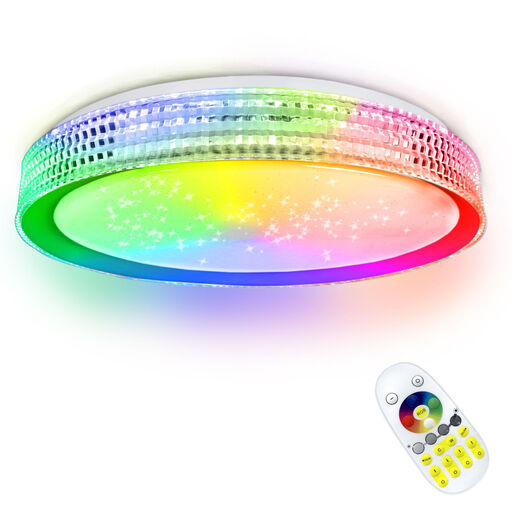
Why this choice suits this profile: Its 50 cm round design, remote control and dimming, white-light and RGB settings make it easy to modernise a living room or bedroom without adding multiple controls.
The product details mention several settings and a remote control, so you can adjust the atmosphere without assuming that a wall dimmer will be compatible.
Dimming function, RGB, colour temperature range from 2 800 to 6 500 K and remote control.
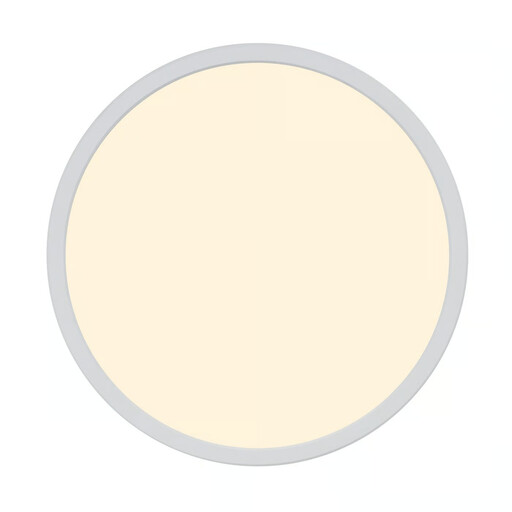
Why this choice suits this profile: With its 2.3 cm ultra-slim design and Bluetooth Mesh control, it is ideal for anyone looking for discreet lighting that can be adjusted via an app.
The 2 700 to 6 500 K range and brightness adjustment are clearly stated. Its IP20 rating confirms that it is intended for dry rooms only, not bathrooms.
1 600 lumens, integrated 15 W LED, Bluetooth Mesh and a stated 5-year LED warranty.
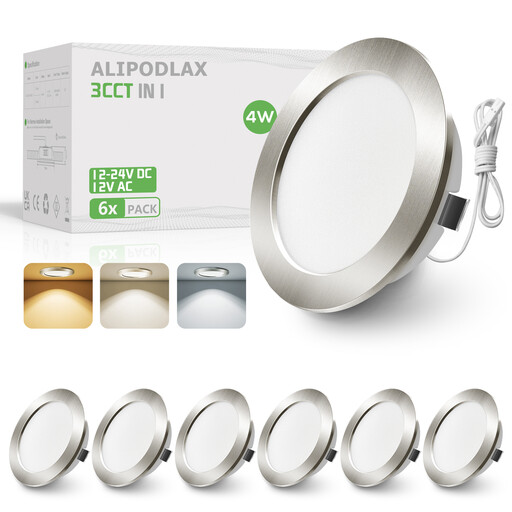
Why this choice suits this profile: Its shallow mounting depth and 12–24 V power supply make it suitable for furniture, kitchens, motorhomes and converted vans with a compatible installation.
The required voltage and need for a separate transformer are clearly stated. It must never be connected directly to the 230 V mains.
4 W, 270 lumens, choice of 3 000, 4 000 and 6 000 K, stated depth of 14.5 mm and IP44 rating.

Why this choice suits this profile: Its IP54 rating, warm 2 700 K light and wall-dimmer adjustment meet the needs of a bathroom or basement, provided the permitted zones are respected.
The IP54 rating is clearly stated in the product details, unlike IP20 models intended for dry rooms only. However, a compatible wall dimmer is still required.
1 600 lumens, integrated 17 W LED, 2.3 cm ultra-slim design and a stated lifespan of 30 000 hours.
We have put together a complete, real-time updated list of products that meet these strict selection criteria and European safety regulations.
Start by looking at the luminous flux, then choose the colour temperature. Warm light, between 2 700 and 3 000 K, is often preferred in relaxation areas. A dimmable model then lets you reduce the brightness when general lighting is not needed.
Consumption depends on the power in watts and how long the light is used. To compare two models, consider their power alongside an equivalent brightness level, taking lumens into account. An integrated LED can also eliminate the need to replace a bulb regularly, but its module is not always replaceable: check this in the product details.
Some light fittings are designed for easy installation, but any mains connection carries an electrical risk. Always switch off the power before carrying out any work. For a fixed installation, installation in a bathroom or unfamiliar wiring, it is best to contact a qualified electrician.