
Livraison le jour même ou le lendemain

Qualité garantie

Débloquez vos offres de bienvenue: Livraison GRATUITE | Jusqu'à -80 % | 30 jours d'essai gratuits à JoyPlus
Téléchargez l'application
Modernising your home with LED ceiling lighting seems straightforward… until you have to compare wattage, colour temperature, remote control compatibility or the IP rating. A poorly chosen ceiling light can cast a light that’s too cold, leave certain areas in shadow, or simply not be compatible with your existing ceiling.
Before you place your order, three common mistakes keep cropping up:
A 60W LED ceiling light is generally suitable for rooms that need well-distributed lighting, such as a living room or a spacious bedroom. However, the actual area covered depends on the design of the diffuser, the beam angle and the stated luminous flux.
The diameter also deserves your attention. A 50 cm LED ceiling light can work well in a living room, bedroom or wide hallway, provided there is enough space around the electrical outlet. Measure the available area and also check the height of the fitting, especially if the room has a low ceiling.
For more targeted lighting, IP65 recessed LED spotlights offer an interesting alternative. The model shown below has a height of 30 mm, runs on 230 V and requires a cut-out between 75 and 85 mm. Be sure to compare these dimensions with your ceiling before ordering.
Colour temperature is measured in kelvins:
A dimmable LED ceiling light lets you adjust the intensity to suit the time of day and your activity. If you use a wall dimmer, check its compatibility with the LED driver. With a model that comes with a remote control, adjustment is usually done from the remote, but the range and available functions should be confirmed in the product specification.
For a bathroom LED spotlight, the IP rating needs close attention. IP65 means the product is protected against dust and water jets, under the conditions set out by this classification. This does not remove the need to follow the electrical zones for bathrooms and the wiring regulations in force in the UK.
Always switch off the power before any installation or maintenance work. For a recessed spotlight, check the cut-out diameter, the available depth, the type of connection and compatibility with the ceiling material. If you have any doubt about connecting to the mains, call in a qualified professional.
The models below cater to different requirements: main lighting, decorative ambience, remote control or targeted lighting. The features mentioned correspond to the information given in the product listings.
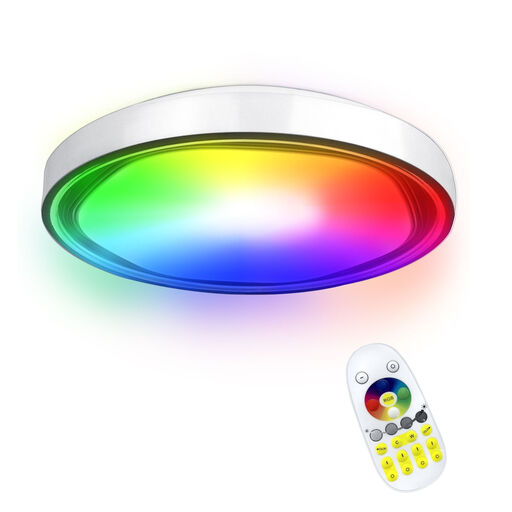
Why this choice suits this profile: with its 50 cm size and stated 60 W power, this model is aimed at those who want to replace a standard ceiling light with an adjustable, remote-controlled solution that also offers RGB colours.
The remote control and dimming let you adapt the lighting rather than relying on a single setting. However, do check the dimensions of the ceiling support and the exact contents of the package before installation.
Stated diameter of 50 cm, adjustable brightness, colour temperature range from 2,800 to 6,500 K, and RGB function.
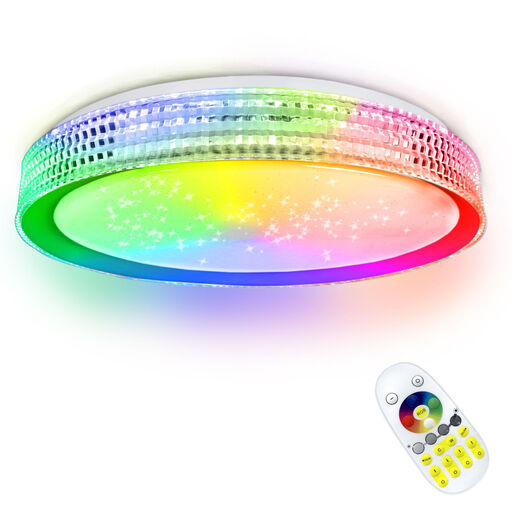
Why this choice suits this profile: its star pattern and grey inner ring will appeal to those who want a light fitting that is as stylish as it is functional.
The decorative effect is clearly stated in the product name – no vague promises. The main lighting remains adjustable according to the specified parameters.
Star effect, round 50 cm format, RGB, adjustable brightness and remote control as stated.
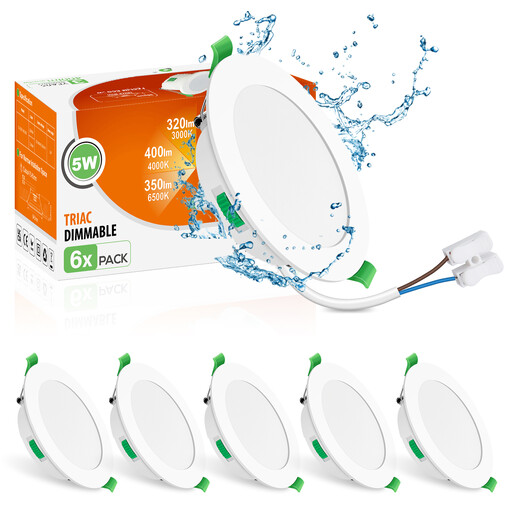
Why this choice suits this profile: this pack of six spotlights is designed for renovations that need multiple light points, particularly in a bathroom, kitchen or hallway.
The IP65 rating, three selectable colour temperatures and cut-out dimensions are all specified. This means you can check compatibility before buying, rather than relying solely on appearance.
5 W per spotlight, 400 lm stated, 3CCT adjustment at 3,000, 4,000 or 6,500 K, dimming from 10% to 100% and 230 V power supply.
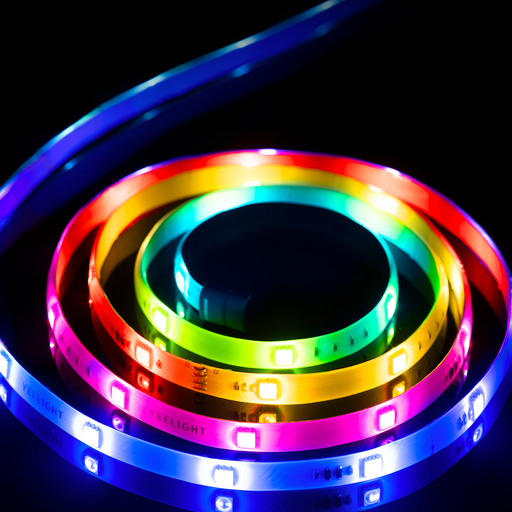
Why this choice suits this profile: this 1-metre RGBIC LED strip complements the main lighting around a television, desk or gaming area. It is aimed at users who want to control their lighting from an app or by voice.
It does not try to replace a ceiling light – its role as indirect lighting is clearly established. Check the length you need and the app’s compatibility with your phone or voice assistant.
RGBIC technology as stated, extendable according to the product listing, app control and voice control support.
We have selected a comprehensive, real-time updated list of products that meet these demanding criteria as well as European safety standards.
Before fixing a ceiling light, identify the relevant circuit on your consumer unit and make sure the ceiling support is strong enough. Heavy models may need a particular fixing system depending on the type of ceiling. For a connected device, also ensure you have sufficient Wi-Fi coverage if control is via an app.
Energy consumption depends on the power actually used and the hours of use. To estimate it, multiply the wattage by the number of hours of use, then divide the result by 1,000 to get kilowatt-hours. Then simply apply your electricity tariff. However, the stated wattage alone is not enough to determine the lifespan or total cost of the light fitting.
Dust the diffuser with a soft, dry cloth. Avoid corrosive products and do not dismantle the LED module. With an IP65 spotlight, also take care to preserve the seal and follow the manufacturer’s recommendations after any maintenance.
For a living room, compare the room’s size, the luminous flux, the ceiling light’s diameter and the ability to adjust the colour temperature. A dimmable LED model with a remote control lets you switch from general lighting to a softer ambience in seconds. An RGB ceiling light can complement the décor, but make sure you have a sufficiently powerful white light for everyday activities.
It depends on the product you choose. A ceiling light is generally connected to the existing circuit, whereas an LED strip is more for indirect lighting and needs a suitable power supply. Check the compatible app, the required network and the connection instructions. Before any work on the mains, switch off the power and call in a professional if you are not confident.
The cost depends on the wattage, the hours of use and the price per kilowatt-hour. The calculation is simple: wattage × hours of use ÷ 1,000 = consumption in kWh. This formula lets you compare appliances without confusing electricity consumption with the actual light output.