
Livraison le jour même ou le lendemain

Qualité garantie

Débloquez vos offres de bienvenue: Livraison GRATUITE | Jusqu'à -80 % | 30 jours d'essai gratuits à JoyPlus
Téléchargez l'application
Choosing an LED ceiling light? On the surface, it seems like child's play. You browse online catalogues, fall for a design, and place your order. Yet, disappointment often follows once the package is unboxed and the fixture is installed: the light is too harsh, the so-called "waterproof" model is completely unsuitable for the bathroom, or the dimmer switch makes the whole thing buzz.
As a product expert at Joybuy, my role is to help you navigate the jungle of options to make the right choice, with full confidence. Let's break down the most common traps and the essential criteria for finding the ceiling fixture that will truly brighten your daily life.
Marketing can be deceptive. To avoid buyer's remorse, here are three absolute red flags to watch out for:
To avoid falling into these traps, rely on objective technical specifications. They are your only real guarantee of quality and safety for your future LED ceiling light.
The Ingress Protection (IP) rating is an international standard that classifies an electrical device's level of protection against solid objects (first digit) and liquids (second digit).
Lighting shapes the atmosphere of a room. You need to master two units to get it right:
To put theory into practice, here are a few models that meet specific profiles and needs.
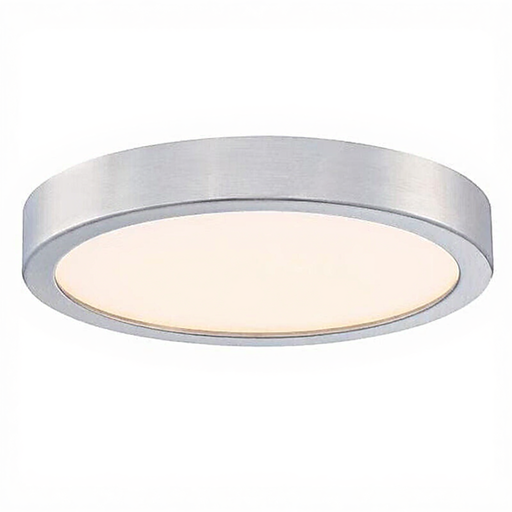
Why it's a match: Its ultra-slim design (3 cm thick) and brushed nickel finish blend with absolute discretion into a contemporary interior, creating a sense of space and modernity.
Its non-dimmable nature settles the issue: no risk of incompatibility with a dimmer. Its long advertised lifespan (30,000 hours) provides reassurance about the reliability of the integrated LEDs.
It diffuses a powerful and uniform warm white light (3000K) at 1500 lumens, perfect for general lighting that is both effective and comfortable.
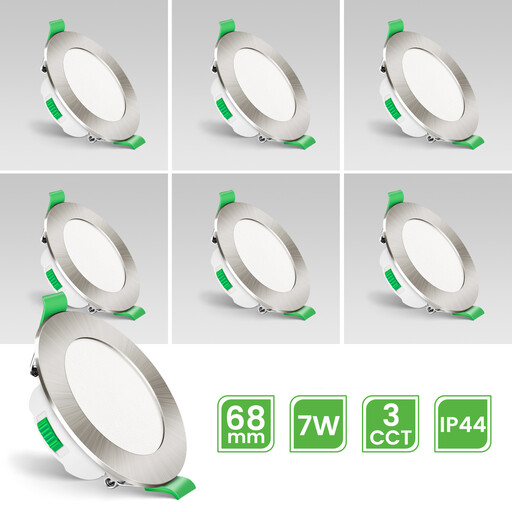
Why it's a match: Specifically designed for damp rooms, this set of recessed spotlights is ideal for creating comprehensive, safe, and uniform lighting in a bathroom or kitchen.
The clearly displayed IP44 rating guarantees a compliant and risk-free installation in permitted bathroom zones. Bonus: the adjustable colour temperature eliminates the risk of choosing the wrong ambiance at purchase.
Maximum versatility: dimmable, ultra-slim (29 mm), and 3 colour temperatures to choose from (3000K, 4000K, 6500K), selectable via a switch on each spot.
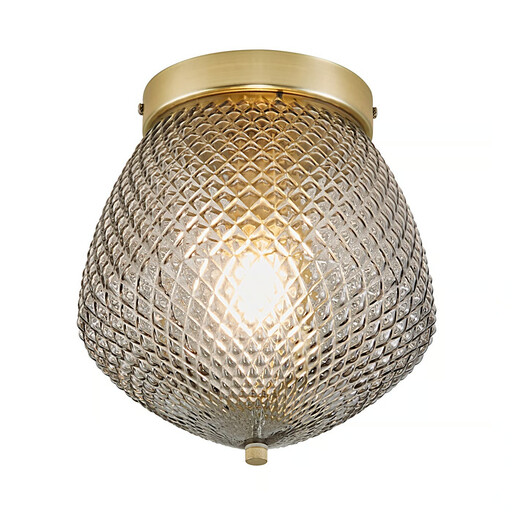
Why it's a match: More than just a light fixture, it's a statement piece. Its patterned smoked glass dome and brushed brass structure make it an elegant centrepiece for an entryway, hallway, or living room with a bold style.
Its standard E27 socket gives you complete freedom over the choice of bulb (LED, wattage, colour, dimmable, smart...). This allows you to completely bypass the trap of an irreplaceable integrated LED.
Its artisanal design (mouth-blown glass) creates unique lighting effects, combined with the flexibility of a replaceable bulb for 100% personalised lighting.
Explore our full selection of products that meet our demanding selection criteria and French safety standards.
For comfortable general lighting, aim for about 100 to 150 lumens per square metre. For a 20?m? living room, one or more fixtures totalling 2000 to 3000 lumens is a good starting point. The ideal solution is to opt for a dimmable ceiling light to adjust the intensity according to the time of day and modulate the ambiance.
Absolutely. For the same brightness, an LED uses up to 85% less electricity than an incandescent bulb and has a lifespan that is 15 to 25 times longer. The initial investment, although sometimes higher, quickly pays for itself through savings on your electricity bill and bulb replacements.
Installing an LED recessed spotlight involves drilling a hole in the ceiling to the specified diameter, shutting off the power at the main circuit breaker, connecting the spotlight's wires to the 230V network (or to a dedicated transformer for low-voltage models), and then securing the spot with its spring clips. To ensure your safety and the installation's compliance with the NFC 15-100 standard, hiring a qualified electrician is essential.