
Livraison le jour même ou le lendemain

Qualité garantie

Débloquez vos offres de bienvenue: Livraison GRATUITE | Jusqu'à -80 % | 30 jours d'essai gratuits à JoyPlus
Téléchargez l'application
At first glance, choosing an LED ceiling light seems like child's play. However, the market is flooded with models featuring spec sheets that are often complex, or even misleading. The wrong choice can lead to unsuitable lighting, unexpected costs, or worse, a safety risk. As a product expert at Joybuy, my mission is to guide you through this jungle. Let's break down the pitfalls to avoid and the essential criteria for a 100% successful purchase.
Before comparing models, let's review the three classic errors that lead straight to disappointment.
To make the right choice, three technical parameters must be examined closely. The visual comfort, safety, and usability of your future ceiling fixture depend on them.
Forget watts; the real metric is lumens (lm). This unit measures the actual perceived light output. Here are a few benchmarks:
The colour temperature, expressed in Kelvins (K), shapes the room's atmosphere:
The Ingress Protection (IP) rating is an international standard that assesses a device's sealing against solid objects (dust) and liquids (water). It is read using two digits:
For a bathroom ceiling light, an IP44 rating is the bare minimum. It guarantees protection against water splashes from all directions. In dry rooms (living room, bedroom), an IP20 rating is more than sufficient.
Modern features transform a simple light source into a true comfort tool.
To move from theory to practice, here is our selection of models that meet specific needs while respecting the criteria we've just discussed.
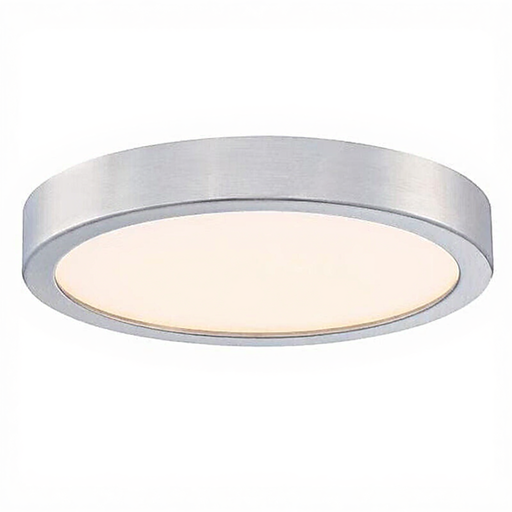
The verdict: This ceiling light gets straight to the point: quality, no-frills lighting. With its ultra-slim ceiling light design and brushed nickel finish, it blends into any modern decor, whether it's an entryway, hallway, or bedroom.
No unpleasant surprises here: the spec sheet clearly states 1500 lumens for generous brightness and a warm white temperature of 3000K. You know what you're buying: light, not just watts.
Simplicity is its superpower. Easy installation, a versatile design, and uniform, flicker-free lighting are guaranteed. Its integrated LED promises years of peace of mind.
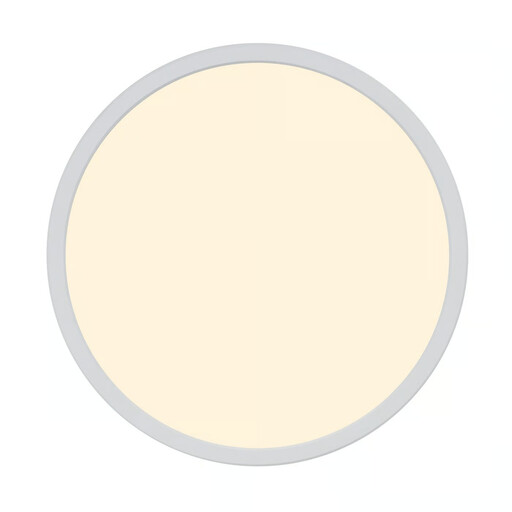
The verdict: This smart ceiling light is the perfect ally for those who love to sculpt their lighting atmosphere. Thanks to Bluetooth Mesh, everything is controlled from your smartphone: adjust the intensity and colour temperature to switch from a relaxing warm white to an efficient work light in the blink of an eye.
It eliminates the headache of dimmer compatibility. Here, the "dimmable" function is entirely managed by the app. Say goodbye to the need for a specific wall switch and the associated risks of flickering.
Absolute versatility. The colour temperature adjusts from 2700K to 6500K, and the intensity is infinitely variable. A single fixture is all you need to go from a cosy atmosphere to a focused reading session.
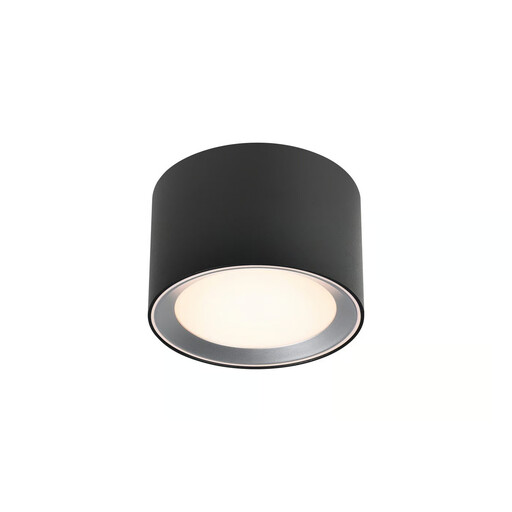
The verdict: This LED spot is designed for damp areas. Its modern look and black ceiling light finish make it a stylish and smart choice for a contemporary bathroom. It ticks all the boxes for both safety and connectivity.
It tackles the safety pitfall in wet rooms head-on. Its IP44 certification isn't an option: it guarantees essential protection against splashes, eliminating any risk of corrosion or short-circuiting.
It brings together the best of both worlds: the safety of the IP44 standard and the intelligence of a smart ceiling light. No more choosing between a safe product for the bathroom and a high-tech fixture.
We have curated a full range of products that meet our selection criteria and the strictest safety standards.
For a 20 m² living room, for example, a total of 3000 to 4000 lumens provides excellent visual comfort for the main lighting. You can achieve this level with a single powerful ceiling light, or by mixing sources: recessed LED spots, floor lamps, etc.
No, and this is one of the most common pitfalls. The majority of dimmable LED ceiling lights require a wall dimmer designed for LEDs. To make your life easier, opt for a smart or remote-controlled model: the dimming is managed directly by the fixture, regardless of your switch.
A quality model has a lifespan of between 25,000 and 50,000 hours. Based on 4 hours of use per day, this represents over 15 years of service. The advantage? No bulbs to change. The disadvantage? The entire fixture will need to be replaced once the LED reaches the end of its life.