
Livraison le jour même ou le lendemain

Qualité garantie

Débloquez vos offres de bienvenue: Livraison GRATUITE | Jusqu'à -80 % | 30 jours d'essai gratuits à JoyPlus
Téléchargez l'application
Choosing a new LED ceiling light may seem simple, but the market is flooded with models featuring technical specifications that are often opaque, or even misleading. A poor choice can quickly result in a failed lighting ambiance, unexpected costs, or safety issues. As the Head of Product Recommendations at Joybuy, my mission is to help you navigate this landscape. Let's break down the common mistakes and essential criteria for a purchase with no unpleasant surprises.
Before diving into specific models, it's crucial to know the pitfalls that can turn a great renovation project into a real headache.
To make a truly informed choice, three technical parameters must be scrutinised. They determine the performance, safety, and versatility of your future LED ceiling light.
This acronym represents an international standard that classifies an electrical device's resistance to solid objects (dust) and liquids (water). It consists of two digits:
For domestic use, here are the ratings you need to know:
Colour temperature, measured in Kelvins (K), defines the "warmth" of white light. It is what dictates the entire atmosphere of a room.
For maximum flexibility, opt for a model with adjustable colour temperature, which allows you to switch from warm white to cool white depending on the time of day. Also, consider the Colour Rendering Index (CRI). A CRI above 80 is a mark of quality, ensuring that the colours of objects under this light remain true and natural.
The type of electrical connection is another decisive technical point.
Rather than drowning you in a list of products, we have matched specific solutions to common user profiles.
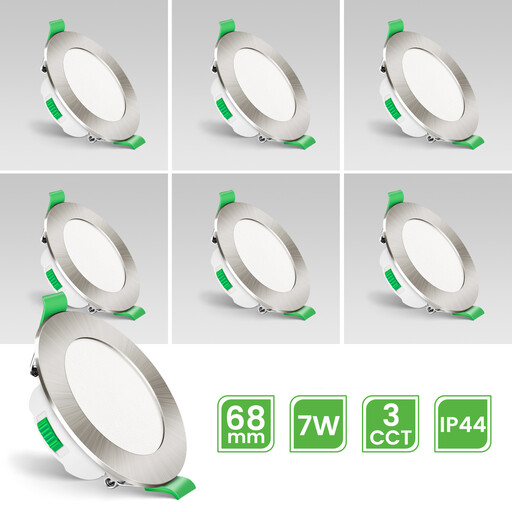
Why we chose it: This pack of six spotlights is an all-in-one, cost-effective solution for renovating one or more rooms. Its versatility makes it a true Swiss Army knife for your projects, from the living room to the bathroom.
It ticks all the boxes to bypass the classic traps: IP44 rating, dimmable function, and adjustable colour temperature (via a switch on the spotlight before installation).
Direct 230V connection without a transformer simplifies installation. Its ultra-slim design (29 mm) is perfect for false ceilings where space is limited.
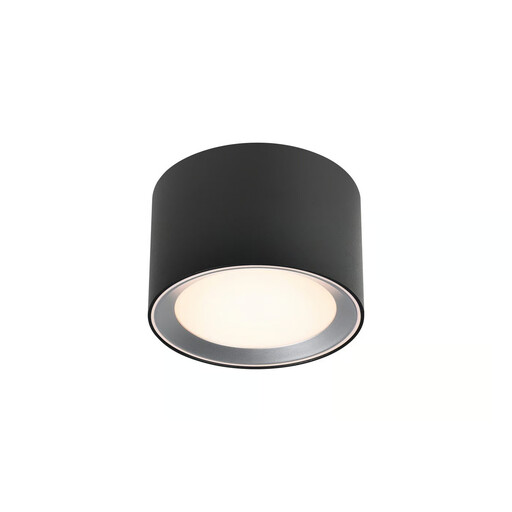
Why we chose it: For those who want to control their lighting from their smartphone with pinpoint precision. This smart light fixture combines a modern design with intelligent features, ideal for a contemporary bathroom or kitchen.
Control via the Nordlux Smart app bypasses compatibility issues with wall dimmers. The colour temperature is fully customisable (2700K to 6500K), offering total flexibility. Its IP44 rating makes it safe for damp rooms.
Full control (On/Off, brightness, temperature) from a smartphone. The option for parallel connection and the screwless terminal system ensure a clean, professional-grade installation.
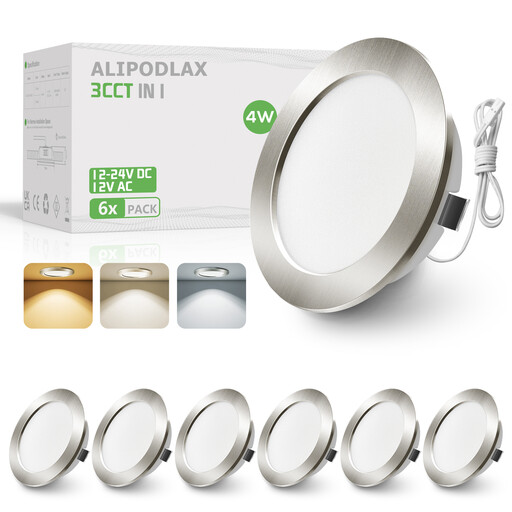
Why we chose it: This spotlight is designed for installations where every millimetre counts. Its very shallow recess depth (14.5 mm) makes it the perfect ally for under-cabinet lighting in kitchens, display cases, or very low ceilings.
It offers a choice of three colour temperatures (3000K, 4000K, 6000K) to suit the application. Its IP44 rating makes it perfectly safe for use as a kitchen LED spot near damp areas.
Its ultra-compact design is its main asset. The low-voltage operation (12-24V, transformer not included) is a guarantee of safety for installations integrated into furniture.
We have selected a full range of products for you that meet our demanding specifications and French and European safety standards.
The lifespan of an integrated LED source is typically between 20,000 and 50,000 hours. For an average use of 5 hours per day, this represents more than 10 years of peace of mind. Be aware, however: on most models with integrated LEDs, the light source cannot be replaced. When the LED reaches the end of its life, the entire fixture must be changed.
Absolutely not. Electrical installation in a bathroom is very strictly regulated by safety standards, which define several "zones". An IP44 fixture is permitted in "zone 2" (the area extending 60 cm around the bath/shower, up to a height of 2.25 m) and in the "outside zones". It is prohibited in zone 1 (directly above the shower/bath) and zone 0 (inside the bath/shower), where an IP67 rating is required.
The light output, measured in lumens (lm), depends on the size of the room and its use. Here are some guidelines to help you:
For example, for a 15 m? living room, plan for a total of 1500 to 3000 lumens, ideally distributed across several light sources to create a versatile ambiance.