
Livraison le jour même ou le lendemain

Qualité garantie

Débloquez vos offres de bienvenue: Livraison GRATUITE | Jusqu'à -80 % | 30 jours d'essai gratuits à JoyPlus
Téléchargez l'application
Replacing halogen or HID bulbs can improve your night-time driving comfort. But the wrong choice can trigger dashboard errors, a poorly aimed beam, or an installation that simply won't work. LED car headlight bulbs shouldn't be chosen based solely on the advertised lumen count.
Before you place an order, check the bulb base type, the original technology, the space available inside the headlight housing, and the regulations that apply in the UK. Here are the key criteria to examine so you can compare models with greater confidence.
Values like 20,000, 30,000 or 50,000 lumens may refer to the total light output of the complete kit, a theoretical estimate, or a figure provided by the brand. On their own, they don't let you judge the quality of the beam once the bulb is fitted to your vehicle.
A very bright LED bulb must also position its light correctly within the reflector or projector. Excessive power can also generate more heat and dazzle oncoming drivers if the beam is poorly adjusted.
An H1 bulb does not automatically replace an H3, an HB3 9005 or an HB4 9006. Similarly, D1S, D2S, D3S and D4S LED bulbs are designed for headlight housings originally intended for HID bulbs. They are not necessarily suitable for a halogen headlight or an integrated LED unit.
Before buying, check the reference printed on the bulb you've removed, in your vehicle's handbook, or in the parts catalogue.
A plug-and-play LED bulb may use the original connector, but the housing may lack the depth to accommodate a fan, a heat sink, or a control box. The polarity, the dust cover, and the shape of the base also need to be checked.
The mention of CANbus indicates the presence of a communication or decoding system designed to reduce error messages and flickering. However, it does not guarantee a problem-free experience on every vehicle.
For main beam headlights, common references include LED H1 bulbs, H3, HB3 9005 and HB4 9006. HB3 and HB4 models may look similar, but their bases and keying are different.
Also check your vehicle's voltage. Some 12V 24V car LED bulbs accept a wide range, while others are primarily designed for 12V installations. Vans, motorhomes, and certain commercial vehicles may require 24V compatibility.
A 6000K to 6500K LED headlight produces a cool white light. This shade can improve contrast perception, but a high colour temperature does not guarantee greater range.
For road use, the LED chips must be positioned to replicate the position of the original filament or light source as closely as possible. After installation, check the headlight aim and look for any dark spots or excessive scatter.
LEDs convert some of the energy they consume into heat. A model with an aluminium body, a heat sink, or a fan therefore needs sufficient space inside the headlight. The rear cover must be able to close without compressing the cooling system.
The product listings shown below mention fans reaching 10,000 or 16,000 rpm, IP65 or IP68 protection, and an advertised lifespan of 50,000 to 60,000 hours. These figures correspond to the specifications provided by the manufacturers. They should be treated as indications, not as a guaranteed lifespan in every vehicle.
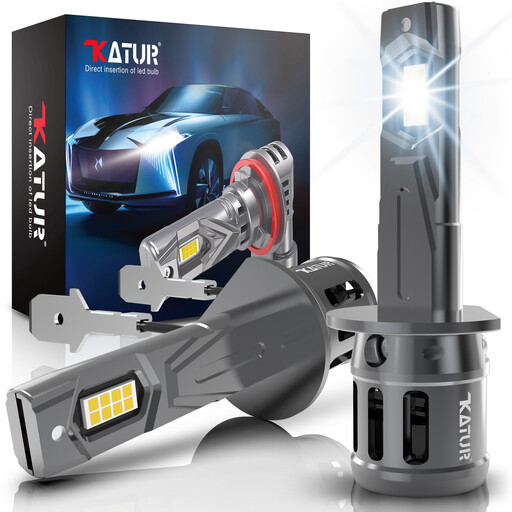
Why this choice suits this profile: Its advertised 1:1 design and plug-and-play installation make it suitable for drivers who want to replace an H1 bulb without modifying the wiring.
The listing mentions an external CANbus unit and recommends checking the space available around the fan before purchasing.
Advertised colour temperature of 6000K, DC 11–18V power supply, fan rated at 16,000 rpm and IP65 protection.
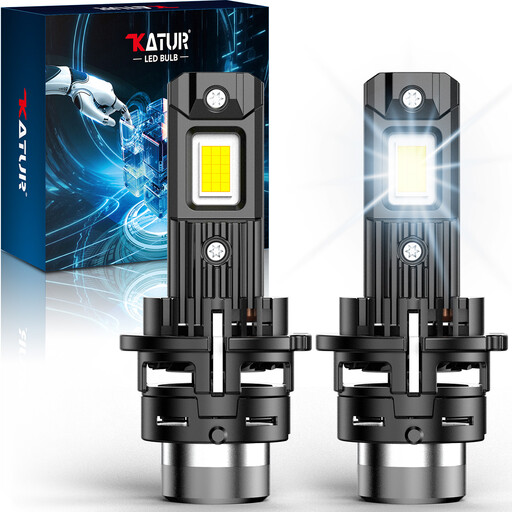
Why this choice suits this profile: This model is aimed at drivers whose vehicle is already equipped with a D4S HID unit and who want a white light with an installation advertised as requiring no modifications.
The description clearly states it is a replacement for D4S HID units only, not a bulb intended for a halogen assembly.
Listing advertises 6500K, 0.01-second start-up, an aluminium body and an integrated fan rated at 16,000 rpm.
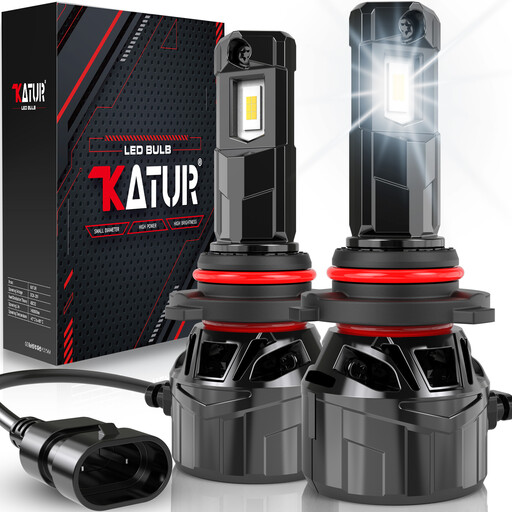
Why this choice suits this profile: The HB3 9005 reference can suit drivers who frequently drive at night in a vehicle equipped with this base, including certain vans and larger vehicles.
The listing notes that some ECUs may still display an error or cause flickering, despite the advertised CANbus compatibility.
Advertised 1:1 design, 9–32V power supply, fan cooling and an advertised operating life of up to 60,000 hours.
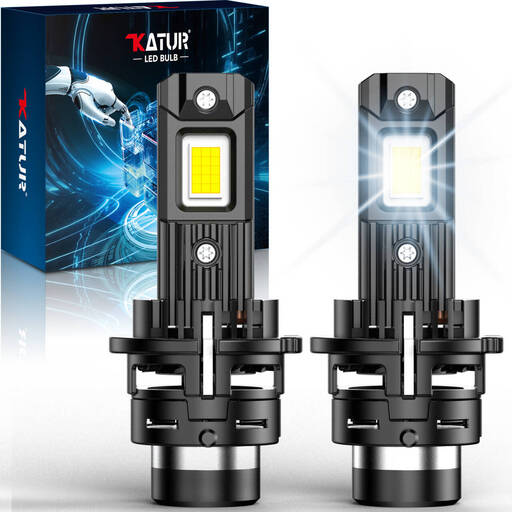
Why this choice suits this profile: This option is aimed at motorists with D2S equipment who want to keep a 1:1 design and a fitting advertised as requiring no extensions or wiring modifications.
The listing reminds you that the product is for D2S HID units only and that actual compatibility must be checked on your vehicle.
Advertised colour temperature of 6500K, 0.01-second start-up, active cooling and integrated CANbus decoding.
We've put together a comprehensive, real-time updated selection of products that meet these strict selection criteria as well as European safety regulations.
Before handling anything, switch off the lights, turn off the engine and let the bulbs cool down. Wear gloves and avoid touching the LED chips directly. Once the bulb is installed, check the polarity, the base locking mechanism, and that the dust cover closes properly.
Then turn on the lights to check for any flickering or error messages. You may need to adjust the headlight aim. In the UK, the compliance of the installation and beam pattern must be checked according to your vehicle and intended use: a physically compatible bulb is not automatically legal for use on the open road.
No. Compatibility depends on the bulb base, the headlight technology, the voltage, the available space, and the vehicle's onboard electronics. Check the reference of your original bulb and verify the dimensions inside the headlight housing before buying.
For some models, manufacturers claim between 50,000 and 60,000 hours. However, this figure depends on temperature, vibration, cooling quality, and actual operating conditions. A blocked fan or a dust cover that is too tight can reduce the operating life.
No. They can reduce errors and flickering on many vehicles, but the sensitivity of ECUs varies from model to model. If a fault persists, an additional decoding module or a return to the original configuration may be necessary.