
Livraison le jour même ou le lendemain

Qualité garantie

Débloquez vos offres de bienvenue: Livraison GRATUITE | Jusqu'à -80 % | 30 jours d'essai gratuits à JoyPlus
Téléchargez l'application
Replacing halogen bulbs with H4, H7 or HB4 LED car bulbs can give your headlights a serious upgrade, but not all products offer the same performance. A very high claimed wattage, “universal” compatibility or the promise of installation in just a few minutes is not enough to make a reliable choice.
Before placing your order, check the bulb base, the space available behind the headlight, heat management and compatibility with the vehicle’s onboard electronics. You should also consult your vehicle’s manual and the relevant French regulations: some replacement LED bulbs are intended for specific uses or require appropriate approval.
Some listings claim 20 000, 30 000 or even more lumens per pair. These figures reflect the information provided by manufacturers and are not enough on their own to assess beam quality. An extremely bright light that is poorly positioned can create dark areas or dazzle oncoming drivers.
A 1:1 LED bulb, designed to reproduce the position of a halogen filament, can help maintain a light distribution close to that intended by the original optics. However, the headlight alignment should still be checked after installation.
An H4 9003 HB2 bulb uses the same type of connection, depending on the naming convention, and provides both high- and dipped-beam functions. An H7 LED bulb is generally intended for a single function, while an HB4 9006 LED bulb is frequently used for certain dipped beams, fog lights or spotlights.
Having the correct bulb base does not guarantee that the bulb will fit in the available housing. The fan, heat sink or control box may require more space than is available behind the headlight. Check the reference printed on the original bulb, your vehicle’s manual and the dimensions of the available space.
LEDs often consume less power than halogen bulbs, but their components still generate heat. A fan-equipped model can improve heat dissipation, at the expense of an additional moving part. A fanless model eliminates noise and the risk of fan failure, but its thermal design must be sufficiently effective.
CANBUS compatibility can help reduce flickering and error messages, although it will not eliminate them on every vehicle. The electrical systems of some European cars remain sensitive and may require the addition of a decoder.
Start by identifying the exact bulb reference:
Also check the stated voltage, particularly if the bulb is intended for a car, motorbike, van or lorry. A reference listed as 9–32 V may suit several systems, but checking your vehicle remains essential.
6000K cool white produces a crisp white light, while 6500 K has a more distinctly cool, slightly bluish tint. Colour temperature does not measure brightness. For dipped beam, focus primarily on a properly focused beam with a sharp cut-off and no dark areas.
For high- and dipped-beam LED bulbs, check that the functions correspond correctly to your vehicle’s optics. LED bulbs intended for fog lights must also be suitable for their position: a beam that is too concentrated or too intense can reduce visual comfort in poor weather.
An aluminium body generally helps dissipate heat. IP65, IP67 or IP68 ratings indicate a level of protection against dust and water under standardised conditions; they do not replace the correct installation of the seal and rear cover.
The term plug and play means that the connection is designed to use the original socket. This does not guarantee that the dust cover will close properly or that the CANBUS system will accept the new electrical load.
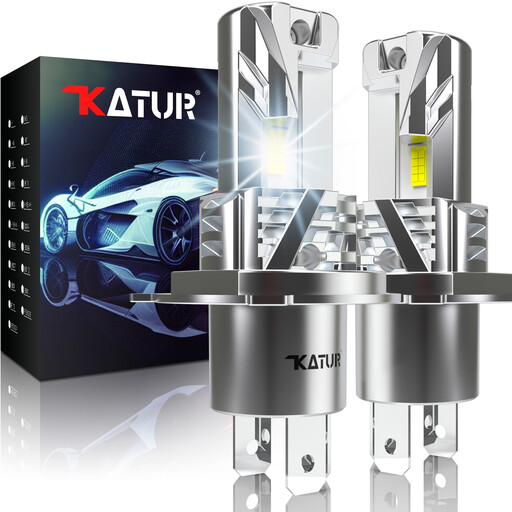
Why this choice suits this profile : this H4/9003/HB2 model has a compact design and works without a fan. It is therefore suitable for a first installation when space behind the headlight is limited.
The design is advertised as 1:1 and the lack of a fan limits space and noise issues. You should still check the beam pattern after installation.
Advertised 6000K tint, compact design, direct connection and 6063 aluminium body, according to the product details.
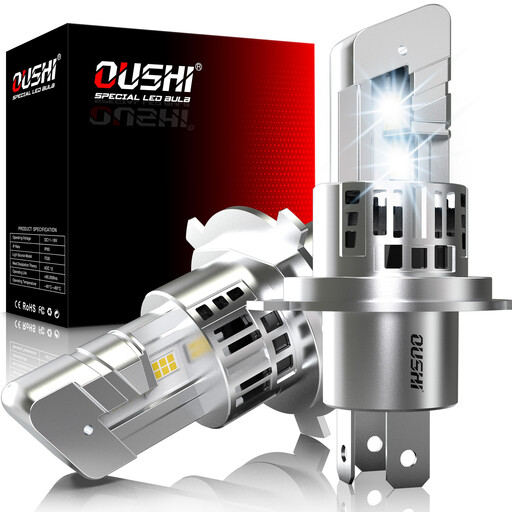
Why this choice suits this profile : this pair of H4 bulbs is aimed at motorists looking for a cool white light and compact integration into the original housing.
The 1:1 design is presented as requiring neither an adapter nor additional wiring. However, the product details state that some vehicles may require a CANBUS decoder.
High- and dipped-beam functions, integrated fan, advertised CANBUS system and 90 W per pair, according to the manufacturer.
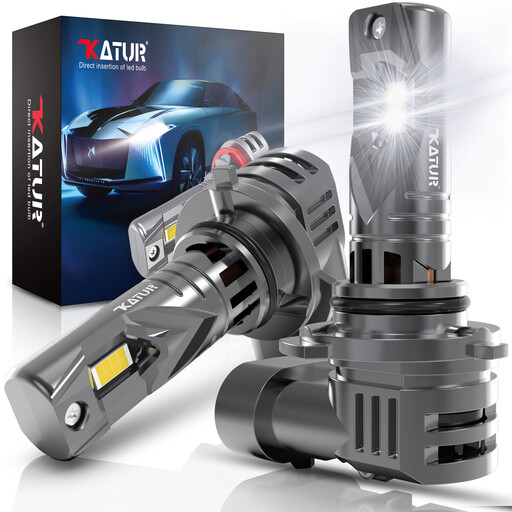
Why this choice suits this profile : this HB4/9006 model is aimed at owners of SUVs, vans, motorbikes or off-road vehicles that use this bulb base for their headlights or fog lights.
The IP65 rating and advertised cooling system are suited to the demands of outdoor use. Nevertheless, check that the cover closes properly and confirm electrical compatibility.
Compact 1:1 design, fan advertised at 16 000 tr/min, aluminium housing and external CANBUS decoder, according to the product details.
We have compiled a complete, real-time selection of products that meet these demanding criteria, while also taking European safety regulations into account.
A bulb advertised as IP68 waterproof, offering “high brightness” or claiming compatibility with 99% of vehicles does not remove the need for these checks. If you drive in France, you should also find out about the approval requirements applicable to your vehicle and the type of light.
No. The bulb bases, connectors and geometry are different. An H4/9003/HB2 does not automatically replace an H7 or HB4/9006. The reference printed on the original bulb must match exactly.
No. CANBUS compatibility reduces the risk of errors, flickering or interference, but every vehicle has different electronic management. An external decoder may still be required on some models.
Product details often claim 50 000 to 60 000 hours. This is a manufacturer estimate that depends on temperature, voltage, vibration and installation quality. Good airflow around the cooling system and a properly sealed housing help preserve headlight performance.