
Livraison le jour même ou le lendemain

Qualité garantie

Débloquez vos offres de bienvenue: Livraison GRATUITE | Jusqu'à -80 % | 30 jours d'essai gratuits à JoyPlus
Téléchargez l'application
Poor visibility, eye strain, a feeling of insecurity… Driving at night with outdated halogen headlights is anything but a pleasant experience. Their yellowish light struggles to illuminate the road ahead, details get lost in the gloom, and your eyes feel the strain. Upgrading to LED bulbs is no longer a mere aesthetic choice, but a real investment in your safety, comfort, and your car's appearance.
Faced with an overwhelming number of options, it can be difficult to know where to start. To help you sort through the choices, we've broken down the essential criteria and selected models that truly perform—all without overwhelming technical jargon.
Before you buy, there are a few crucial points to check to ensure perfect compatibility and optimal performance.
This is the number one, non-negotiable criterion: the socket type. Every vehicle uses specific standards like H4, H7, 9005 (HB3), or 9006 (HB4). This reference is usually engraved on the original bulb or listed in your vehicle's manual. Opting for an LED bulb with a "1:1 mini size" design is a guarantee of peace of mind: it ensures an ultra-simple plug-and-play installation, directly replacing the old one without any need to modify the headlight housing.
The effectiveness of an LED headlight relies on two pillars:
A long lifespan is one of the key advantages of LED technology. It directly depends on the efficiency of the bulb's cooling system (fan, aluminium heat sink). Good heat dissipation is the key to stable performance and maximum longevity.
Finally, on modern vehicles, smooth communication with the on-board computer (OBC) is essential. To avoid error messages or flickering, choose a car LED kit that is certified OBC error-free (or "CAN bus ready").
Here are a few models that stand out for their performance and ease of integration.
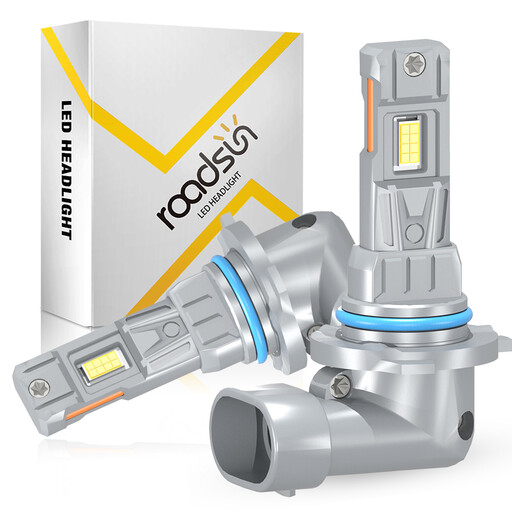
Why we love it: This model gets straight to the point: an incredibly simple installation and great versatility. Its 1:1 design, modelled after a 9006/HB4 halogen bulb, eliminates any physical compatibility headaches from the start. It's perfect as an LED fog light or for high beams.
The pros:
Who is it for? For drivers who want to replace their 9006/HB4 bulbs with a simple, effective solution without worrying about the installation. Ideal for fog lights or high beams.
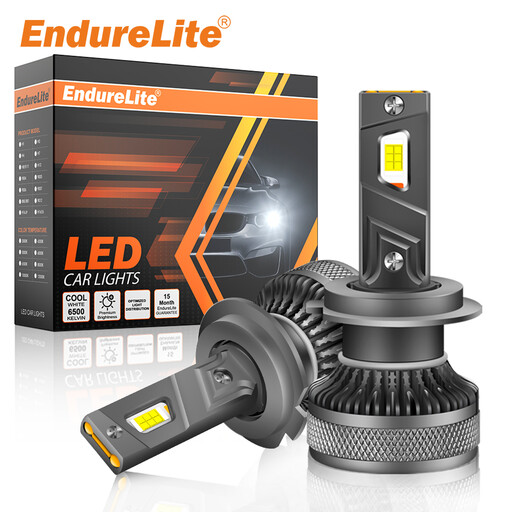
Why we love it: With a rated power of 20,000 lumens per pair, this kit is all about raw performance. It's aimed at those who demand a vastly increased light range for absolute safety on the darkest roads.
The pros:
Who is it for? For high-mileage drivers who travel on country roads and poorly lit motorways, and for whom lighting power is non-negotiable.
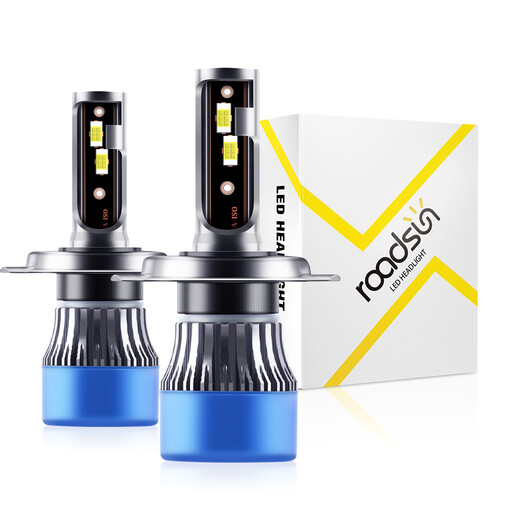
Why we love it: The H4 bulb is unique in that it handles both low and high beams. This Roadsun model perfectly masters this dual function and adds an active cooling fan, guaranteeing a long lifespan even under heavy use.
The pros:
Who is it for? For owners of H4-equipped vehicles who want a complete and reliable upgrade for their main headlights, with perfect switching between low and high beams.
Our selection covers the most common needs, but every car and driver has unique requirements. If you can't find the right socket type or want to explore other technologies, our full catalogue is here for you.
Discover our full range of driving accessories
No, the vast majority of modern kits are designed for a plug-and-play installation. In practice, this means they plug directly into the original connector without any wiring modifications. The process rarely takes more than 15 minutes. Just remember to consult your vehicle's manual to learn how to access the bulbs.
This is a very real risk on multiplexed cars (most post-2005 models). Because an LED consumes much less power than a halogen, the on-board computer (OBC) may think a bulb has failed and display a warning. To avoid this pitfall, it is essential to choose a model labelled as OBC error-free or "CAN bus" compatible.
This is a sensitive issue. French regulations are very strict: to be used legally on public roads, an aftermarket bulb must have a specific ECE approval for its type (e.g., ECE R37 for halogens). To date, only a few LED bulbs from major brands have obtained this approval, and only for specific vehicle models. For all others, their use is theoretically restricted to racetracks or private property. It is the user's responsibility to ensure their equipment complies with local legislation and vehicle inspection requirements.