
Livraison le jour même ou le lendemain

Qualité garantie

Débloquez vos offres de bienvenue: Livraison GRATUITE | Jusqu'à -80 % | 30 jours d'essai gratuits à JoyPlus
Téléchargez l'application
Replacing a halogen or xenon bulb with an LED bulb for your car can modernise your lighting, reduce power consumption and simplify certain replacements. But a model described as "universal" won't necessarily suit every vehicle. An incompatible base, a poorly aimed beam or a dashboard error message can quickly turn a promising purchase into a wasted expense.
Product listings often boast an impressive lumen count. This figure represents a theoretical light output, but it isn't enough to judge the result on the road. The shape of the beam, the position of the LED chips and compatibility with your headlight reflector all play a crucial role.
A poorly positioned LED bulb for car headlights can create dark spots or dazzle other drivers. So, look for a design described as 1:1, meaning it sits as close as possible to the original filament position, along with a properly distributed beam.
The references H4, H7, H1, H11, HB3 and HB4 are not interchangeable. An LED H4 bulb typically handles both dipped and main beam functions in a single base, whereas an LED H7 bulb has a different configuration. The HB3 and HB4 formats are also different, even though they may be used in some headlights or fog lights.
Before ordering, check the reference on the bulb you've removed, in your vehicle's handbook or in the manufacturer's catalogue. For secondary lighting, the designations T10, W5W, 194, 168 and 2825 can refer to similar formats, but you'll need to compare the length and connection type.
A Canbus error-free LED bulb includes a circuit designed to limit warnings caused by the low power consumption of LEDs. However, this doesn't guarantee perfect compatibility with every vehicle. Sensitivity varies depending on the make, model and year of your car. Product listings often note that a warning or flicker may still appear on some electronic systems.
Make sure you have a returns option or a device specifically compatible with your vehicle. If an additional resistor is needed, bear in mind that it can generate a lot of heat and must be installed according to the manufacturer's instructions.
Measure your original bulb and check the depth of the housing. An LED bulb with a fan may need more space behind the headlight. A plug and play model with no external wiring makes installation easier, but still check that the cap, seal and rear cover close properly.
For an LED fog light bulb, the HB3, HB4 or H11 format depends on your vehicle. Inside the cabin and for the number plate, the LED T10 W5W bulb or LED 194 bulb are common. Depending on the original setup, they can be used for interior lighting, sidelights or the LED number plate bulb.
A bulb rated at 6000 K produces a cool white light, often described as "xenon white". This value describes the shade, not directly the lighting power. A higher temperature can give a more modern look, but perceived visibility also depends on optical quality and weather conditions.
Inside the cabin, white, amber, red or blue can suit different purposes. For exterior lights, check the rules on colour and light function before making any customisations.
LEDs generally consume less than an equivalent halogen bulb, but their components still generate heat. An aluminium body, heatsink or fan helps to dissipate it. The IP ratings quoted, such as IP65 or IP68, indicate the level of protection against dust and water under the conditions specified by the manufacturer.
The lifespans quoted, sometimes 50,000 or 60,000 hours, are product data sheet figures. They can vary depending on temperature, vibration and the quality of your vehicle's electrical system.
Replacing a halogen bulb with an LED is not automatically permitted in all headlights. Before using it on open roads, consult your vehicle's handbook, the manufacturer's documentation and any applicable regulatory markings. After installation, also check the headlight alignment so you don't dazzle oncoming drivers.
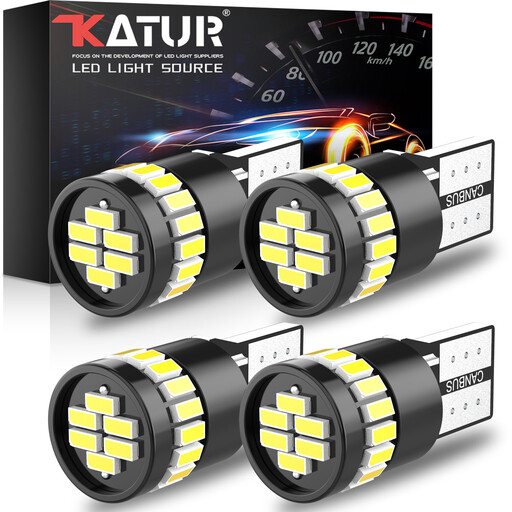
Why this choice suits this profile: This pack of four bulbs is aimed at drivers who want to start by upgrading their interior or number plate lighting. It runs on 12 V and covers several common references: 168, 2825, W5W and T10.
The listing describes a compact plug and play design with Canbus compatibility. It's still essential to compare the reference of your original bulb before buying.
6000 K colour, 280 lm quoted, 24 SMD 3014 chips and a lifespan of up to 60,000 hours according to the product data sheet.
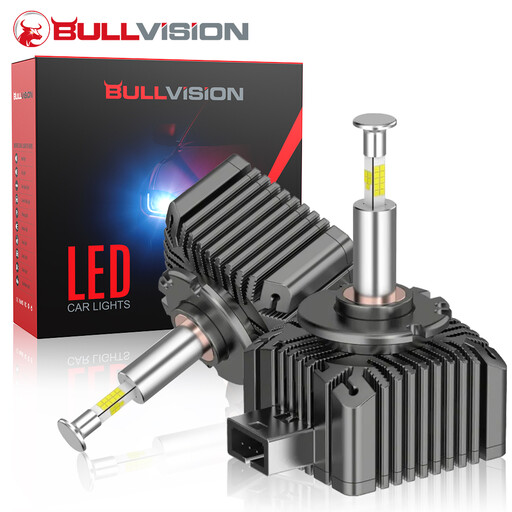
Why this choice suits this profile: This pair is aimed at owners whose vehicle specifically uses a D4S or D4R base and who want a cool white light for their main headlights.
Its integrated cooling system reduces the risk of overheating, while the claimed 1:1 design aims to preserve the beam geometry. Compatibility must still be confirmed on your vehicle.
Quoted power of 110 W, stated output of 21,000 lm, 6000 K colour, integrated fan and IP68 protection according to the product data sheet.
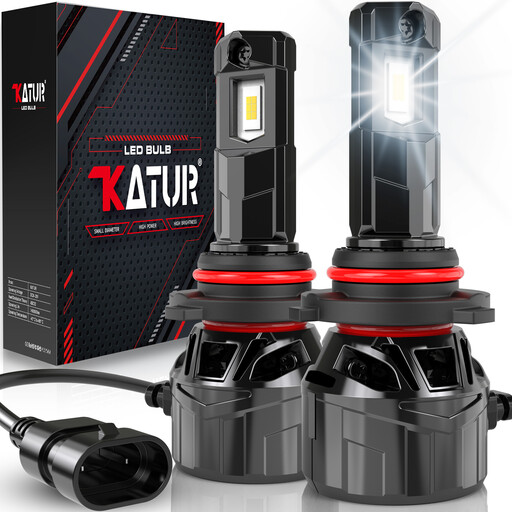
Why this choice suits this profile: This HB3/9005 model is aimed at drivers who use their lights or fog lights frequently and want a compact installation without major modifications to the housing.
The manufacturer claims a 1:1 format and fan cooling. The integrated Canbus system is described as compatible with most vehicles, but a test is still essential.
Pair quoted at 120 W and 30,000 lm, voltage range of 9 to 32 V, colour temperature of 6000 K and fans running at 16,000 rpm according to the data sheet.
We've put together a comprehensive, real-time updated selection of products that meet these demanding criteria as well as European safety regulations.
For an LED interior car bulb, installation is usually simpler. For a number plate bulb or exterior light, still check the colour, brightness and compliance with your vehicle's setup.
LEDs are often designed to provide comparable lighting with lower electrical power. However, the actual consumption depends on the model, the Canbus circuit and the number of bulbs installed. Check the wattage stated on the product listing rather than relying solely on marketing claims.
Manufacturers sometimes quote up to 50,000 or 60,000 hours. This is an estimate obtained under specific conditions. Heat, vibration, moisture and the quality of the power supply can reduce this lifespan. An effective heatsink and a well-ventilated housing help to limit thermal stress.
A 6000 K LED bulb produces a cool white light, but this shade alone doesn't guarantee better visibility. The base, headlight optics, beam shape and compliance for road use remain the priorities.