
Livraison le jour même ou le lendemain

Qualité garantie

Débloquez vos offres de bienvenue: Livraison GRATUITE | Jusqu'à -80 % | 30 jours d'essai gratuits à JoyPlus
Téléchargez l'application
Thinking of swapping your old halogen bulbs for an LED kit? It's a tempting upgrade. The benefits include better night-time visibility for increased safety and a modernised look for your vehicle, thanks to a whiter, more striking light. But be warned: the market is flooded with marketing promises that can easily turn a promising purchase into a real headache.
As a product expert at Joybuy, my mission is to clear the path for you. Here are the 3 mistakes to absolutely avoid when choosing your next LED bulb kit.
To avoid these pitfalls, focus on objective criteria. Here are the three pillars that define the quality and suitability of a car LED kit.
The basics: know the socket type of your original bulbs. The most common are the H7 LED bulb (often for low beams) and the H4 LED bulb (which combines low and high beams in a single bulb). You can find this information in your vehicle's manual or through an online search.
The second compatibility point is electronic. Modern cars use a multiplexed system (CANbus) to monitor component function. Since an LED bulb consumes far less power than a halogen, the on-board computer might register a fault (a "burnt-out" bulb) and trigger an alert. The solution? Choose a model with an integrated error-free CANbus system. This module acts as a decoy, ensuring seamless communication with the vehicle's electronics.
Colour temperature, measured in Kelvin (K), defines the hue of the light. A standard halogen bulb emits a yellowish light (around 3200K). In contrast, a 6500K cool white provides an output closer to daylight, offering a more modern look and improving contrast perception.
But the beam pattern is even more critical. A good replacement kit must perfectly replicate the sharp cut-off line of the original beam. The goal is to illuminate the road effectively without ever dazzling oncoming drivers. This is a major safety issue and a reason to fail a technical inspection.
An LED chip gets hot. If this heat isn't properly dissipated, the bulb's performance and lifespan will plummet. There are two main technologies:
Instead of an endless list, we've selected models that meet specific needs. Find the one that's right for you.
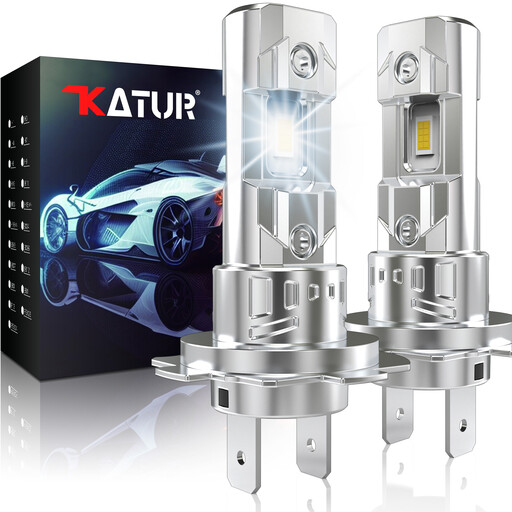
Why this model? For those who want a visible upgrade and a hassle-free installation. It's the smart, balanced choice for a first-time switch to LED.
Its fanless design and ultra-compact size eliminate two major risks: mechanical failure and installation headaches inside the headlight housing. This comes very close to a true plug-and-play experience.
Absolute silent operation and a much easier installation thanks to its form factor, which mimics a classic halogen bulb.
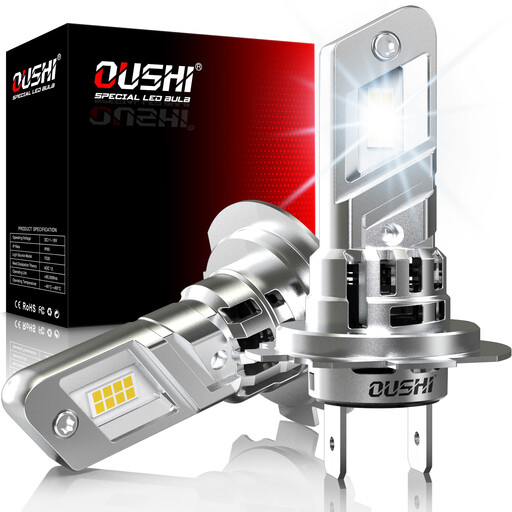
Why this model? For demanding drivers who want ultra-powerful lighting and a sharp, modern look. The raw power is controlled by electronics designed for modern vehicles.
This kit includes a latest-generation CANbus system. It's designed to bypass alerts on the most sensitive European vehicles, a common pitfall with high-power kits.
Top-tier light output (30,000 lm per pair, according to the manufacturer) and a 6500K cool white colour for uncompromising looks and visibility.
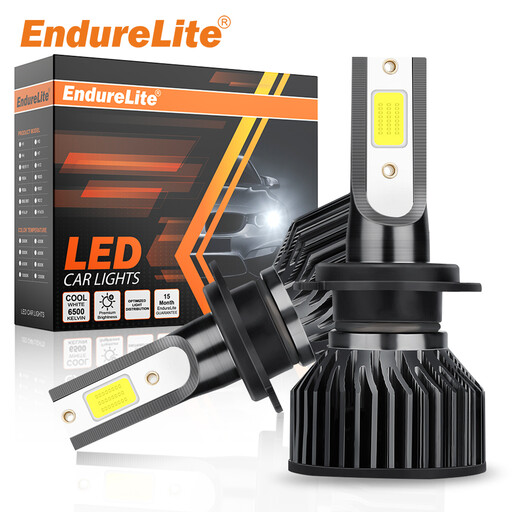
Why this model? Designed for high-mileage drivers and anyone for whom long-term reliability is non-negotiable. Its wide range of compatible sockets makes it a safe bet for outfitting multiple vehicles.
This kit focuses entirely on longevity, featuring active fan cooling and an advertised lifespan of 50,000 hours. It directly counters the trap of bulbs that burn out too quickly.
A design focused on durability and broad compatibility with numerous sockets (H4, H7, H11...), making it a choice that's as reliable as it is versatile.
We have curated a complete selection of products that meet our quality standards and current regulations.
Ideally, yes. But the term plug-and-play deserves some clarification. Always check two things: the bulb's dimensions (especially at the rear, where the cooling system is) to ensure the headlight's dust cover can be closed, and error-free CANbus compatibility. On some notoriously finicky European vehicles, an external decoder (sold separately) may be necessary if the integrated module isn't sufficient.
It's directly linked to the quality of its cooling system. The advertised lifespans (often over 30,000 hours) are realistic, but only for models with high-performance thermal management. Be wary of entry-level bulbs with vague or non-existent cooling systems: their brightness is likely to plummet after just a few hundred hours.
This is a crucial and often tricky point. To be street legal, replacement bulbs must have the proper certification for your region (look for markings like ECE or DOT on the product). Most importantly, the beam pattern produced by the bulb once installed in your headlight housing must match the original to avoid dazzling other drivers. A non-certified bulb or improper headlight alignment after installation is a reason to fail a technical inspection. It is therefore imperative to verify the product's compliance before purchasing and to have your headlight alignment checked by a professional after installation.