
Same-day & Next-day Delivery

Quality Guaranteed

Unlock Your Welcome Offers: FREE Delivery | Up to 80% OFF | Free 30-day JoyPlus trial
Download the APP
Personalising your interior with LED ambient lighting for cars can transform a dashboard, doors or footwell in just a few hours. But not all kits are created equal, and they do not all meet the same needs. Between claims of ‘16 million colours’, music-synchronised effects and Bluetooth apps, certain technical details can make the difference between a successful installation and a complete headache.
Here are the key criteria to consider before buying car interior LED strip lighting, an RGB LED strip for cars or a complete personalisation kit.
A connected strip designed for a bedroom, television or office is not necessarily suitable for a car. The Yeelight LED Lightstrip 1S, for example, is primarily intended for household use. It can be extended up to 32.8 ft and controlled with several voice assistants, but its product details do not present it as 12 V RGB lighting designed for a vehicle.
For a car installation, check the operating voltage, connection type and whether the controller is compatible with the vehicle’s electrical system. A kit designed for 12 V DC may seem like the obvious choice for automotive power, but the manufacturer’s specifications should always be your reference.
A large number of LEDs does not guarantee even illumination. The result also depends on the material used, the spacing between the light sources and the design of the strip or fibre.
Car LED optical fibre distributes light along a tube or profile, whereas a conventional strip makes the individual light points more visible. Acrylic strips are useful for creating a continuous line of light in dashboard gaps, provided they are not subjected to excessively tight curves.
Kits made up of several controllers, extension cables and door modules require a little preparation. On a dusty or damp surface, the adhesive may come away. A poorly positioned cable could also interfere with a pedal, sliding seat or door mechanism.
Always carry out a full test before permanently securing the components. Plan a discreet route for the wires and install the control boxes away from heat, pinch points and any possible water splashes.
For car interior lighting, look for a clearly stated voltage, such as 12 V, or a range compatible with your vehicle. Some products claim to offer short-circuit protection, a memory function or low heat emission. This information describes the features claimed by the manufacturer; it does not, by itself, guarantee compatibility with every car model.
Never connect a kit if its recommended voltage does not match your installation. If connecting it to the fuse box, it is best to consult a professional if you are not familiar with automotive electrics.
An LED strip with a Bluetooth app will generally allow you to select a fixed colour, adjust the brightness, change the speed of the effects or activate a sound-reactive mode. However, the app name varies by model: Lotus Lantern, LotusLamp X, LED LAMP and Magic Lantern appear on different products.
Before placing your order, check compatibility with your smartphone, the pairing process and the stated range. An integrated touch button can also be useful when you do not want to take out your phone.
Dreamcolor car kits often include several sections, intended for areas such as the dashboard, footwells and doors. Some components can be cut, but only at the designated points. Cutting in the wrong place can disrupt synchronisation or prevent part of the kit from working.
With optical fibre, avoid overly tight angles and sharp bends. Carefully measure the contours before buying and allow enough length to reach the controller without putting strain on the cables.
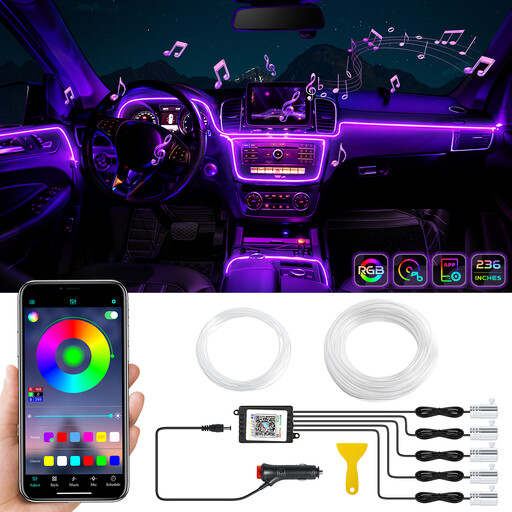
Why this product suits this profile: This kit is designed for DIY installation, with 6 m of fibre, a Lotus Lantern app and a car power supply specified in its product details. It is a good starting point for personalising a dashboard or doors.
The product details explain the connection, the steps for cutting the fibre and the test to carry out before installation. This helps minimise mistakes when fitting the kit in a hurry.
Bluetooth control, static or sound-reactive modes, 6 m of fibre and stated compatibility with iOS and Android.
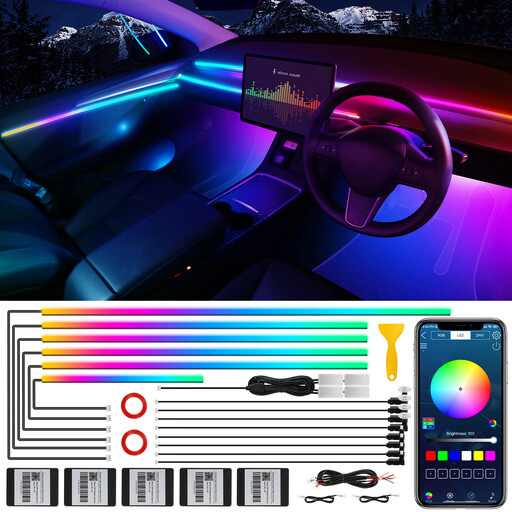
Why this product suits this profile: Its extended configuration is ideal for interiors where you want to illuminate the dashboard, footwells, handles and door storage compartments.
The product details describe the different modules and controllers. You will still need to plan a tidy position for each control box and check the lengths before starting the installation.
18 elements, 600 stated LEDs, app control, Dreamcolor modes and independent control of several zones.
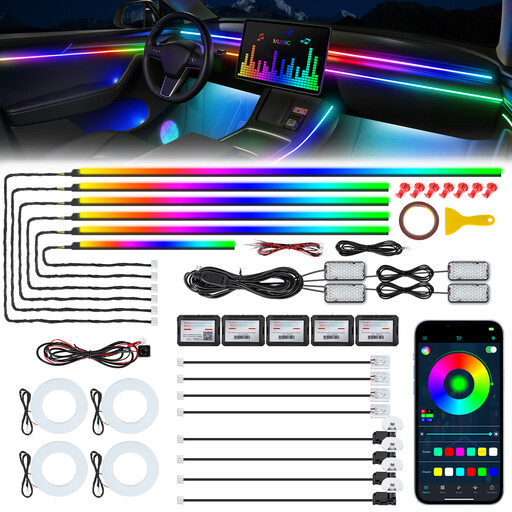
Why this product suits this profile: This version is aimed at drivers who want to create multiple illuminated zones, particularly around handles, storage compartments and door speakers.
The product details specify the included components and remind you not to bend the fibres sharply. This is important for a long installation distributed throughout the interior.
22 stated elements, static and dynamic modes, sound sensor and wireless control via the app.
We have put together a complete, regularly updated selection of products that meet these demanding criteria, while also taking European safety regulations into account.
For a neat result, clean and then dry the surfaces before applying the adhesive. Test the kit, then install the strips where they will not obstruct your view or access to the controls. When driving, the light should remain subtle enough to prevent reflections and distractions.
Synchronising LED lighting with music generally relies on a microphone built into the control box. The result depends on the sound volume, the position of the controller and surrounding noise. For everyday use, a static mode with moderate brightness will often be more comfortable than animations that become too intense.
Power consumption varies depending on the number of modules, brightness level and duration of use. LEDs are generally valued for their energy efficiency, but check the power or current specified in the model’s product details. Above all, avoid leaving the lighting on for long periods when the engine is switched off.
Yes, some kits are designed for DIY installation with adhesive, a removal tool and connection to a 12 V power supply. However, you must secure the cables, follow the cutting marks and avoid moving areas or places exposed to heat. For a permanent connection to the fuse box, professional installation will reduce the risk of mistakes.
Longevity depends on the quality of the components, as well as heat, moisture, vibration and mounting. Installing the kit on a clean surface, without excessive bending or putting tension on the cables, will help it work reliably for longer. Also remember to check the warranty and replacement terms before buying.