
Livraison le jour même ou le lendemain

Qualité garantie

Débloquez vos offres de bienvenue: Livraison GRATUITE | Jusqu'à -80 % | 30 jours d'essai gratuits à JoyPlus
Téléchargez l'application
Investing in an XXL television is a significant upgrade for your living room. But mounting it on the wall is a delicate task with no room for error. The wrong mount not only compromises the aesthetics of your setup but, more critically, the safety of your valuable screen and your home. To help you avoid disaster, our guide will walk you through decoding spec sheets and identifying the essential criteria for a reliable and long-lasting installation.
First, let's look at the most common pitfalls that lead straight to catastrophe:
To protect your investment and ensure your peace of mind, three technical points must be scrutinised.
The VESA (Video Electronics Standards Association) standard defines the distance in millimetres between the four mounting holes on the back of your television. This is THE number one compatibility factor. An 85-inch TV might require a VESA 600x600 TV mount, while another model of the same size might only need a VESA 400x400.
A 75-inch television can easily exceed 40 kg. You therefore need a heavy-duty TV mount with a maximum load capacity that is significantly higher than your screen's weight. Be aware, this sturdiness is only guaranteed if the mount is fixed to a suitable wall.
For a clean look and seamless integration into your living room, a low-profile TV wall mount is ideal. It places the television as close to the wall as possible for a sleek "picture frame" effect. But beyond aesthetics, safety remains the absolute priority. Check for an anti-lift TV mount. This usually consists of security screws at the bottom of the vertical brackets, which are tightened once the television is hung on the wall plate. This simple mechanism prevents the screen from being lifted or sliding off the mount in case of a bump or mishandling.
Here are a few options that meet specific needs, taking into account the safety and compatibility criteria we've discussed.
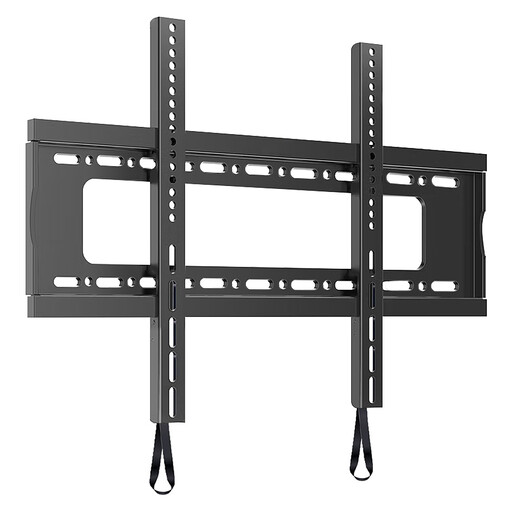
Why we recommend it: Engineered for the largest and heaviest TVs on the market. Its cold-rolled steel construction and wide wall plate are designed to distribute the load optimally on load-bearing walls.
This mount doesn't just rely on screen size: it emphasizes a very high weight capacity (85 kg) and broad VESA compatibility up to 600x600 mm. It includes a screw-based locking system to prevent any accidental dislodging.
Its single-piece steel frame, 2.8 mm thick, and its extra-wide wall plate (660 x 218 mm) ensure maximum strength and surface contact, perfect for mounting in concrete.
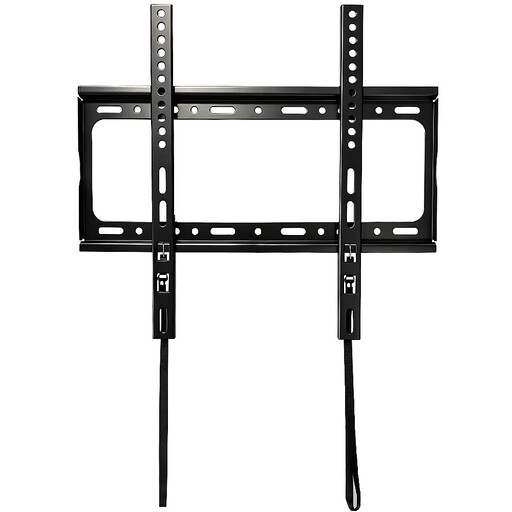
Why we recommend it: A reliable and robust solution for most 65 to 85-inch TVs that don't require the widest VESA compatibility. It offers an excellent balance of strength and discretion.
It clearly states its limits (max VESA 400x400 mm, 65 kg weight limit), which prevents unpleasant surprises. Its installation is strictly for load-bearing walls, and it is equipped with a security lock.
Its ultra-slim 29 mm profile makes it nearly invisible behind the screen. The 2.9 mm thick steel guarantees unshakeable rigidity for TVs in this category.
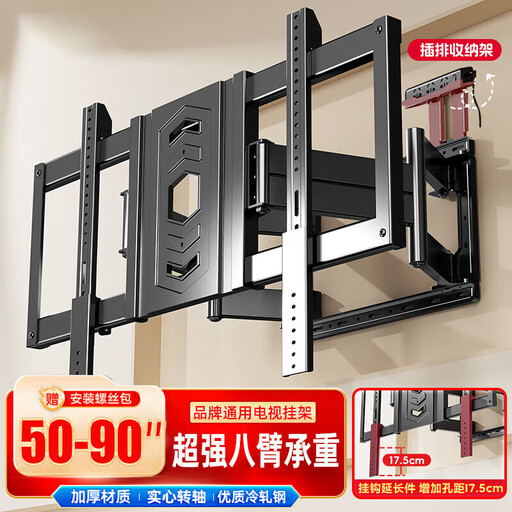
Why we recommend it: This isn't a fixed mount, but an excellent alternative for those who need to adjust the viewing angle. It allows you to orient a large screen to suit a room with a complex layout, like a living room that opens into a kitchen.
This articulating model is made of reinforced steel to handle the leverage effect of the extended arm. It logically sacrifices the ultra-slim profile for versatility, a trade-off to be aware of. Its VESA up to 600x400 mm compatibility is clearly stated.
It offers extension, swivel, and tilt (+/-5°) to eliminate glare and find the perfect viewing angle, something impossible with a fixed mount. Ideal for versatile home cinemas.
Discover our complete selection of mounts that meet our strict selection criteria and European safety standards.
No, this is strictly not recommended and is extremely dangerous. A standard plasterboard wall (like drywall) is not designed to support the weight and tension (the leverage effect) exerted by a television of this size, even when using expansion anchors like Molly bolts. The mount must be anchored into a load-bearing wall: concrete, solid brick, or into the wood studs of a frame.
It's a mechanical locking system that secures the television to its wall plate. Most often, it consists of two screws located at the bottom of the vertical brackets (the ones attached to the back of the TV). Once the screen is hung on the wall rail, you tighten these screws from below to prevent any accidental lifting or sliding. It's a simple but absolutely essential safety feature.
The easiest way: consult your television's manual or spec sheet. The VESA standard is always listed there (e.g., VESA 600 x 400 mm). If you no longer have these documents, you can measure it manually: measure the horizontal distance (in millimetres) between the centres of the two top mounting holes, then the vertical distance between a top hole and a bottom hole. This will give you the two numbers that make up your VESA standard.