Who is this type of washing machine right for?
The right drum size depends on how much laundry builds up between washes, as well as the space available for the machine.
Households that wait for a full load
If you wait until the laundry basket is full, estimate the size of your usual loads rather than automatically opting for a large drum. ADEME advises against washing half-loads; on the other hand, a machine with too little capacity could mean you have to run more cycles.
Families that often wash household linen
Bedding, towels and clothes can add up to large loads. UFC-Que Choisir says families with children could consider 8 to 10 kg. Check whether this range suits the loads you have after sorting laundry by programme.
Households with a narrow laundry space
If width is your main constraint, compare the space needed for a top-loader with the capacity you require. According to UFC-Que Choisir, top-loading models are generally 40 to 46 cm wide, compared with around 60 cm for front-loaders. Remember to allow room for the lid or door to open, too.
What should you compare before choosing?
Start with the size of your loads, then compare machines suited to that volume using the same energy-label criteria.
| Feature |
What to check |
What I need |
| Capacity |
Estimate the weight of the dry laundry that builds up between washes. Also check the maximum load for the programmes you use: the capacity shown on the label applies to Eco 40-60, not every type of fabric. |
I want to fill the drum regularly without having to run several cycles for a typical load. UFC-Que Choisir says 5 to 7 kg is generally enough for a single person or couple, while families with children could consider 8 to 10 kg. |
| Water and electricity |
On the EU energy label, check the A to G rating, kWh per 100 cycles, litres per cycle and the Eco 40-60 programme duration. Ideally, compare machines with capacities suited to similar-sized loads. |
If I group my washing into larger loads, I want to compare consumption on the reference programme rather than judge it by drum size alone. |
| Spin performance and noise |
Compare the spin-drying efficiency class, noise emissions during spinning in dB, and the noise class. The maximum speed in rpm doesn’t tell you all of this. |
I dry my laundry at home or the machine is near a living space, so the amount of water left in the clothes after spinning and the noise during the cycle matter as much as the stated speed. |
| Size and access |
Measure the width, depth and height, then check how much room is needed to open the door or lid. According to UFC-Que Choisir, top-loaders are generally 40 to 46 cm wide and have capacities of 5 to 8 kg. |
I have limited space for width, but still need to be able to load the machine easily and wash the amount of laundry my household builds up. |
| Durability |
For the model you’re considering, check the durability index displayed in France, along with information about parts, maintenance and after-sales service. Make sure the documents relate to the exact model. |
As well as energy and water use, I want to consider maintenance and repair options before choosing a machine for regular use. |
A few models from well-known brands
These models give you examples of different styles and capacities to compare; their specifications don’t automatically apply to other machines from the same brand.
Bosch
The Bosch WGG04209FR front-loader is an example of a 9 kg machine, with an A energy rating and a maximum spin speed of 1,200 rpm, according to Bosch Électroménager France.
- Its capacity makes it a useful comparison for households whose full loads are close to 9 kg.
- Bosch says this model is no longer available on its French website. For another model, check its own energy label, dimensions and noise level.
Electrolux
According to Electrolux France, the Electrolux EW7T3733BA top-loader combines a 7 kg capacity with a width of 400 mm.
- Its stated figures of 45 kWh per 100 cycles and 45 L per cycle let you assess this specific model for energy and water use.
- Check that 7 kg is enough for your larger loads and that there is sufficient clearance to open the lid.
Miele
Miele France lists the Miele WEA125 WCS 8kg Active front-loader with an 8 kg capacity and a maximum spin speed of 1,400 rpm.
- This model offers a useful example of a mid-range capacity for households that regularly wash larger loads.
- Miele says it has tested this model to the equivalent of 20 years’ use. This is the manufacturer’s claim and doesn’t predict the lifespan of every individual machine. Also compare the durability information and warranty terms for the model you’re considering.
Washing machines for larger loads
This Joybuy selection includes four 8 kg front-loaders and one 7 kg top-loader. Compare their capacities with your usual loads, then check the label and installation space required for each model.
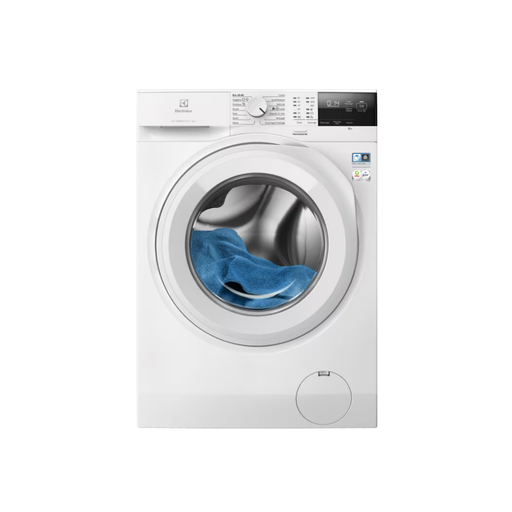 Image unavailable
Electrolux EW6FI4805AW, 8 kg front-loader
Worth considering if an 8 kg capacity suits your larger loads. The product details list a 1,400 rpm spin speed and SensiCare. Also compare spin noise and Eco 40-60 figures, and allow enough room to open the door.
View on Joybuy
 Image unavailable
Haier T Series 7 THASN276TM6-S, 7 kg top-loader
A top-loader is worth considering if width is limited and 7 kg is enough for your usual loads. The product details list a 1,200 rpm spin speed and an A energy rating. Also measure the clearance above the lid and compare spin noise.
View on Joybuy
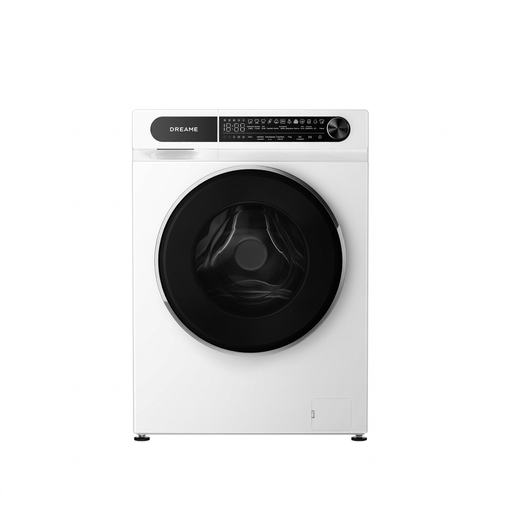 Image unavailable
Dreame DRWASHS8KG Washing Machine S, 8 kg
This 8 kg model may be worth considering if the capacity suits the laundry you build up between washes. Before choosing, check its full dimensions, spin-drying class, noise level and the durability index applicable to this model.
View on Joybuy
 Image unavailable
Hisense WF5I8043BWF, 8 kg front-loader
This freestanding 8 kg model is worth considering if your full loads are close to this capacity. The product details list a 1,400 rpm spin speed. To assess spin performance and noise, also check the spin-drying class and noise figures on the energy label.
View on Joybuy
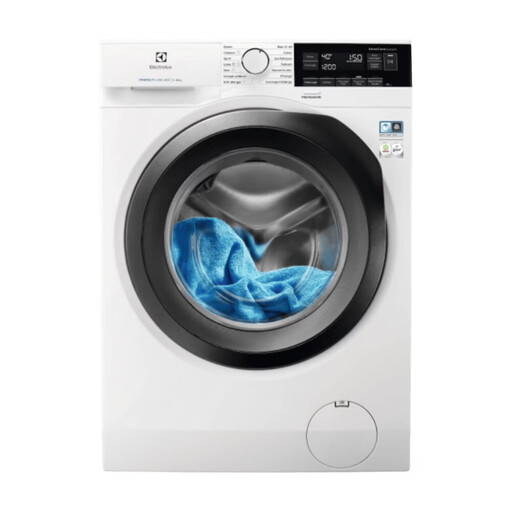 Image unavailable
Electrolux EW6F3811RC, 8 kg front-loader
Worth considering for larger loads of up to 8 kg, with freestanding installation. The product details list a 1,400 rpm spin speed and a C energy rating. Before comparing it with other models, also check the kWh per 100 cycles, litres per cycle and spin-drying class.
View on Joybuy
Frequently asked questions
Does an 8 kg capacity apply to every programme?
No. An 8 kg capacity refers to the weight of dry laundry for the programme it applies to; on the energy label, that’s Eco 40-60. Check the manual for the maximum loads for synthetics, wool and delicates programmes.
How do you compare the energy and water use of two washing machines?
Check the kWh per 100 cycles and litres per cycle, as well as the A to G energy rating. According to the European Commission, these figures appear on the label for the Eco 40-60 programme. Ideally, compare machines with capacities suited to your usual loads.
Does a larger drum always reduce consumption if you group your washing into larger loads?
No. A large drum isn’t a good fit if your loads are often too small to fill it. ADEME recommends filling the washing machine sufficiently and says a half-load uses less water but the same amount of electricity. Choose a capacity you can fill regularly without packing the laundry in too tightly.
Does the energy label show noise and spin performance?
Yes. The EU energy label includes information such as noise during spinning and its noise class, as well as the spin-drying efficiency class. Compare these details with the maximum spin speed if the machine is near a living space or you dry laundry indoors.
What should you check when assessing the durability of a washing machine in France?
Check the durability index for the exact model, then look at the available information about maintenance, parts and warranty. According to ADEME, the index has been displayed on washing machines put on sale in France since April 2025, and takes repairability and reliability into account.


