Parents preparing several lunchboxes each week
A 750 g or 1 kg jar may suit regular family use. The right size depends on how much your household will use, as well as the product’s storage instructions.


If you regularly prepare school lunchboxes, first choose a spread that fits your child’s dietary needs and the school’s rules. Then compare the ingredients, nutritional values and the amount your household will realistically use. A large jar doesn’t change the recipe or the place of sugary foods in your child’s diet.
A 750 g or 1 kg jar may suit regular family use. The right size depends on how much your household will use, as well as the product’s storage instructions.
Check the recipe for the child concerned rather than assuming which allergens it contains from the brand name alone. Where an individual care plan (PAI) applies, the French Ministry of National Education says it may set out dietary adjustments to follow at school.
Sugars, fat, the ingredients list and the portion you plan to serve are best considered together. Santé publique France says that displaying the Nutri-Score is voluntary, so its absence is no substitute for checking the nutritional information.
For a school lunchbox, start with any dietary restrictions that apply to your child, then consider the recipe and jar size in light of how you’ll use it.
| Criterion | What to check | Who this matters to |
|---|---|---|
| Allergens and school requirements | Check the allergens and ‘may contain’ warnings on the jar you buy; follow any dietary adjustments set out in the PAI. | If my child has a dietary restriction, I need to know whether this particular recipe is suitable before putting it in their lunchbox. Around 33% of consumers put this first. |
| Recipe and portion | Compare sugars and fat per 100 g, then consider the serving size. Where it appears on the packaging, Nutri-Score is intended for comparing products in the same category. | When putting together a snack, I want to consider the recipe and portion, not just the jar size. Around 27% of consumers are said to prioritise this. |
| How much you’ll use | Choose 750 g, 1 kg or more according to how often you’ll actually use it, rather than assuming a bigger jar will be a better fit. | When I often make sandwiches, I look for an amount that makes sense for what my household will use. This is the main need for around 27% of consumers. |
| Storage and preparation | Check the manufacturer’s instructions and take out the amount you need when preparing the lunchbox. | I prefer a jar that’s easy to store and use between preparations; around 13% of consumers would prioritise this convenience. |
Ingredients and allergens vary by product. The product information we reviewed lists hazelnuts, milk or soya, among other ingredients. You can’t tell whether a product is suitable for a particular dietary restriction just from the name ‘chocolate and hazelnut spread’.
Check the packaging on the jar you choose, including any ‘may contain’ warnings, and follow the dietary requirements that apply to your child at school.
A 3 kg pack calls for a different rate of use from a 750 g or 1 kg jar. Its size alone won’t tell you whether it suits your household’s habits.
Choose a size based on how much you’ll actually use and check the storage instructions for the product you buy.
These claims describe characteristics that are separate from sugar content. For example, the product information for the 400 g Auchan Bio jar lists 55 g of sugars per 100 g.
Compare the nutritional values per 100 g of similar spreads, and don’t draw conclusions about nutrition from a single claim on the packaging.
Santé publique France says that displaying it is voluntary. Its absence alone therefore doesn’t mean that a pre-packed spread fails to meet requirements.
Check the nutritional information and ingredients list, whether or not the logo is displayed.
A chocolate and hazelnut recipe, available in a 1 kg jar for regular family use.
A hazelnut spread available in a 1 kg jar.
A 1 kg product sold by E.Leclerc.
Two documented recipes suit different preferences: Pasta Cao in a 750 g jar and palm oil-free Auchan Bio in a 400 g jar.
These jars come in a range of sizes for preparing lunchboxes at home. There’s also a Banania recipe to consider separately from classic chocolate and hazelnut spreads. For each product, match the size to how often you’ll use it and check the label if your child has a dietary restriction.
 Image unavailable
This jar suits regular family use if 1 kg fits your preparation routine.
Carrefour’s product information for this product lists 56.3 g of sugars per 100 g and names hazelnuts, milk and soya. Check the jar’s label for any dietary restrictions that apply to your child.
 Image unavailable
Consider this 3 kg size only if your household regularly uses this much; it’s considerably larger than family-size 750 g to 1 kg jars.
Check the allergens on the packaging and the storage instructions before choosing this size for school lunchboxes.
 Image unavailable
A 750 g jar may suit a household that uses less spread than it would get through in a 1 kg jar.
If your child’s lunchbox has dietary restrictions, check the full ingredients list, allergens and ‘may contain’ warnings on this jar.
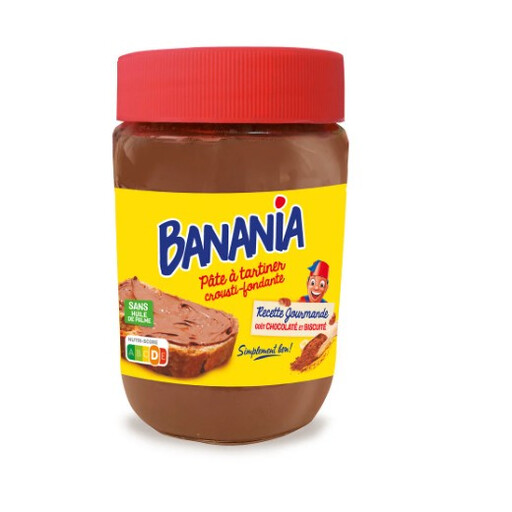 Image unavailable
This 750 g jar is worth considering if your household would prefer a recipe that’s different from classic chocolate and hazelnut spread.
The recipe contains banana. Check the ingredients, allergens and ‘may contain’ warnings on the packaging before using it in a school lunchbox.
Check the ingredients, highlighted allergens and ‘may contain’ warnings on the specific jar you plan to use. The DGCCRF reminds consumers that allergens must be emphasised in the ingredients list. If your child has a PAI, also follow the dietary adjustments agreed with the school.
No. Santé publique France says that displaying it is voluntary. For pre-packed spread, check the nutritional information and ingredients, then use Nutri-Score, if shown, to compare products in the same category.
Follow the storage instructions on the jar you buy. Joybuy’s product information for Nutella 1 kg says to store it in a cool, dry place, without refrigerating it. Don’t assume the same instructions apply to other recipes.
Not necessarily: these claims don’t describe sugar content. The product information for the 400 g Auchan Bio jar lists 55 g of sugars per 100 g. To compare recipes, check the ‘of which sugars’ line in the nutritional information per 100 g.