Households that do a big weekly shop
If you store several days’ worth of fresh food at a time, choose a fridge compartment that can hold your shopping, without overlooking how much space the appliance will take up in your kitchen.


When shopping for a large household, start by choosing usable capacities that suit your fresh food and frozen food needs, rather than focusing on total capacity alone. A fridge-freezer may be enough if width is limited; consider a multi-door or side-by-side model if your storage needs justify it, after checking access, noise, energy consumption and the model’s installation instructions.
The number of people in your household is a useful starting point, but how often you shop, how much freezer space you need and your kitchen layout will help determine which format to consider.
If you store several days’ worth of fresh food at a time, choose a fridge compartment that can hold your shopping, without overlooking how much space the appliance will take up in your kitchen.
If you freeze meals or regularly buy frozen food, look at the freezer’s capacity and layout separately from the total capacity. UFC-Que Choisir’s tests distinguish between a weekly shop and more intensive freezing needs.
A spacious appliance also needs to fit through doors and hallways, have enough room once installed and operate at an acceptable noise level near living areas.
Start by comparing the capacity of both compartments with the space available. The right format depends on how well it fits these requirements.
Consider this if: you want an appliance for a family but don’t have a lot of width to spare for a fridge.
Bear in mind: freezer space may be limited for your needs; check its usable capacity separately.
Consider this if: several people need to store a large shop and want to organise food across multiple compartments.
Bear in mind: this layout doesn’t guarantee low energy consumption or low noise levels; compare the specific models you’re considering.
Consider this if: you need plenty of storage in the long term and your kitchen and access routes can accommodate a wide appliance.
Bear in mind: according to UFC-Que Choisir, American-style fridges generally use more energy than standard fridges.
| Criterion | What to check | Who this matters to |
|---|---|---|
| Fresh food capacity | Compare the fridge’s usable capacity in litres with how often you shop. UFC-Que Choisir suggests allowing 100 to 150 L for one person, then 50 L for each additional person. | If you need to store enough fresh food for several people until your next shop, fridge space comes first. Around 29% of consumers put this need at the top of their list. |
| Size and access | Measure the space, clearances and delivery route, then compare them with the appliance’s dimensions and those of its packaging, where available. | In a narrow kitchen or a home with tight access routes, I need to be able to get the appliance in and install it before I can benefit from extra capacity. This is the top priority for around 29% of consumers. |
| Freezer storage | Check the freezer’s usable capacity in litres and how easy it is to access the drawers, rather than looking at total capacity alone. | If I freeze meals and often bring home frozen food, extra fresh food space can’t replace a freezer that meets my needs. Around 24% of consumers prioritise freezer space. |
| Noise and energy consumption | Compare the stated noise level in dB(A), energy rating and annual consumption in kWh for the models you’re considering. | Noise matters day to day when the appliance is near a living area; energy consumption also matters for an appliance that runs continuously. Around 18% of consumers put these criteria first. |
A large capacity may still leave too little room for frozen food. For example, according to Bosch, the Bosch KGN36VLED fridge-freezer divides its 326 L between 237 L of fridge space and 89 L of freezer space.
Estimate how much you store in the fridge and freezer separately, then compare the usable capacity of each compartment.
There’s no point choosing the capacity you need if the appliance can’t be brought into your home. Samsung specifically advises checking that its RS68CG882DS9EF will fit through with its packaging.
Measure the space, doors, hallways and lift, as well as the packaged appliance if those dimensions are available.
The format alone isn’t enough to judge a model’s energy consumption. UFC-Que Choisir describes American-style fridges as generally using more energy than standard fridges.
Compare the stated annual consumption and usable capacities of the appliances you’re actually considering.
The stated noise level matters more when the appliance is close to a living area. UFC-Que Choisir uses less than 40 dB(A) as a guide to the quietest fridges.
Check the dB(A) rating for each model and consider where you plan to put it. Don’t assume a particular format will be quieter.
These examples can help you identify configurations to compare; the features of one model don’t apply to every appliance from the same brand.
Worth exploring for freestanding fridge-freezers when the available width points you towards this format.
Worth exploring if you’re looking for a freestanding multi-door model with several storage zones.
Worth exploring if an American-style model suits your storage needs and you have a spacious enough kitchen.
This selection includes a fridge-freezer, multi-door models and a side-by-side appliance to compare with your storage needs and kitchen dimensions. For each appliance, also check the space available for delivery and the installation instructions.
 Image unavailable
Worth considering if you’re looking for several compartments to store food for a large household. The product title lists four doors, a total capacity of 467 L, Total No Frost technology and an energy rating of E. Check how the capacity is divided and how much space you’ll need in your kitchen.
 Image unavailable
Worth considering if you want to look at a 360 L model before moving up to a larger appliance. The product title lists Total No Frost, an energy rating of E, and Wi-Fi and My Zone features. Check that the freezer space suits your needs.
 Image unavailable
Worth considering if you need plenty of storage and have room for this format. The product title lists a total capacity of 495 L and an energy rating of E. Compare the usable capacity of both compartments and check the installation requirements before choosing.
 Image unavailable
Worth considering if you need plenty of space for both frozen food and fresh food, and the delivery route can accommodate a side-by-side appliance. The product title splits its 525 L between 333 L of fridge space and 192 L of freezer space. It also lists No Frost, 37 dB and an energy rating of E. Check its dimensions and annual energy consumption on the product page before ordering.
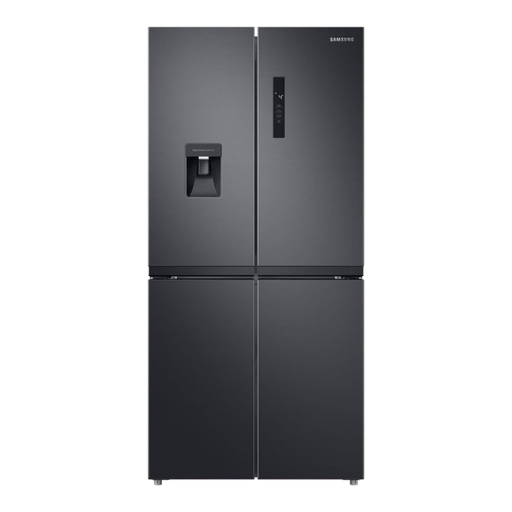 Image unavailable
Worth considering if you’re looking for a total capacity of 488 L for a large household’s shopping. The product title lists an energy rating of E. Check the fridge and freezer capacities separately, then confirm the dimensions and clearances needed for installation.
Start with your usual shopping habits, then check the usable capacity of the fridge and freezer separately. UFC-Que Choisir suggests allowing 100 to 150 L for one person, then 50 L for each additional person. For four people, that means considering around 250 to 300 L, then adjusting to suit the amount of food you actually store.
No. It’s most suitable if you have a long-term need for plenty of storage and your kitchen and access routes can accommodate its width. UFC-Que Choisir describes these models as generally using more energy than standard fridges, so compare the energy consumption of the models you’re considering and check how much space they need with the doors open.
Measure the space where it will go and the entire delivery route, including doors, hallways and lifts. Check the dimensions of the packaging where available, then consult the model’s instructions for installation guidance.
Check the energy label and compare the energy rating and annual consumption in kWh of appliances that meet your capacity needs. ADEME reminds consumers that large domestic appliances must display an energy label. If your kitchen is close to a living area, also check the stated noise level.