
Livraison le jour même ou le lendemain

Qualité garantie

Débloquez vos offres de bienvenue: Livraison GRATUITE | Jusqu'à -80 % | 30 jours d'essai gratuits à JoyPlus
Téléchargez l'application
Printing XXL prototypes, complex functional parts, or small-batch colour runs? What seemed like science fiction just a few years ago is now within reach for discerning professionals, designers, and creators. However, in a constantly evolving market, it's easy to get lost in a jungle of technical specifications. This guide is designed to decode the best current options for large-volume, multi-colour 3D printing and give you the keys to making the right choice.
Before diving into our selection, let's review the key factors that distinguish a professional 3D printer truly suited to your projects.
A large print volume is essential for creating massive parts in a single piece or launching batch productions. But be aware: a large volume often means extended print times. This is where speed comes into play. A high-speed 3D printer, capable of high acceleration and travel speeds (in mm/s), can cut your production times in half, or even more. The secret, therefore, is to find the right balance between the maximum size of your objects and the machine's ability to print them quickly and effectively.
Multi-colour printing offers clear aesthetic and functional value, but not all systems are created equal. Prioritise an integrated multi-filament 3D printing system, where a central unit (like an AMS) automatically manages multiple spools. This guarantees a simple and reliable experience, free from tedious manual interventions. These systems don't just juggle colours?: they also pave the way for multi-material printing, allowing you to combine rigid and flexible filaments or use a soluble support material for complex geometries.
In a professional environment, every minute counts. A well-designed ecosystem is therefore crucial. Ensure compatibility with the market's leading advanced slicers, and check for time-saving tools?: remote camera monitoring, a mobile app, Wi-Fi and Ethernet connectivity... Smart features, like print failure detection (the infamous “?spaghetti detection?”) or automatic bed levelling, are no longer gimmicks. They are decisive advantages that ensure the reliability of your prints and drastically reduce manual intervention.
We have scoured the market to select models that excel in the trifecta of volume, speed, and multi-colour capability. Each has its own unique personality.
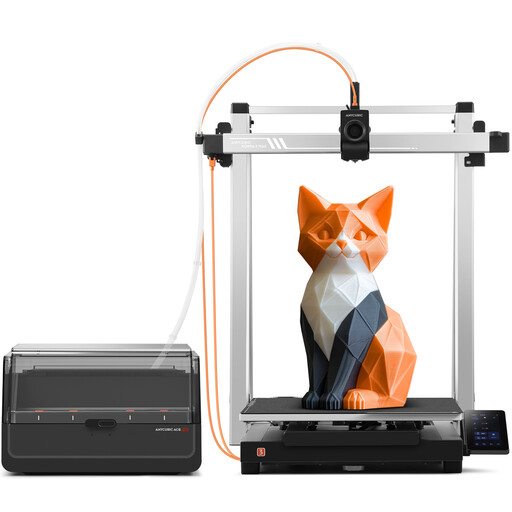
Why it stands out?: The Anycubic Kobra 3 Max Combo is a machine of superlatives. For those who think big and refuse to compromise on size, it offers a colossal 88-litre print volume, paired with an 8-colour system. It's the ideal tool for the most ambitious projects.
Advantages?:
Who is it for?? Professionals, design studios, and creators who need to produce very large objects (architectural models, 1:1 scale prototypes, large batches) in a single piece and in full colour.
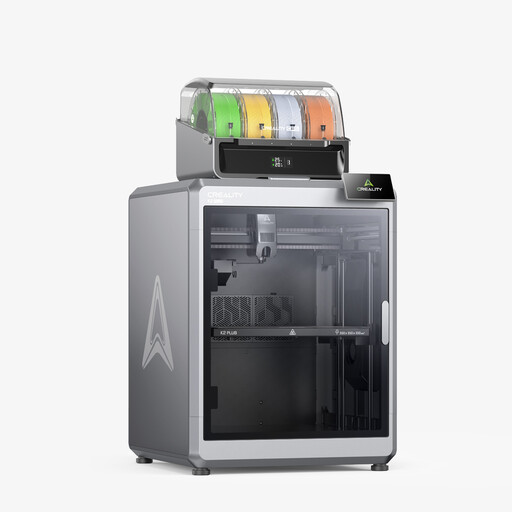
Why it stands out?: The Creality K2 Plus Combo plays the card of versatility and scalability. Its key strength? A heated chamber and a high-temperature nozzle make it compatible with the most demanding engineering filaments. Its CFS (Creality Filament System) is expandable up to 16 colours by combining multiple units.
Advantages?:
Who is it for?? Engineers, R&D departments, and expert users who work with engineering materials (ABS, ASA, PA-CF...) and require a perfectly controlled printing environment with maximum flexibility in the number of colours.
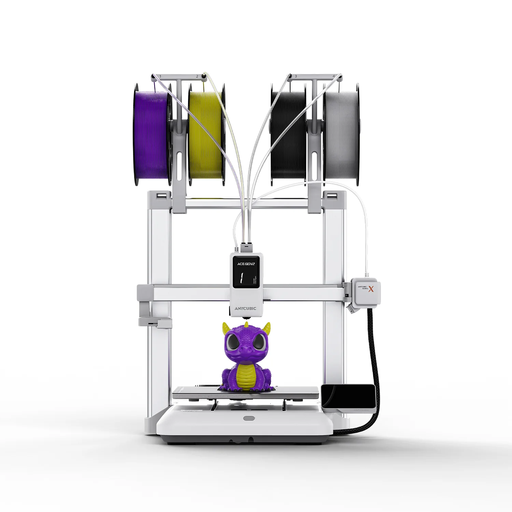
Why it stands out?: The Kobra X (Joybuy version) is an excellent entry ticket into the world of high-speed, multi-colour 3D printing. It directly integrates a 4-colour system into a more compact chassis without sacrificing speed or smart features.
Advantages?:
Who is it for?? Creators, advanced makers, and small businesses looking for a high-performance, accessible multi-colour solution to bring their prototypes and models to life.
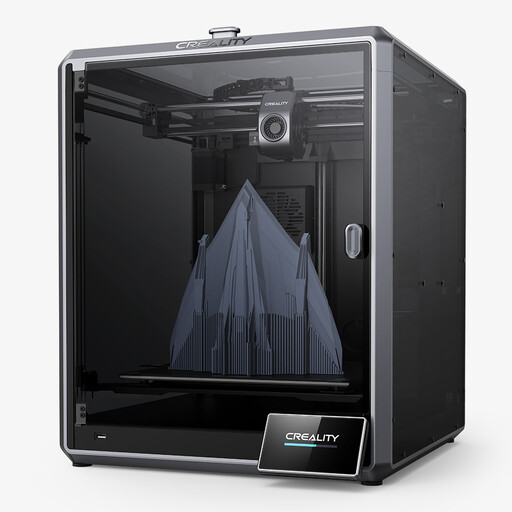
Why it stands out?: A monochrome intruder in this guide? Not quite. The K1 MAX earns its spot for one simple reason: its blistering print speed. For anyone who prioritises rapid prototyping over colour, it is a formidable alternative.
Advantages?:
Who is it for?? Professionals and rapid prototyping workshops where every hour counts and who need to produce large-scale monochrome parts in record time.
If speed is your number one criterion and multi-colour capability is secondary, our range of high-speed printers might be a better fit. These machines are optimised to slash print times while maintaining excellent surface quality.
Discover our selection of high-speed printers.
That's a persistent myth. Today, high-speed 3D printers integrate technologies like vibration compensation (input shaping) and pressure advance, which ensure excellent quality even at full speed. While a very slow speed will always offer a marginally superior finish, the gap has become negligible on well-tuned machines. The key is to properly configure your slicer settings to find the optimal speed-to-quality ratio.
Simply put, a multi-colour printer uses several colours of the same material (e.g., red PLA and blue PLA). A multi-material printer goes a step further: it can combine materials with different properties within a single object (e.g., rigid PLA with flexible TPU, or a primary material with a soluble support like PVA). Fortunately, most advanced multi-filament systems, like those in our selection, are capable of doing both.
Not necessarily. It all depends on your applications. For producing small parts in large quantities, a more compact but ultra-fast machine will often be more cost-effective. However, for prototyping large objects or manufacturing monolithic parts, a large print volume is non-negotiable. Before choosing, ask yourself the right question: what is the maximum size of the parts I produce regularly??