
Livraison le jour même ou le lendemain

Qualité garantie

Débloquez vos offres de bienvenue: Livraison GRATUITE | Jusqu'à -80 % | 30 jours d'essai gratuits à JoyPlus
Téléchargez l'application
A large cat tree makes excellent use of an apartment’s vertical space, especially when several cats share the same home. However, an imposing tower is not necessarily the right fit for your interior. Inaccurate dimensions, an overly narrow base or accessories that are difficult to clean: there are plenty of pitfalls to avoid.
This 2026 selection is based on practical criteria: stability, platform size, number of scratching surfaces, stated capacity and ease of maintenance.
A 200 cm cat tower is bound to attract attention. But the taller it is, the more each jump between levels places stress on its base. A large model should therefore stand on a wide, reinforced base, with a wall-mounted anti-tip device where one is provided.
On a smooth floor, such as varnished wood or tile, the cat tree may also slide if it is poorly positioned. Wall anchoring is not a gimmick: with a structure this tall, it plays a genuine role in keeping the entire unit safe.
A six-level XXL cat tree is not necessarily comfortable for a large cat. Instead, examine the dimensions of the platforms, cubicles and beds. A 50 × 30 cm platform does not offer the same comfort as a 60 × 40 cm resting area.
The spacing between levels also deserves your attention. Steps separated by 20 to 30 cm make it easier for cats to move around, while an overly steep structure may be challenging for an older or less agile cat.
Fabric coverings quickly trap hair. It is better to prioritise removable, washable cushions, surfaces that are easy to vacuum and replaceable components, such as hanging balls or sisal-covered posts.
A cat tree with scratching facilities should also offer several scratching zones. With just one post, it may wear out quickly in a home where several cats take turns using it.
When choosing a tall cat tree, pay particular attention to:
The capacity stated by the manufacturer should be treated as a theoretical load limit, not as a guarantee that applies in every situation. A cat leaping from one platform to another puts different demands on the structure than an animal resting calmly on it.
For a cat tree for large cats, measure the resting areas first rather than focusing only on the total height. A sufficiently wide platform allows the animal to stretch out without hanging over the edge, while an overly cramped cubby may never be used.
In a multi-cat household, prioritise a combination of resting options: separate cubbies, a hammock, an elevated bed and open platforms. This layout reduces the risk of disputes over a single space, although it obviously cannot guarantee how every animal will behave.
Sisal should be positioned along the routes cats naturally use. Vertical posts, an angled board or surfaces distributed across several levels provide far more opportunities than a single scratching post placed at floor level.
The diameter of the posts, the tension of the rope and whether worn components can be replaced are all useful details to check. Inspect the ropes, screws and panels regularly. If any part becomes unstable or shows signs of damage, stop using the structure until it has been repaired or replaced.
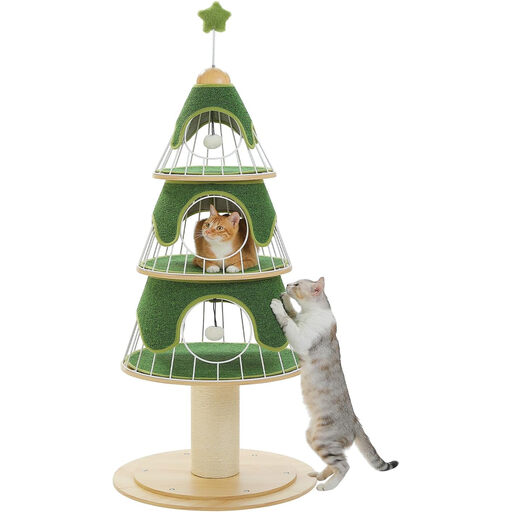
Why this model suits this profile: at 130 cm tall, this tower is ideal for households that want to give their cat more vertical space without installing an XXL cat tree.
Its stated 60 × 60 cm base and sisal-covered posts address the common problems of limited scratching space and an overly narrow base.
Three levels, three stated cubbies and central posts measuring 12.5 cm in diameter.
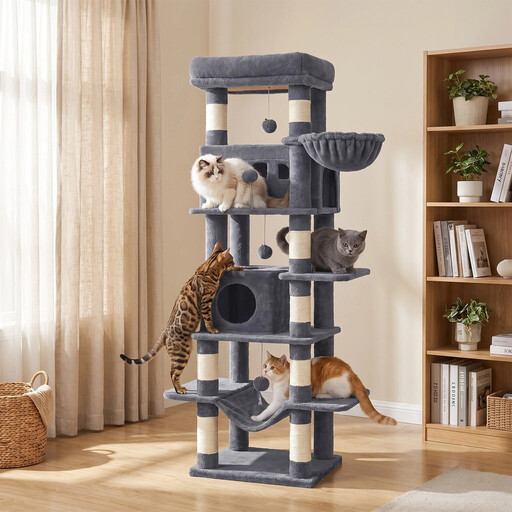
Why this model suits this profile: its six levels, two cubbies, hammock and bed create multiple resting spaces within a vertical structure.
Its 17 posts, including eight covered in sisal, prevent all scratching activity from being concentrated in one place.
A 50 × 30 cm platform, removable and washable cushions, a 30 cm bed and a stated anti-tip system.
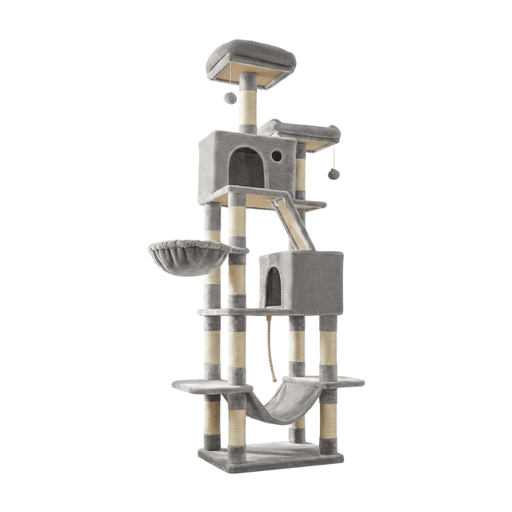
Why this model suits this profile: this 206 cm tower is designed for households with several cats, particularly animals that enjoy climbing and staying active.
Its reinforced base and anti-tip kit are suited to the demands of a very tall structure, provided it is anchored to the wall as instructed in the manual.
13 sisal posts, two cubbies, a hammock, a bed and a stated capacity of up to six cats weighing 7 kg each.
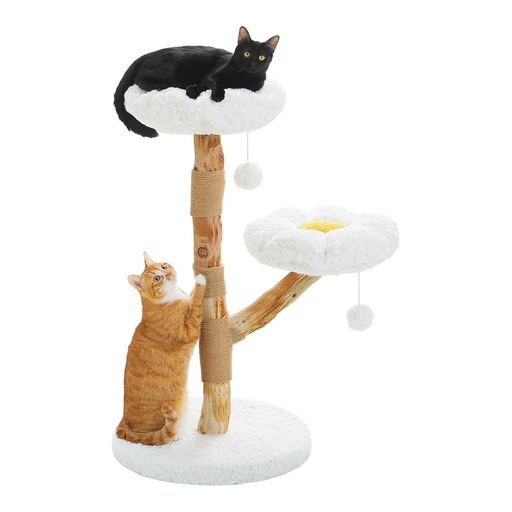
Why this model suits this profile: its natural wood construction and 49 × 49 cm footprint make it easy to integrate into an interior where aesthetics and floor space matter.
Its reinforced base and wooden posts wrapped in sisal rope address the common weaknesses of a small, unstable scratching post.
Two velvet beds, a solid wood structure and a stated capacity for cats weighing up to 16 lb, or approximately 7.3 kg.
Install the large cat tree against a wall on a level surface, leaving sufficient clearance around the jumping areas. Assemble every component according to the instructions, then check all connections before allowing your cat to use it for the first time.
For maintenance:
The lifespan of a cat tree depends on how frequently it is scratched, the cats’ weight and the quality of maintenance. In a particularly active household, a monthly inspection is a sensible routine.
We have gathered an updated selection of models that meet these stability, capacity and safety criteria for indoor use in France.
For a very tall structure, wall anchoring is strongly recommended whenever an anti-tip kit is supplied. It should be installed on a suitable support, following the instructions in the manual. This precaution is particularly important when several cats use the tower or when some are large and highly active.
A height between 130 and 175 cm may be sufficient in a limited space. Above 200 cm, the structure provides more climbing opportunities, but you will need to check the ceiling height, the footprint of the base and whether the tower can be anchored to the wall. Ultimately, the number of platforms and resting areas matters just as much as the total height.
A model equipped with several sisal posts can meet part of your cat’s scratching needs. However, some cats prefer horizontal or angled surfaces. Placing a cat scratching post near the sofa or in a high-traffic area is an effective way to complement the setup.