
Livraison le jour même ou le lendemain

Qualité garantie

Débloquez vos offres de bienvenue: Livraison GRATUITE | Jusqu'à -80 % | 30 jours d'essai gratuits à JoyPlus
Téléchargez l'application
A large cat tree for multiple cats must withstand daily use, provide plenty of resting spaces and remain completely stable when cats climb or leap from one level to another. The problem is that flattering photos and impressive dimensions on paper do not always guarantee a sensible choice.
In a French home, especially a flat, every square centimetre matters. Making the most of height is therefore often the best approach, provided you do not compromise on the width of the base, ease of cleaning or the needs of adult, heavy or numerous cats.
A 170 cm cat tree may look impressive, but its stability depends just as much on its base, the diameter of its posts and whether it has an anti-tip fixing. A tall, narrow structure is more likely to wobble when an energetic cat rushes towards the top platform.
Before ordering, check in particular:
A multi-level cat tree may boast six levels while offering platforms that are too cramped for a large cat. For an overweight or heavily built cat, a resting area of around 50 × 30 cm provides considerably more comfort than a small shelf.
The dens must also be spacious enough for the cat to enter, turn around and leave without difficulty. In a household with five or six cats, several separate spaces also help reduce tension.
Cushions and plush coverings quickly collect hair. When they are not removable, cleaning soon becomes a chore and odours can build up. Opt for a cat tree with washable cushions, surfaces that are easy to vacuum and, if possible, a detachable platform that can be rinsed in accordance with the manufacturer's recommendations.
A 170 cm cat tree fits into many homes, provided you measure the ceiling height and leave enough room to move around it. A depth of 40 to 50 cm generally lets you make the most of the height without taking up too much room, but the overall width must still be compatible with the available space.
The distance between levels also deserves your attention. Steps spaced around 20 to 30 cm apart make it easier for adult or older cats to climb, while still providing a genuine cat climbing tower.
Sisal-covered posts encourage scratching and help protect sofas, curtains and rugs. A model that distributes scratching areas across several levels prevents a single post from being used constantly.
The number of posts is not everything, however: also check their diameter, how securely they are fixed and whether the covering is continuous. A cat tree with sisal scratching posts should be inspected regularly to detect any loose rope or section that has become unstable.
The capacity stated by the manufacturer is not enough to predict how your cats will behave. Six cats weighing 6.8 kg will not necessarily all climb at the same time or with the same force. For a cat tree for large cats or a large household, look for several sleeping areas, a large platform and a reinforced base.
Washable cushions, the hammock, basket and dens are not merely decorative features: they spread out the areas used and allow each cat to retreat when needed.
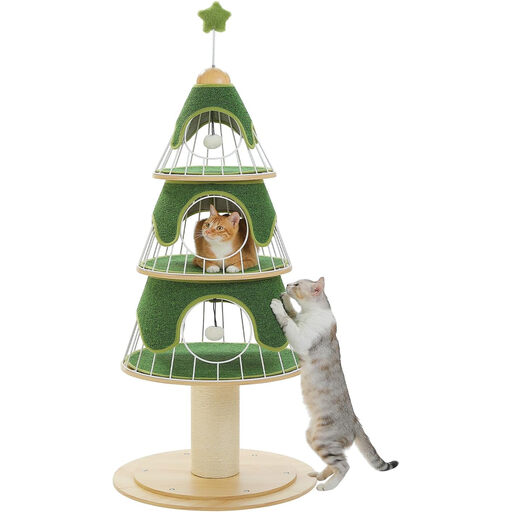
Why this choice suits this profile : At 130 cm high with a 60 × 60 cm base, this model is ideal for anyone looking for a relatively compact structure for one or more cats without taking up the full height of the room.
Its widened 60 × 60 cm base reduces the risk associated with tall, narrow structures. The three levels and sisal posts create separate areas for resting and scratching.
Three dens, central posts measuring 12.5 cm in diameter and a format that is easy to install in a living room or bedroom.
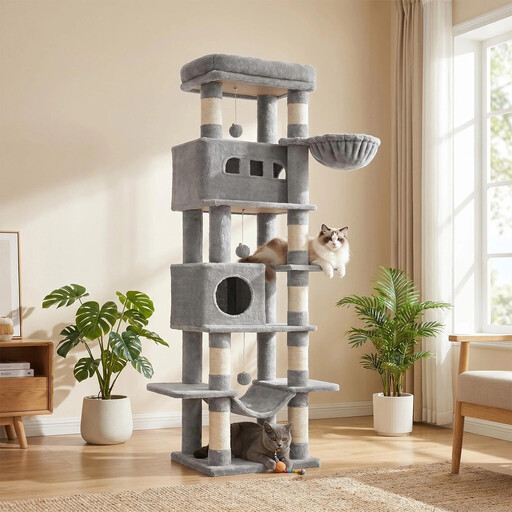
Why this choice suits this profile : This model combines several functions in one vertical structure: dens, a hammock, a 30 cm basket, a platform and hanging toys.
The 17 posts, 8 of which are covered in sisal, distribute the scratching areas. The doubly reinforced base and anti-tip system limit jolting when cats chase one another from level to level.
Six levels, a 50 × 40 cm den, two removable cushions and a detachable top platform.
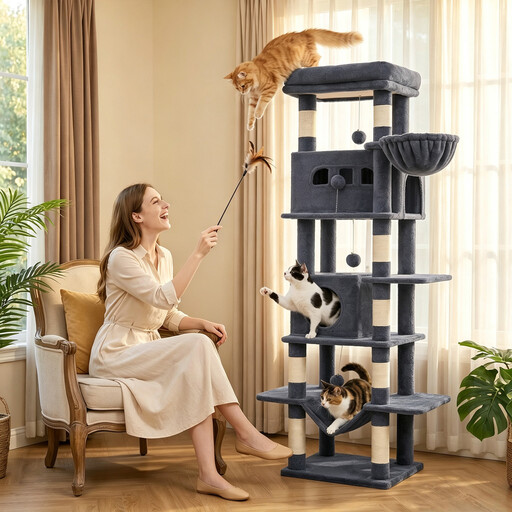
Why this choice suits this profile : Its vertical design is suitable for households wanting to accommodate several cats while keeping the floor footprint to a minimum, provided there is sufficient ceiling height.
The widened, reinforced base, together with the anti-tip system, addresses the demands created by repeated jumping. The removable cushions make it easier to remove hair and dirt.
Six levels, two dens, a hammock, a basket, 8 sisal posts and a 60 × 40 cm platform.
We have put together a complete, real-time-updated selection of products that meet these demanding criteria as well as European safety standards.
Install the cat tree on a perfectly level floor, away from doors, radiators and frequently opened windows. Assemble each part according to the instructions, then check that all screws are tight before first use. For a very tall model, always use the anti-tip device supplied.
A monthly check helps you quickly identify:
Vacuum the surfaces using a suitable attachment and remove the cushions to wash them according to the manufacturer's instructions. Hanging balls should be replaced as soon as they become damaged, particularly if the cats play with the tree unsupervised.
A height of 170 cm generally provides several levels while remaining suitable for many homes. Models over 200 cm require you to measure the ceiling height precisely and check the stability of the whole structure after assembly.
It depends on the animals' weight, their habits and the number of areas available. A model equipped with several dens, a hammock, a basket and a large platform distributes use more effectively. Always follow the capacity stated by the manufacturer and observe how the cats interact.
Choose a stable structure, regularly tighten the fixings and replace worn accessories. Frequent cleaning limits the build-up of hair and helps you spot the first signs of deterioration quickly. With intensive use, several sisal posts also help distribute wear more evenly rather than concentrating it in one area.