
Same-day & Next-day Delivery

Quality Guaranteed

Unlock Your Welcome Offers: FREE Delivery | Up to 80% OFF | Free 30-day JoyPlus trial
Download the APP
Carrying shopping, camping gear or gardening tools quickly becomes a chore when bags and boxes start piling up. A large-capacity folding trolley can make these trips much easier – provided you don’t rely solely on the advertised volume or the maximum weight stated.
Some models look spacious, but their narrow wheels sink into sand. Others boast an impressive load capacity, yet lack a sturdy enough frame for uneven paths. Here are the criteria to examine before choosing a folding transport trolley that suits your needs.
A 200 L folding wagon can hold a large number of items, but that doesn’t mean it can carry 200 kg. Volume refers to the interior space, whereas load capacity depends on the strength of the frame, base, stitching and wheels.
Check separately:
A 300 L folding trolley will be handy for transporting bulky equipment, but it may also take up a lot of room in a boot or a narrow storage area.
Compact wheels may be fine on paved surfaces, but they quickly show their limits on damp grass, gravel paths or sand. For a beach trolley, a camping trolley or garden use, wide wheels distribute pressure better and sink less easily.
7-inch all-terrain wheels, when mentioned on the product page, offer better grip on uneven surfaces. However, they don’t make pulling easy in deep sand – the load and its distribution remain key factors.
One-hand folding is convenient, but you should especially examine the structure once the trolley is deployed. A lacquered steel or steel alloy frame can provide good rigidity, while water-resistant 600D Oxford fabric protects the contents from light splashes.
Bear in mind, though: water-resistant fabric isn’t necessarily waterproof. For carrying shopping or electronic equipment, it’s best to place waterproof bags inside.
A robust 200 kg trolley or a 300 kg folding trolley should be chosen based on the load you’ll actually carry, not on a marketing figure taken in isolation. For shopping, toys or picnics, a 150 kg capacity may already be more than enough. For bags of compost, timber or camping gear, an advertised capacity of 200 or 300 kg offers a greater margin.
Never exceed the maximum load stated by the manufacturer. Place heavy items at the bottom and centre to reduce the risk of tipping.
Measure the available space in your boot, cellar or garden shed. Some 200 L models measure approximately 92 × 57 × 97 cm when unfolded, while 300 L models can exceed 1.20 m in length.
A four-way folding system makes storage easier, but also remember to check:
A folding trolley with a brake proves useful on slopes, at festivals or when you need to keep the trolley stationary while loading. Retention straps are also handy for securing bags, boxes and items that might slide.
An adjustable handle lets you adapt the pulling position to your height. However, it doesn’t replace good weight distribution, especially on grass or gravel paths.
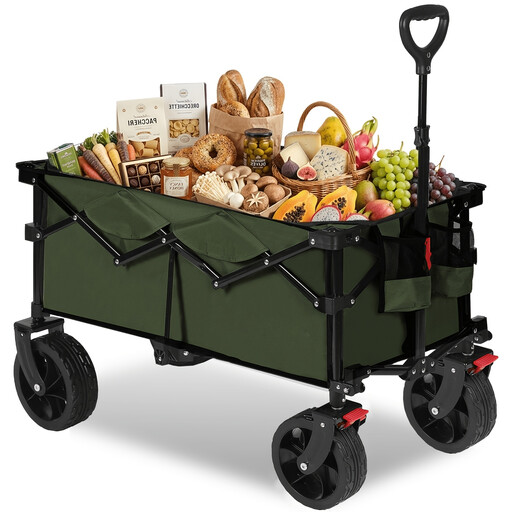
Why this choice suits this profile: With its 150 L volume, stated 150 kg load capacity and four-way folding, this model is ideal for shopping, picnics and occasional outings, without being too bulky.
The maximum load and volume are stated separately, so you won’t confuse available space with the weight it can actually carry. The product page also mentions the wide wheels and brake.
High-carbon steel frame, 600D Oxford fabric, adjustable handle and two cup holders.
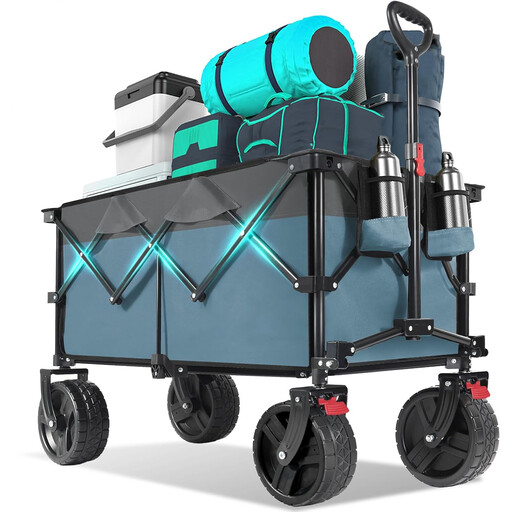
Why this choice suits this profile: Its 200 L capacity, 7-inch all-terrain wheels and brake make it suitable for regular use on grass, paths, at festivals or on campsites.
The page clearly distinguishes the 200 L volume from the stated 200 kg load. The wide wheels make moving on uneven ground easier, while the brake keeps the trolley stationary on a slope.
Steel alloy frame, water-resistant 600D Oxford fabric, retention straps and adjustable handle.
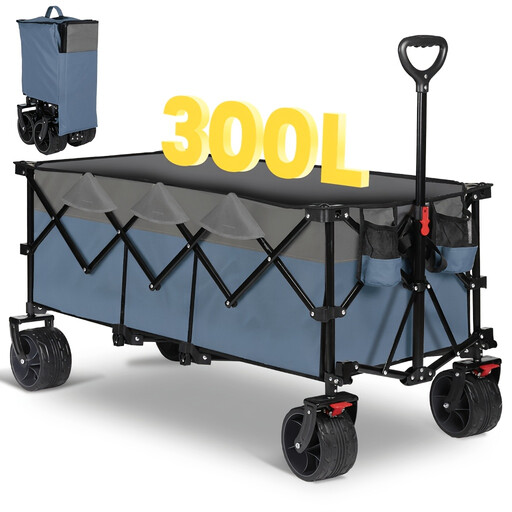
Why this choice suits this profile: Its stated 300 L volume and 200 kg maximum load are ideal for frequent transport of gardening equipment, camping gear or bulky items.
The available information clearly separates the 300 L storage from the 200 kg load. Wide wheels, silent bearings and brakes make moving across different types of terrain easier.
600D Oxford fabric, four-way folding mechanism, length over 1.20 m and two cup holders.
We’ve compiled a complete, up-to-date selection of products that meet these demanding criteria, while complying with European safety regulations.
A large-capacity folding trolley will retain its qualities for longer if you maintain it after each outing. Remove sand, leaves and small stones stuck in the wheels. Clean the fabric with a damp cloth and a mild detergent, then let it dry completely before folding the trolley.
Avoid storing it while still damp in a closed boot. Regularly check the frame fixings, wheel axles, brake and handle. Repeated loads close to the stated limit can accelerate wear, even if the trolley still seems to work normally.
For sand and uneven paths, go for an all-terrain folding trolley fitted with wide wheels, durable fabric and an adjustable handle. On soft sand, reduce the load and place heavy items at the bottom to improve stability.
Not necessarily. The 200 L refers to the interior volume, while the capacity in kilograms must be checked on the technical data sheet. Some 200 L models state a maximum load of 200 kg, others a different value. Never exceed the limit specified for the model you choose.
Remove the items, clean the wheels, dry the fabric, then use the folding mechanism provided by the manufacturer. Before buying, measure the trolley’s dimensions when folded to make sure it will fit in your boot, cupboard or garden shed.