Runners planning their fuelling during exercise
You want to work out whether a portion of biscuits can fit into a plan based on carbohydrate intake. The weight of the pack doesn’t tell you how much you’ll actually eat.


For sharing biscuits around a marathon, choose a pack size that suits the number of people and how you plan to hand them out. A large pack on its own isn’t a race-day fuelling strategy. A 2015 review indexed by PubMed gives a guideline of 30 to 60 g of carbohydrates per hour for exercise lasting 1 to 2 hours 30 minutes. If you’re thinking of eating biscuits during exercise, work out how much you’ll actually consume and consider how they fit into your plans.
You want to work out whether a portion of biscuits can fit into a plan based on carbohydrate intake. The weight of the pack doesn’t tell you how much you’ll actually eat.
You need to hand out biscuits to a group before or after the race. Individually wrapped portions can make them easier to count and carry.
You’re mainly choosing a practical pack for a break around the event. The number of portions, recipe and allergens matter more here than a carbohydrate intake planned for the race.
First, distinguish between biscuits intended for planned fuelling during exercise and those for a group break. The same information on the pack won’t meet both needs in the same way.
| What matters | What to check | Which shoppers? |
|---|---|---|
| Fuel during exercise | Carbohydrates per 100 g and the planned amount per serving; compare these figures with your fuelling plan. | If I’m planning to eat biscuits during the race, I need to be able to work out what each serving provides, rather than relying on the size of the pack. Planned fuelling would be the top priority for around 36% of shoppers. |
| Sharing with a group | Number of bags and biscuits in each bag; whether the portions can be carried separately. | If I’m handing out biscuits to several people before or after the race, I want portions that are easy to share. Around 29% of shoppers would prioritise ease of distribution. |
| Ingredients and allergens | Ingredients list, highlighted allergens and any ‘may contain’ statements for the exact product. | Before offering biscuits to a group, I need to know exactly what the recipe contains. Checking the ingredients would be the priority for around 21% of shoppers. |
| Quantity to share | Net weight, number of portions and whether the biscuits come in separate bags. | For a group break, I’m looking for a quantity that suits the group, without assuming that a heavier pack offers more portions that are easy to serve. Volume would be the main consideration for around 14% of shoppers. |
The number of biscuits in a pack doesn’t tell you how many carbohydrates you’ll consume per serving, or how often you’ll eat them.
If you’re thinking of eating them during exercise, start with the nutritional information and planned portion size rather than the words ‘family pack’.
A plain Petit Beurre biscuit and a chocolate-coated shortbread biscuit won’t necessarily have the same nutritional values. Figures for one product don’t apply to an entire brand.
Compare the carbohydrates, fat and ingredients per 100 g for the exact products you’re considering.
Ingredients and allergens vary between recipes. Someone in the group may need to check the pack before having a biscuit.
Keep the packaging for the product you’re handing out to hand, with its ingredients list and allergen information clearly visible.
A box of separately wrapped bags and an unportioned pack of the same weight aren’t equally easy to share.
Check the weight, number of bags and number of biscuits per bag together. If you’re dividing an opened pack yourself, have a container ready.
Le Véritable Petit Beurre is a plain Petit Beurre biscuit that you can compare with shortbread biscuits if you’re looking for something to portion out yourself.
The large box of Sablés de Retz is a good choice when you want portions to be individually wrapped already.
Petit Beurre Original biscuits let you compare a plain biscuit in a larger pack.
These products show two ways of packing biscuits: in individual bags or in an unportioned pack.
This 200 g pack is a straightforward choice for sharing before or after the race, with portions to divide up yourself. It isn’t the same as larger boxes of biscuits in individually wrapped bags.
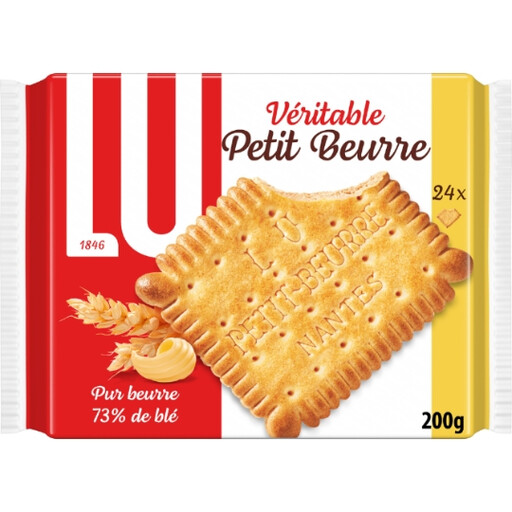 Image unavailable
This pack of Petit Beurre biscuits can be shared as a snack before or after the race.
For this SKU, Joybuy’s listing states 73 g of carbohydrates and 12 g of fat per 100 g. Check the number of biscuits, the packaging and the ingredients for the product before planning portions for a group. These nutritional values alone aren’t enough to plan your fuelling during exercise.
No. The size of the pack doesn’t tell you how many carbohydrates you’ll consume during the race. A 2015 review indexed by PubMed gives a guideline of 30 to 60 g of carbohydrates per hour for exercise lasting 1 to 2 hours 30 minutes. If you’re thinking of eating shortbread biscuits during exercise, work out how much you’ll have per serving, and don’t apply this guideline without taking the duration and conditions of your event into account.
Separate bags are handy when you need to count the biscuits and hand them out to several people. St Michel describes a box of 24 bags, each containing five Sablés de Retz biscuits. If you’re setting up a table where you can portion out the biscuits yourself, check the weight and packaging of the product you choose instead.
Check the ingredients list, allergens and any ‘may contain’ statements for the exact product. France’s Directorate-General for Competition, Consumer Affairs and Fraud Control reminds consumers that allergenic ingredients must be highlighted on the labels of prepacked food sold in France. Keep this information accessible when sharing the biscuits.