People looking for the lowest fat content
You’re looking for lactose-free cow’s milk and want to compare the grams of fat per 100 ml first. The words “lactose-free” aren’t enough to tell skimmed and semi-skimmed milk apart.


If keeping fat intake low is your priority, start by comparing skimmed lactose-free milk. Candia lists 0 g per 100 ml for its Candia+ product, while Lactel lists 0.2 g per 100 ml for its Matin Léger skimmed milk. The semi-skimmed products reviewed contain 1.2 g per 100 ml. Check the product and its nutritional values on the pack you buy, then choose a size you can finish within the stated time after opening. The words “lactose-free” tell you neither the fat content nor whether the product is free from milk proteins.
You’re looking for lactose-free cow’s milk and want to compare the grams of fat per 100 ml first. The words “lactose-free” aren’t enough to tell skimmed and semi-skimmed milk apart.
You’d like to keep using UHT milk while checking its stated lactose content. The amount you drink should still be guided by your personal tolerance, as France’s national health insurance service, Assurance Maladie, advises.
You’re happy with 1.2 g of fat per 100 ml and also care about the UHT format and bottle size.
First, compare the fat and lactose content per 100 ml for the exact product. Then check the volume and the instructions for use after opening: UHT treatment keeps unopened milk fresh, but it doesn’t replace these instructions.
| What to check | Look for | Who is it for? |
|---|---|---|
| Fat content | The amount per 100 ml and whether it’s labelled “skimmed” or “semi-skimmed”. | If I’m looking for the lowest fat content, I want to distinguish skimmed milk from products with 1.2 g per 100 ml; around 36% of consumers prioritise reducing fat. |
| Lactose | The amount stated per 100 ml and the ingredients list. | When my lactose tolerance guides my choice, I need to know how much lactose the milk contains rather than relying on its name alone; this is the top priority for around 29% of consumers. |
| Size and storage | The volume, UHT label, and instructions for refrigeration and use after opening. | To avoid opening a bottle I won’t finish in time, I choose a size that suits how I use it; around 21% of consumers prioritise this practical consideration. |
| Organic or origin | Any organic or origin information on the product, without confusing it with the fat content. | If the production method or the milk’s origin matters more to me, I still check the fat content; around 14% of consumers put this first. |
These labels describe different characteristics. Candia lists 0 g of fat per 100 ml for its lactose-free skimmed milk, while several lactose-free semi-skimmed products from Lactel, Carrefour and Auchan list 1.2 g per 100 ml.
Before choosing a product, compare the “fat” line in the nutritional information per 100 ml.
The time allowed after opening varies by product: the Lactel and Délisse product pages say three days in the fridge, while the Auchan product reviewed says five days.
Choose a size that suits how much you drink and follow the time stated on your bottle after opening.
A multipack of large bottles can lead to waste if you can’t finish each one within the stated time.
The lactose-free milk products reviewed are still made from milk. So the words “lactose-free” don’t prove that a product is suitable for someone with a milk protein allergy.
If you have a known or suspected allergy, don’t rely on this label alone; ask a medical professional for advice.
On its own, this word tells you neither how much fat nor how much lactose the product contains.
Compare the values stated per 100 ml, the ingredients and the storage instructions for the exact product.
The Matin Léger range includes lactose-free UHT milk that’s both skimmed and 1.2% fat.
Candia+ includes lactose-free skimmed UHT milk in 1 L and 6 × 1 L formats.
The Carrefour Classic’ and Carrefour Bio products reviewed are lactose-free, semi-skimmed UHT milk.
The Délisse product reviewed is lactose-free UHT milk with 1.2% fat, sold in a multipack of six 50 cl bottles.
The product reviewed is lactose-free semi-skimmed UHT milk in a multipack of 6 × 1 L.
This Joybuy product is an option if you’re looking for a multipack of skimmed lactose-free UHT milk: 6 × 1 L. If your choice depends on a specific fat-content threshold, check the value on the pack: the Joybuy product page and the Lactel Matin Léger skimmed milk page list different amounts.
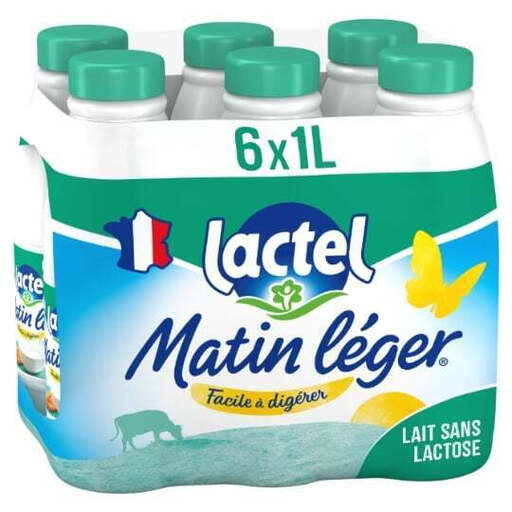 Image unavailable
A UHT option to consider if you’re looking for lactose-free skimmed cow’s milk and can use each 1 L bottle within the recommended time after opening.
The product page lists a pack of six bottles and says to refrigerate after opening and use within three days.
For fat content, check the pack label before buying: the Joybuy product page lists 0.1 g per 100 ml, compared with 0.2 g per 100 ml on the Lactel Matin Léger skimmed milk page. This product contains milk.
Compare the grams of fat per 100 ml for each product. Candia lists 0 g for its lactose-free skimmed milk and Lactel lists 0.2 g on its Matin Léger skimmed milk page, compared with 1.2 g per 100 ml for the semi-skimmed products reviewed. Always check the value on the pack you buy.
The stated lactose content can help you choose a milk, but the amount that suits you depends on your personal tolerance. Assurance Maladie recommends adjusting how much you consume rather than automatically cutting out all dairy products. If you’re unsure about your situation, ask a medical professional for advice.
No. The products reviewed are cow’s milk, even when their lactose content has been reduced. If you have a known or suspected milk protein allergy, the words “lactose-free” aren’t enough to help you choose a product; ask a medical professional for advice.
Follow the time stated for the product you buy and refrigerate it after opening. The Lactel and Délisse product pages say three days, Candia’s says four days, and the Auchan product reviewed says five days. The time stated for one brand doesn’t apply to other products.