People with lactose intolerance who are making crêpes
If you want to keep cow’s milk in your batter, check the lactose content stated on the product. Assurance Maladie points out that the amount people can tolerate varies.


If you’re making crêpes for someone who is lactose intolerant and consumes dairy, choose milk with its lactose content clearly stated on the label, then compare the fat content and pack size to suit your recipe. If someone has a milk or milk protein allergy, lactose-free milk that contains dairy isn’t suitable. Check the ingredients of any alternative you choose, as well as those of the rest of the recipe.
If you want to keep cow’s milk in your batter, check the lactose content stated on the product. Assurance Maladie points out that the amount people can tolerate varies.
Before choosing milk, distinguish between lactose intolerance and a milk allergy. The lactose-free options listed by Carrefour and Auchan still contain milk, so they aren’t suitable for anyone avoiding milk proteins.
Once you’ve clarified the dietary requirement, you can compare whole, semi-skimmed and skimmed options. Lactel, for example, lists 3.6 g of fat per 100 ml for Matin Léger whole milk and 0.2 g for Matin Léger skimmed milk. These figures alone don’t predict how your batter will turn out.
First, clarify whether you need to avoid lactose or milk itself. Then compare the information per 100 ml and choose a pack size that suits the amount of batter you plan to make.
| Criteria | What to check | Who is it for? |
|---|---|---|
| Lactose content | Check the lactose content per 100 ml and the ingredients list, particularly whether lactase is included. | I want to keep cow’s milk in my crêpes while taking my lactose tolerance into account. Around 36% of consumers put reducing lactose first. |
| Whether it contains milk | If a guest needs to avoid milk, check the ingredients and allergen information for every product you’re considering. | If I’m serving crêpes to someone with a milk allergy, I need to rule out lactose-free milk that still contains milk. This distinction is a priority for around 29% of consumers. |
| Fat content | Compare the fat content per 100 ml in whole, semi-skimmed and skimmed options. | I want to choose a type of milk to suit my recipe, without assuming that ‘lactose-free’ means ‘skimmed’. Around 21% of consumers put this cooking-related consideration first. |
| Pack size and storage | Check the pack size and the storage instructions after opening for the specific product you buy. | If I’m only making one batch of batter, I want to be able to use the leftover milk within the time stated on the packaging. Pack size and storage come first for around 14% of consumers. |
Assurance Maladie distinguishes between lactose intolerance and a food allergy. Milk with reduced lactose may still contain milk.
If someone needs to avoid milk or its proteins, rule out lactose-free milk that contains milk, and check the ingredients and allergen information for the alternative you choose.
This wording doesn’t tell you the product’s lactose content or how much each person can tolerate.
Check the lactose content per 100 ml and the ingredients. Assurance Maladie says that consumption should be adjusted to each person’s individual tolerance.
Instructions vary between products: the Lactel, Candia and Auchan product pages state that the relevant products should be kept chilled for three, four or five days after opening, respectively.
Choose a pack size to suit the amount of milk you need for your crêpes, and follow the instructions on the bottle you buy.
According to Lactel’s product pages, Matin Léger skimmed milk contains 0.2 g of fat per 100 ml, compared with 3.6 g for the whole milk version. Lactose content and fat content are two separate things.
Compare them separately on the label, and don’t assume that one figure alone will tell you how your recipe will taste or feel.
The Matin Léger range includes whole and skimmed lactose-free milk. Lactel also recommends its whole milk option for cooking.
Candia+ offers lactose-free milk with 1.0% fat, including in 50 cl and 1 L packs.
Carrefour offers lactose-free semi-skimmed milk in a 1 L bottle, with 1.2% fat.
Auchan offers lactose-free milk with 1.2 g of fat per 100 ml, in a 1 L pack.
The Délisse product listed by E.Leclerc is UHT lactose-free milk sold in a pack of six 50 cl bottles.
This lactose-free skimmed milk is for people who want to keep cow’s milk in their crêpe batter. It isn’t suitable if you need to avoid milk.
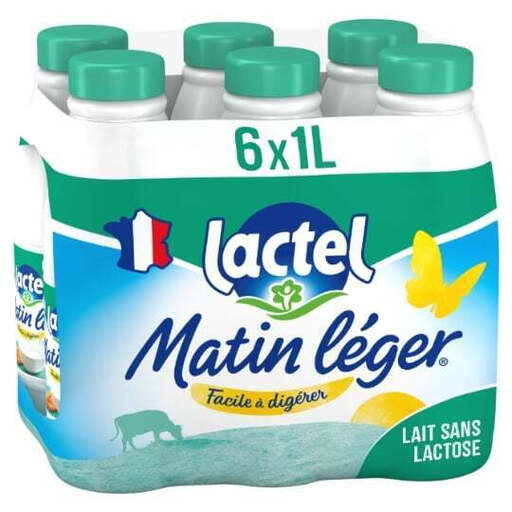 Image unavailable
For cow’s milk crêpe batter when you’re looking for lactose-free skimmed milk. The pack contains six 1 L cartons; check the lactose content and storage instructions on the packaging you receive. This product contains milk and isn’t suitable if you need to avoid milk proteins.
Yes, if you consume dairy and choose a product that suits your lactose tolerance. Some Candia and Lactel products state that they contain less than 0.1 g of lactose per 100 ml. Assurance Maladie points out that the amount people can tolerate varies.
Not if it contains milk: removing or reducing lactose doesn’t remove milk proteins. Assurance Maladie distinguishes between an allergy and an intolerance, so check the ingredients of every product you use in your crêpes.
Once you’ve checked that the milk is suitable for your guests’ needs, choose its fat content to suit your recipe. Lactel states that Matin Léger whole milk contains 3.6 g per 100 ml, while Matin Léger skimmed milk contains 0.2 g. These figures describe the milk, but don’t guarantee a particular result in your crêpes.
Follow the storage time stated for the product you buy and keep it chilled. The Lactel, Candia and Auchan product pages give storage times of three, four and five days after opening for the relevant products, so there isn’t one time limit that applies to every bottle.